1. Overview
Circle theorems are fundamental geometric principles that govern the relationships between angles, lines, and arcs within a circle. They provide the tools to calculate unknown angles and solve geometric problems involving circles. This revision note covers the essential circle theorems required for the IGCSE Cambridge Mathematics (0580) syllabus, including both Core and Extended curriculum topics. Understanding and applying these theorems is crucial for success in geometry questions.
Key Definitions
- Tangent: A straight line that touches the circumference of a circle at exactly one point.
- Chord: A straight line segment joining two points on the circumference.
- Diameter: A chord that passes through the center of the circle.
- Radius: The distance from the center to any point on the circumference (half the diameter).
- Arc: A part of the circumference.
- Segment: An area of a circle bounded by a chord and an arc.
- Cyclic Quadrilateral: A four-sided shape where all four vertices (corners) lie on the circumference of a circle.
- Subtended: An angle "created" by an arc or chord at a specific point (either the center or the circumference).
Core Content
Angle in a Semicircle
The angle subtended at the circumference by a diameter is always 90°. Any triangle drawn using the diameter as its base and a third point on the circumference will be a right-angled triangle.
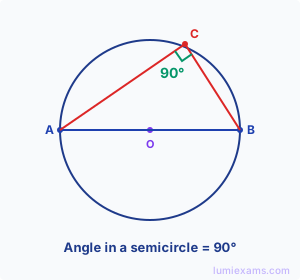
Worked example 1 — Angle in a semicircle
Question: In a circle with center , is the diameter. Point lies on the circumference. If angle , find angle .
- Identify the diameter: passes through .
- Apply theorem: Angle (angle in a semicircle).
- Sum of angles in a triangle: .
- Final Answer: Angle .
Worked example 2 — Finding an angle using semicircle property
Question: A circle has diameter . Point lies on the circumference such that . Calculate the size of .
- (Angle in a semicircle)
- (Angles in a triangle)
- (Substitute known values)
- (Subtract from both sides)
- Final Answer:
Tangent and Radius
The angle between a tangent and the radius at the point of contact is 90°.
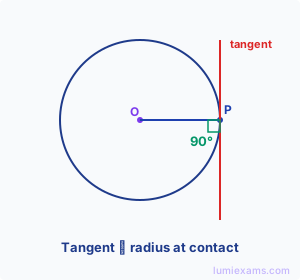
Worked example 3 — Tangent and radius
Question: A tangent touches a circle at . The radius of the circle is . A line connects the center to a point outside the circle. If angle , find angle .
- Apply theorem: Angle (tangent is perpendicular to radius).
- Sum of angles in triangle .
- Calculation: .
- Final Answer: Angle .
Worked example 4 — Combining tangent/radius with isosceles triangle
Question: is a tangent to a circle at point . is the center of the circle, and cm. cm. Calculate the length of .
- (Tangent meets radius at )
- Triangle is a right-angled triangle.
- (Pythagoras' Theorem)
- (Substitute known values)
- (Subtract 25 from both sides)
- (Take the square root of both sides)
- cm
- Final Answer: cm
Extended Content (Extended Curriculum Only)
Angle at the Centre
The angle subtended by an arc at the centre of a circle is twice the angle subtended by the same arc at the circumference.
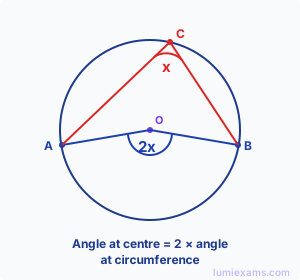
Worked example 5 — Angle at the centre
Question: Points , , and lie on a circle with center . If angle , find the reflex angle .
- Angle at center is angle at circumference.
- Obtuse angle .
- Reflex angle .
- Final Answer: .
Worked example 6 — Combining angle at centre with isosceles triangle
Question: Points and lie on a circle with center . . Find the angle subtended by the arc at the center of the circle, .
- (Both are radii of the circle)
- Triangle is isosceles.
- (Base angles of an isosceles triangle are equal)
- (Angles in a triangle)
- (Subtract from both sides)
- Final Answer:
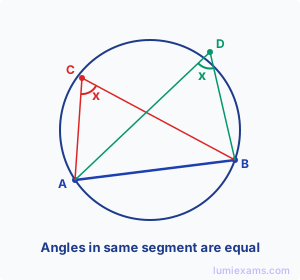
Angles in the Same Segment
Angles subtended by the same arc (or chord) at the circumference are equal. This is often called the "Bow-tie" theorem.
Cyclic Quadrilaterals
The opposite angles in a cyclic quadrilateral sum to 180° (they are supplementary).
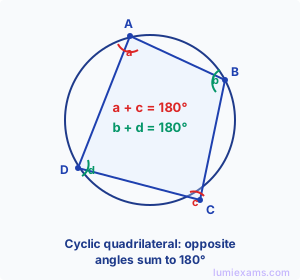
Worked example 7 — Cyclic quadrilateral
Question: is a cyclic quadrilateral. If angle and angle , find angles and .
- Opposite angles sum to .
- Angle .
- Angle .
- Final Answer: Angle and Angle .
Alternate Segment Theorem
The angle between a tangent and a chord is equal to the angle in the alternate segment.
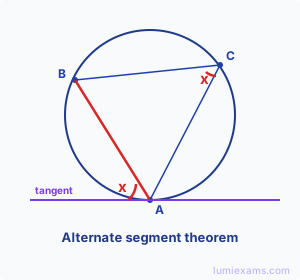
Worked example 8 — Alternate segment theorem
Question: A tangent touches a circle at point . Chord is drawn. . Point lies on the circumference such that is subtended by chord . Find .
- (Alternate Segment Theorem)
- Final Answer:
Key Equations
- Angle in semicircle:
- Radius Tangent:
- Angle at centre:
- Opposite angles of cyclic quad:
- Sum of angles around a point:
Note: These formulas are not provided on the IGCSE formula sheet. You must memorize the theorems and the specific geometric language used to describe them.
Common Mistakes to Avoid
- ❌ Wrong: Assuming that any four-sided shape inside a circle is a cyclic quadrilateral. ✓ Right: Verify that all four vertices of the quadrilateral lie exactly on the circumference before applying the rule that opposite angles sum to .
- ❌ Wrong: Forgetting to double-check whether you need the reflex angle at the center. ✓ Right: Read the question carefully. If it asks for the reflex angle, remember to subtract the acute/obtuse angle you initially calculated from .
- ❌ Wrong: Assuming that if a line looks like a tangent, it is definitely a tangent. ✓ Right: Only use the "tangent meets radius at " theorem if the question explicitly states that the line is a tangent, or if you are asked to prove that it is a tangent.
- ❌ Wrong: Confusing the "angle at the center" theorem with the "angles in the same segment" theorem. ✓ Right: The "angle at the center" theorem relates an angle at the center to an angle at the circumference subtended by the same arc. "Angles in the same segment" relates two angles at the circumference subtended by the same arc.
Exam Tips
- Command Words: If the question says "Give a reason for your answer," you must write the name of the theorem (e.g., "angles in the same segment are equal"). You will lose marks even if your calculation is correct.
- The Isosceles Trap: Look for triangles formed by two radii. These are always isosceles triangles, meaning the two angles at the circumference are equal. This is the most common "hidden" step in IGCSE circle questions.
- Calculator vs Non-Calculator: In non-calculator papers, angles are often multiples of or . If you get in a non-calculator section, re-check your subtraction!
- Multi-step logic: Often, you need to use "Angles on a straight line = " or "Angles in a triangle = " in combination with circle theorems. Work through the diagram step-by-step, labeling every angle you find.