1. Overview
This topic focuses on circles, arcs, and sectors, essential for the IGCSE Cambridge Mathematics (0580) exam. You'll learn how to calculate the circumference (perimeter) and area of circles, as well as the lengths of arcs and areas of sectors. These skills are crucial for solving problems involving circular shapes and designs, and understanding concepts like rotation. The key is mastering the formulas and knowing when to apply them.
Key Definitions
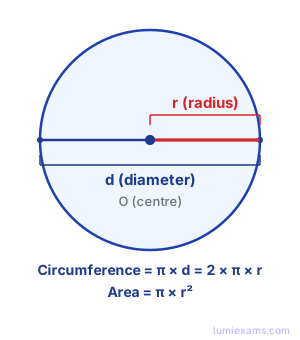
- Radius (): The distance from the center of the circle to any point on its edge.
- Diameter (): The distance across the circle passing through the center ().
- Circumference (): The total distance around the edge of the circle (the perimeter).
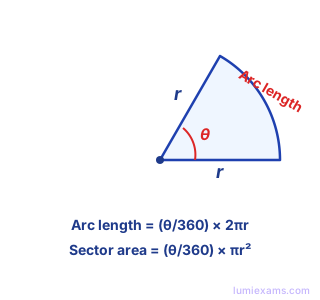
- Arc: A portion of the circumference of a circle.
- Sector: A "pizza slice" section of a circle, bounded by two radii and an arc.
- Chord: A straight line joining two points on the circumference.
- Segment: The area between a chord and an arc.
- Tangent: A straight line that touches the circumference at exactly one point.
Core Content
Circumference and Area
To calculate the properties of a circle, we use the mathematical constant (Pi), which is approximately It's best to use the button on your calculator for the most accurate results.
Circumference Formula: OR (Not on formula sheet - MEMORIZE)
Area Formula: (Not on formula sheet - MEMORIZE)
Worked example 1 — Calculating area and circumference
Question: A circle has a radius of cm. Calculate its circumference and area, giving your answers to 3 significant figures.
Identify the radius: cm
- Reason: Given in the question.
Circumference:
- Reason: Applying the circumference formula.
- Reason: Substituting the value of .
- Reason: Simplifying.
cm
- Reason: Using the button on the calculator.
- Reason: Rounding to 3 significant figures.
Area:
- Reason: Applying the area formula.
- Reason: Substituting the value of .
- Reason: Simplifying.
cm²
- Reason: Using the button on the calculator.
- Reason: Rounding to 3 significant figures.
Arcs and Sectors (Factors of 360°)
For Core students, you will often deal with fractions of a circle where the angle (theta) is a factor of (e.g., for a quarter circle, for a semi-circle).
Arc Length: (Not on formula sheet - MEMORIZE)
Sector Area: (Not on formula sheet - MEMORIZE)
Worked example 2 — Area of a sector
Question: A sector of a circle has a radius of cm and a central angle of . Calculate the area of the sector, giving your answer to 3 significant figures.
- Identify the radius: cm
- Reason: Given in the question.
- Identify the angle:
- Reason: Given in the question.
- Sector Area:
- Reason: Applying the sector area formula.
- Reason: Substituting the values of and .
- Reason: Simplifying the fraction.
- Reason: Simplifying.
- Reason: Simplifying.
- cm²
- Reason: Using the button on the calculator.
- Reason: Rounding to 3 significant figures.
Extended Content (Extended Only)
Extended students must be able to calculate arc lengths and sector areas for any angle . They also need to be able to work backwards, finding the radius or angle given the arc length or sector area.
Perimeter of a Sector
A common exam trap is asking for the "Perimeter of a Sector." This is the sum of the curved arc length plus the two straight radii.
- Perimeter
Worked example 3 — Sector calculations
Question: A sector has a radius of cm and an angle of . Calculate the arc length and the total perimeter, giving your answers to 3 significant figures.
- Arc Length formula:
- Reason: Stating the formula.
- Substitute values:
- Reason: Substituting the given values.
- Simplify fraction:
- Reason: Simplifying the fraction.
- Calculate Arc Length:
- Reason: Simplifying.
- Arc Length cm
- Reason: Using the button on the calculator.
- Arc Length
- Reason: Rounding to 3 significant figures.
- Total Perimeter: Arc Length
- Reason: Perimeter of a sector is the arc length plus two radii.
- Total Perimeter
- Reason: Substituting the values.
- Total Perimeter
- Reason: Rounding to 3 significant figures.
Worked example 4 — Finding the angle
Question: A sector has an area of cm² and a radius of cm. Find the angle , in degrees, giving your answer to 1 decimal place.
- Set up the equation:
- Reason: Applying the sector area formula.
- Simplify:
- Reason: Simplifying.
- Multiply both sides by 360:
- Reason: Isolating .
- Reason: Simplifying.
- Divide both sides by :
- Reason: Isolating .
- Calculate:
- Reason: Simplifying.
- Reason: Using the button on the calculator.
- Reason: Rounding to 1 decimal place.
Worked example 5 — Finding the radius
Question: A sector has an arc length of cm and an angle of . Find the radius of the sector, giving your answer to 3 significant figures.
- Arc Length formula:
- Reason: Stating the formula.
- Substitute values:
- Reason: Substituting the given values.
- Simplify fraction:
- Reason: Simplifying the fraction.
- Reason: Simplifying.
- Reason: Simplifying.
- Multiply both sides by 5:
- Reason: Isolating .
- Divide both sides by :
- Reason: Isolating .
- Reason: Simplifying.
- cm
- Reason: Using the button on the calculator.
- Reason: Rounding to 3 significant figures.
Key Equations
Note: These formulas are not provided on the IGCSE formula sheet. You must memorize them.
| Property | Formula | Units (e.g.) |
|---|---|---|
| Circumference | or | cm, m, mm |
| Area of Circle | cm², m², mm² | |
| Arc Length | cm, m, mm | |
| Sector Area | cm², m², mm² |
Common Mistakes to Avoid
- ❌ Wrong: Using as an approximation for throughout the calculation.
- ✅ Right: Use the button on your calculator for maximum precision. Rounding too early results in inaccurate final answers, especially in multi-step problems.
- ❌ Wrong: Confusing Diameter and Radius when calculating the area.
- ✅ Right: Always check if the question gives you or . If it gives , remember to divide by before using the formula.
- ❌ Wrong: Forgetting to include the radii when calculating the perimeter of a sector.
- ✅ Right: The perimeter of a sector includes the arc length and the two radii that form the sector. So, Perimeter = Arc Length + .
- ❌ Wrong: Using the area formula for circumference, or vice versa.
- ✅ Right: Drill the formulas! Area is always in square units (cm², m²), and the formula is . Circumference is a length (cm, m), and the formula is .
- ❌ Wrong: Not giving the final answer to 3 significant figures.
- ✅ Right: Unless the question specifies otherwise, always round your final answer to 3 significant figures.
Exam Tips
- Accuracy: IGCSE marks are strict. Always give your final answer to three significant figures unless the question specifies otherwise (or if the answer is exact).
- Command Words:
- "Calculate": Show all steps of your working.
- "Give your answer in terms of ": Do not press the decimal button on your calculator; leave your answer as (e.g.) .
- Compound Shapes: Expect circles to be combined with other shapes. You might have to find the area of a square and subtract the area of a circle (the "shaded region" problems).
- Calculator Tip: If you are in a non-calculator paper (rare for this specific topic), use for only if specifically told to do so. Otherwise, keep in your working as a symbol.
- The "Reverse" Question: Practice finding the radius when given the area. . Don't forget to square root! Also, practice finding the radius when given the circumference: .