1. Overview
Transformations in IGCSE Mathematics (0580) involve changing the position or size of a shape. You'll learn to perform and describe reflections, rotations, enlargements, and translations. Mastering these transformations is crucial for geometry and spatial reasoning questions. The key is to accurately identify and state all the necessary parameters for each transformation type.
Key Definitions
- Object: The original shape before any transformation has taken place.
- Image: The new shape produced after the transformation (usually labeled with prime notation, e.g., Shape becomes Shape ).
- Congruent: Shapes that are identical in size and shape; the image is congruent to the object in reflections, rotations, and translations.
- Similar: Shapes that are the same shape but different sizes; the image is similar to the object in enlargements.
- Invariant Point: A point that remains in the same position after a transformation.
- Vector: A quantity representing a movement in a specific direction, written as .
Core Content
1. Reflection
To reflect a shape, you "flip" it over a mirror line. Every point on the image is the same distance from the mirror line as the corresponding point on the object.
- Required Information: The equation of the mirror line (e.g., , , or the -axis).
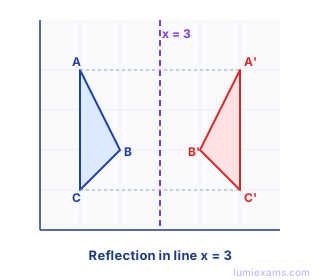
Worked example 1 — Reflection in a vertical line
Question: Reflect triangle with vertices , , and in the line .
- Identify the mirror line: is a vertical line passing through on the -axis.
- Consider point . It is 1 unit to the left of the mirror line.
- Count 1 unit to the right of the mirror line to find the image point .
- Therefore, is at .
- Consider point . It is 1 unit to the right of the mirror line.
- Count 1 unit to the left of the mirror line to find the image point .
- Therefore, is at .
- Consider point . It is 1 unit to the right of the mirror line.
- Count 1 unit to the left of the mirror line to find the image point .
- Therefore, is at .
Result: Image vertices are , , and .
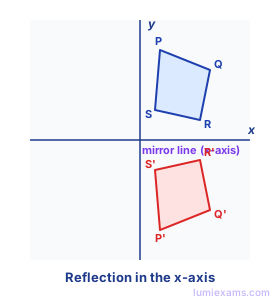
Worked example 2 — Reflection in the x-axis
Question: Reflect the shape defined by the points , , , and in the x-axis.
- The x-axis is the line .
- Point is 2 units above the x-axis.
- The reflected point will be 2 units below the x-axis.
- Therefore, is at .
- Point is 2 units above the x-axis.
- The reflected point will be 2 units below the x-axis.
- Therefore, is at .
- Point is 4 units above the x-axis.
- The reflected point will be 4 units below the x-axis.
- Therefore, is at .
- Point is 4 units above the x-axis.
- The reflected point will be 4 units below the x-axis.
- Therefore, is at .
Result: The reflected shape has vertices , , , and .
2. Rotation
Rotation "turns" a shape around a fixed point.
- Required Information:
- Centre of rotation (a coordinate).
- Angle of rotation (90°, 180°, 270°).
- Direction (Clockwise or Anticlockwise).
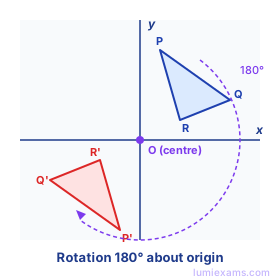
Worked example 3 — Rotation about the origin
Question: Rotate triangle with vertices , , and by about the origin .
- A rotation of about the origin maps to .
- For point , the image will be .
- For point , the image will be .
- For point , the image will be .
Result: The rotated triangle has vertices , , and .
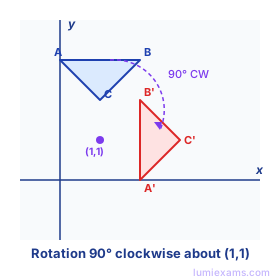
Worked example 4 — Rotation 90 degrees clockwise
Question: Rotate the triangle with vertices , , and by clockwise about the point .
- Consider point . The centre of rotation is .
- The vector from the centre of rotation to is .
- A clockwise rotation transforms the vector to .
- So, the vector becomes .
- The new point is found by adding this vector to the centre of rotation: .
- Therefore, is at .
- Consider point . The vector from the centre of rotation to is .
- Rotating this vector clockwise gives .
- The new point is .
- Therefore, is at .
- Consider point . The vector from the centre of rotation to is .
- Rotating this vector clockwise gives .
- The new point is .
- Therefore, is at .
Result: The rotated triangle has vertices , , and .
3. Enlargement
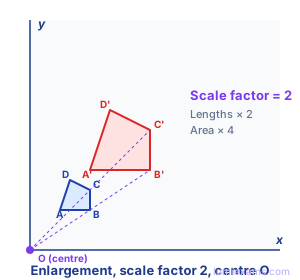
Enlargement changes the size of a shape by a scale factor from a specific centre.
- Required Information:
- Centre of enlargement (a coordinate).
- Scale Factor ().
- Formula: .
Worked example 5 — Enlargement with positive scale factor
Question: Enlarge quadrilateral with vertices , , , and by a scale factor of from the centre of enlargement .
- The scale factor is .
- For point , the vector from the centre is .
- Multiply this vector by the scale factor: .
- The image point is at .
- For point , the vector from the centre is .
- Multiply this vector by the scale factor: .
- The image point is at .
- For point , the vector from the centre is .
- Multiply this vector by the scale factor: .
- The image point is at .
- For point , the vector from the centre is .
- Multiply this vector by the scale factor: .
- The image point is at .
Result: The enlarged quadrilateral has vertices , , , and .
4. Translation
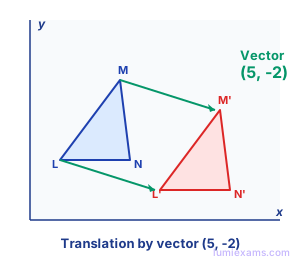
Translation "slides" a shape without turning it or changing its size.
- Required Information: A translation vector .
- Top number (): Horizontal movement (positive = right, negative = left).
- Bottom number (): Vertical movement (positive = up, negative = down).
Worked example 6 — Translation by a vector
Question: Translate triangle with vertices , , and by the vector .
- The translation vector is .
- For point , add the vector: .
- The image point is at .
- For point , add the vector: .
- The image point is at .
- For point , add the vector: .
- The image point is at .
Result: The translated triangle has vertices , , and .
Extended Content (Extended Only)
While the syllabus objectives for topic 7.1 are Core, Extended students benefit from a deeper understanding of these concepts. This includes recognizing how transformations relate to coordinate geometry and vectors, which are essential for more advanced topics. For example, understanding how a rotation about the origin corresponds to multiplying the position vector by provides a foundation for working with transformation matrices later on. Similarly, a strong grasp of enlargement with positive scale factors is crucial before tackling negative or fractional scale factors. Extended students should also practice describing combinations of transformations, even though the exam will only ask for a single equivalent transformation. Visualising the effect of transformations on various shapes, including irregular polygons and curves, will further enhance problem-solving skills.
Key Equations
Scale Factor (): Memorise this formula.
Column Vector: Where is horizontal change and is vertical change. Memorise this notation.
Inverse Translation: If a translation from to is , the translation from back to is . Memorise this relationship.
Common Mistakes to Avoid
- ❌ Wrong: Saying "The shape moved to the right and up" instead of using the term "Translation". ✅ Right: Describe the movement as a "Translation by the vector ", specifying the values of and .
- ❌ Wrong: Describing a shape as "becoming smaller" after an enlargement. ✅ Right: Use the correct terminology: "Enlargement, scale factor , centre of enlargement ", where is less than 1.
- ❌ Wrong: Stating the angle of rotation without specifying the direction (clockwise or anticlockwise). ✅ Right: Always include the direction: "Rotation of 90° clockwise about the point (2, 3)".
- ❌ Wrong: Calculating the translation vector from to when the shape moved from to . ✅ Right: Ensure you calculate (end point - start point) to find the correct vector. If moves to , the vector is .
- ❌ Wrong: Omitting the centre of enlargement when describing an enlargement. ✅ Right: The centre of enlargement is crucial. Use ray lines connecting corresponding vertices to find it if it's not obvious.
- ❌ Wrong: Listing multiple transformations when the question asks for a single transformation. For example, stating "reflection then translation". ✅ Right: Identify the single transformation that maps the object directly to the image.
Exam Tips
- Command Words:
- "Describe fully": This is a hint that you need multiple pieces of information (e.g., for rotation: name, angle, direction, AND centre).
- "Draw": Use a sharp pencil and a ruler. Accuracy within 1-2mm is usually required.
- Tracing Paper: Always ask for tracing paper in the exam. It is the most reliable way to perform rotations and check reflections.
- Calculator Tip: For vector additions or enlargements, you can use your calculator to verify simple multiplications (e.g., ), but most of this topic is visual.
- Formula Sheet: No formulas for transformations are provided on the IGCSE formula sheet; you must memorise the requirements for each description.
- The "Single Transformation" Trap: If a question asks for a single transformation that maps to , and you see was reflected then rotated, do not write both. Look for the one single movement (often a different reflection or rotation) that maps them directly.