1. Overview
This topic explores how substances transition between solid, liquid, and gaseous states through the transfer of thermal energy. Understanding these processes is vital for explaining everything from how our bodies stay cool by sweating to the industrial processes used to generate power.
Key Definitions
- Melting: The process where a solid turns into a liquid at a constant temperature.
- Boiling: The process where a liquid turns into a gas at a specific temperature (the boiling point) throughout the bulk of the liquid.
- Condensation: The process where a gas turns into a liquid due to a loss of thermal energy.
- Solidification (Freezing): The process where a liquid turns into a solid.
- Evaporation: The process where a liquid turns into a gas at the surface of the liquid, occurring at temperatures below the boiling point.
- Internal Energy: The sum of the total kinetic energy (related to temperature) and total potential energy (related to state) of the particles in a system.
Core Content
Melting and Boiling (Energy vs. Temperature)
When a substance reaches its melting or boiling point, it continues to absorb energy even though its temperature does not increase.
- Energy Input: The thermal energy supplied is used to break the bonds (intermolecular forces) between particles rather than increasing their kinetic energy.
- Temperature Plateau: On a heating curve, these changes of state are represented by horizontal (flat) lines.
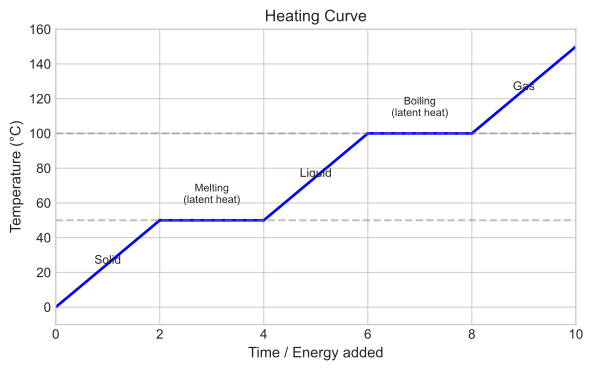 ) on the y-axis and Time or Energy Input " class="diagram-img" style="max-width: 450px; width: 100%; height: auto; display: inline-block;">
Water at Standard Atmospheric Pressure
You must memorize the following for pure water at sea level:
- Melting Point:
- Boiling Point:
Condensation and Solidification (Particle Model)
- Condensation: Gas particles lose kinetic energy and move slower. As they get closer together, the attractive forces pull them into a liquid structure.
- Solidification: Liquid particles lose more energy, moving so slowly that they settle into a fixed, regular lattice structure.
Evaporation
Evaporation occurs because particles in a liquid have a range of energies.
- Process: Some "more-energetic" particles near the surface have enough kinetic energy to overcome the attractive forces of neighboring molecules and escape as a gas.
- Cooling Effect: Because the fastest (hottest) particles escape, the average kinetic energy of the remaining particles decreases. Since temperature is a measure of average kinetic energy, the liquid cools down.
Extended Content (Extended Curriculum Only)
Differences Between Boiling and Evaporation
| Feature | Boiling | Evaporation |
|---|---|---|
| Temperature | Occurs only at the fixed boiling point. | Occurs at any temperature below boiling. |
| Location | Happens throughout the entire liquid (bubbles form). | Happens only at the surface. |
| Speed | A fast process. | A slow process. |
| External Energy | Requires an external heat source. | Can occur using the internal energy of the liquid. |
Factors Affecting the Rate of Evaporation
The rate of evaporation increases when:
- Temperature increases: More particles have the required kinetic energy to escape.
- Surface Area increases: More particles are positioned at the surface, providing more "exit points."
- Air Movement (Wind) increases: Escaped vapor is blown away, preventing particles from falling back into the liquid and allowing more to escape.
Cooling of an Object in Contact with Evaporating Liquid
When a liquid evaporates from the surface of an object (e.g., sweat on skin):
- The liquid absorbs the "Latent Heat" required for the phase change from the object it is touching.
- As the liquid evaporates, it carries this thermal energy away, reducing the temperature of the object.
Key Equations
While this topic is mostly descriptive, it links to the calculation of energy during state changes:
- : Thermal energy transferred (Joules, J)
- : Mass of the substance (kilograms, kg)
- : Specific Latent Heat (J/kg)
Temperature Conversion:
- Example: Boiling water = .
Common Mistakes to Avoid
- ❌ Wrong: Thinking that the temperature of boiling water keeps rising as you add more heat.
- ✓ Right: The temperature stays exactly until all the water has turned into steam; the extra energy is "Latent Heat."
- ❌ Wrong: Suggesting evaporation only happens when a liquid is hot.
- ✓ Right: Evaporation happens at all temperatures (e.g., a puddle drying on a cold day).
- ❌ Wrong: Using "normal body temperature" () as a fixed calibration point for thermometers in an exam.
- ✓ Right: Only use the fixed points of water ( and ) as standard physical constants.
- ❌ Wrong: Forgetting to add 273 when converting Celsius to Kelvin.
- ✓ Right: Always check if the question requires the answer in Kelvin (K).
Exam Tips
- Look for "Flat Lines": If an exam question provides a cooling or heating graph, any horizontal section is where a change of state is occurring. If the graph is sloped, the temperature is changing.
- Explain the "Why": When asked why evaporation causes cooling, always mention that the "most energetic particles" escape, which "lowers the average kinetic energy" of the remaining particles.
- State Change vs. Temperature: In "describe" questions, clarify that during melting/boiling, energy is used to increase potential energy (breaking bonds) rather than kinetic energy (increasing temperature).
Exam-Style Questions
Practice these original exam-style questions to test your understanding. Each question mirrors the style, structure, and mark allocation of real Cambridge 0625 Theory papers.
Exam-Style Question 1 — Short Answer [5 marks]
Question:
A student investigates the rate of evaporation of water from two identical beakers. Beaker A is placed in a warm room, and beaker B is placed in a cold room.
(a) State two differences between boiling and evaporation. [2]
(b) Explain, in terms of the kinetic energy of water molecules, why the rate of evaporation is higher in the warm room (beaker A). [3]
Worked Solution:
(a)
- Evaporation occurs only at the surface of the liquid, while boiling occurs throughout the liquid. [Location of the process]
- Evaporation occurs at any temperature below the boiling point, while boiling occurs at a specific temperature. [Temperature range]
How to earn full marks:
- 1 mark for stating the difference in location.
- 1 mark for stating the difference in temperature.
(b)
- Water molecules in the warm room have higher average kinetic energy than those in the cold room. [Kinetic energy difference]
- More energetic molecules are more likely to overcome the intermolecular forces and escape from the surface of the water. [Overcoming forces]
- Therefore, a greater number of molecules escape per unit time in the warm room, leading to a higher rate of evaporation. [Rate of evaporation]
How to earn full marks:
- 1 mark for stating that water molecules in the warm room have higher average kinetic energy.
- 1 mark for linking higher kinetic energy to overcoming intermolecular forces.
- 1 mark for explaining how this leads to a higher rate of evaporation.
Common Pitfall: Remember that evaporation can happen at any temperature, not just at the boiling point. Also, be sure to explain the link between kinetic energy and the ability of molecules to overcome intermolecular forces.
Exam-Style Question 2 — Short Answer [6 marks]
Question:
A block of ice at is heated at a constant rate until it becomes steam at .
(a) Describe what happens to the temperature of the ice as it is heated from to . [1]
(b) Explain, in terms of the arrangement and motion of particles, what happens to the ice at . [3]
(c) Name the process that occurs when steam at changes to water at . [1]
(d) State what happens to the temperature of the water as it boils to become steam. [1]
Worked Solution:
(a)
- The temperature of the ice increases from to . [Temperature increase]
How to earn full marks:
- 1 mark for stating that the temperature increases from to .
(b)
- At , the ice starts to melt. [Melting begins]
- The particles gain energy which allows them to overcome the strong forces holding them in a fixed lattice structure. [Energy input and overcoming forces]
- The particles start to move more freely, changing from a solid to a liquid state, but the temperature remains constant. [Change of state at constant temperature]
How to earn full marks:
- 1 mark for stating that the ice starts to melt at .
- 1 mark for stating that the particles are overcoming forces holding them in a fixed lattice.
- 1 mark for mentioning that the particles move more freely and the state changes from solid to liquid.
(c)
- Condensation [Process Name]
How to earn full marks:
- 1 mark for stating the name of the process is condensation.
(d)
- The temperature remains constant. [Temperature behaviour]
How to earn full marks:
- 1 mark for stating that the temperature remains constant.
Common Pitfall: Many students forget that during a change of state (melting or boiling), the temperature remains constant even though heat is being added. The energy is being used to break the intermolecular bonds, not to increase the kinetic energy of the molecules.
Exam-Style Question 3 — Extended Response [8 marks]
Question:
A student performs an experiment to investigate how the rate of evaporation of a liquid depends on the surface area of the liquid. The student uses three identical shallow dishes, each containing the same volume () of ethanol. Dish A has a diameter of 5 cm, dish B has a diameter of 10 cm, and dish C has a diameter of 15 cm. The student measures the mass of each dish every 30 minutes for a total of 2 hours. The experiment is conducted at a constant room temperature and with no air movement.
(a) State two variables that must be kept constant to ensure a fair test. [2]
(b) Describe how the student could measure the mass of each dish accurately. [2]
(c) Explain how the surface area of the liquid affects the rate of evaporation, based on the kinetic theory of matter. [4]
Worked Solution:
(a)
- Temperature of the room must be kept constant. [Controlled Variable 1]
- Air movement (or draughts) must be kept constant (or eliminated). [Controlled Variable 2]
How to earn full marks:
- 1 mark for stating temperature of the room.
- 1 mark for stating air movement.
(b)
- Place the dish on an electronic balance. [Use of Balance]
- Record the reading on the balance in grams (or kg). [Recording the Reading]
How to earn full marks:
- 1 mark for stating to place the dish on an electronic balance.
- 1 mark for stating to record the reading on the balance in grams (or kg).
(c)
- A larger surface area means more molecules are exposed at the surface of the liquid. [More molecules exposed]
- These molecules have a range of kinetic energies. [Kinetic energy range]
- The more energetic molecules have sufficient energy to overcome the intermolecular forces and escape into the surroundings (evaporate). [Overcoming forces]
- With a larger surface area, more molecules can escape per unit time, increasing the rate of evaporation. [Rate of evaporation increase]
How to earn full marks:
- 1 mark for stating that larger surface area means more molecules exposed.
- 1 mark for stating the molecules have a range of kinetic energies.
- 1 mark for linking energetic molecules escaping to overcoming intermolecular forces.
- 1 mark for explaining the increase in the rate of evaporation.
Common Pitfall: When describing experiments, always remember to state the units you would use when taking measurements. Also, be clear about why a larger surface area increases evaporation – it's not just that there's more liquid, but that more molecules are at the surface and able to escape.
Exam-Style Question 4 — Extended Response [9 marks]
Question:
A hiker uses a portable stove to boil water at the top of a mountain. At this altitude, the atmospheric pressure is lower than at sea level. The hiker notices that the water boils at .
(a) Define boiling point. [1]
(b) Explain, in terms of particles, why the boiling point of water decreases as the pressure decreases. [4]
(c) The power output of the stove is 800 W. The mass of water the hiker needs to boil is 0.8 kg. The specific latent heat of vaporisation of water at is . Calculate the time taken for all the water to boil away at , assuming that all the power supplied is used to vaporise the water. [4]
Worked Solution:
(a)
- The boiling point is the temperature at which a liquid changes to a gas throughout its volume. [Definition of boiling point]
How to earn full marks:
- 1 mark for stating the temperature at which a liquid changes to a gas throughout its volume.
(b)
- At lower pressure, the water molecules are further apart. [Molecular proximity]
- Weaker intermolecular forces between the water molecules need to be overcome for boiling to occur. [Intermolecular forces]
- Less kinetic energy is required for the molecules to overcome these weaker intermolecular forces. [Kinetic energy needed]
- Therefore, a lower temperature (boiling point) is required to provide the necessary kinetic energy. [Lower temperature required]
How to earn full marks:
- 1 mark for stating that at lower pressure, the water molecules are further apart.
- 1 mark for stating that weaker intermolecular forces are present.
- 1 mark for stating that less kinetic energy is required to overcome these forces.
- 1 mark for stating that a lower temperature (boiling point) is required.
(c)
- Calculate the total energy required to vaporise the water: [Using the latent heat equation]
How to earn full marks:
- 1 mark for using the correct latent heat formula.
- 1 mark for correct substitution of values.
- Calculate the time taken using the power equation: , so [Using the power equation]
How to earn full marks:
- 1 mark for using the correct power formula.
- 1 mark for correct substitution of values, ECF allowed.
- Final answer:
How to earn full marks:
- Correct final answer with correct units.
Common Pitfall: Be careful to use the correct value for the specific latent heat of vaporisation, as it can change with temperature. Also, remember to rearrange the power equation correctly to solve for time.