1. Overview
The a.c. (alternating current) generator is a device that converts mechanical energy into electrical energy using the principle of electromagnetic induction. It is the fundamental technology used in power stations to produce the electricity we use in our homes.
Key Definitions
- Electromagnetic Induction: The production of an electromotive force (e.m.f.) across a conductor when it moves through a magnetic field or when the magnetic field around it changes.
- Alternating Current (a.c.): A flow of electric charge that periodically reverses its direction.
- Slip Rings: Metal rings attached to the rotating coil that allow electrical contact with the external circuit without tangling the wires.
- Brushes: Carbon blocks that rub against the slip rings to transfer the induced current to the external circuit.
Core Content
Note: The IGCSE syllabus classifies the specific mechanics of the a.c. generator under the Supplement (Extended) curriculum. However, all students should understand that electricity is induced when a wire "cuts" through magnetic field lines.
Extended Content (Extended Curriculum Only)
How a Simple a.c. Generator Works
An a.c. generator consists of a rectangular coil of wire placed between the poles of a permanent magnet.
- Rotation: The coil is rotated mechanically (e.g., by a turbine).
- Cutting Field Lines: As the coil rotates, the sides of the coil "cut" through the magnetic field lines.
- Induced e.m.f.: This cutting action induces an e.m.f., which drives a current through the coil.
- Slip Rings and Brushes: Because the coil is rotating, slip rings and brushes are used to connect the rotating coil to the fixed external circuit, ensuring the wires do not twist.
Interpreting e.m.f. vs. Time Graphs
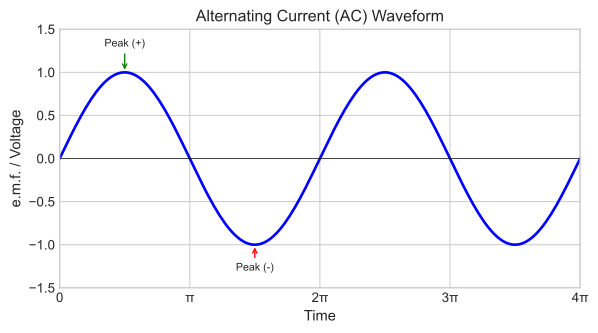
The induced e.m.f. is not constant; it changes as the coil rotates.
- Maximum e.m.f. (Peaks and Troughs): Occurs when the coil is horizontal (parallel to the magnetic field). At this point, the sides of the coil are moving perpendicular to the field lines, cutting them at the maximum rate.
- Zero e.m.f.: Occurs when the coil is vertical (perpendicular to the magnetic field). At this point, the sides of the coil are moving parallel to the field lines and are not "cutting" them at all.
Factors Affecting the Induced e.m.f.
To increase the magnitude of the peak e.m.f., you can:
- Increase the speed of rotation.
- Increase the strength of the magnetic field.
- Increase the number of turns on the coil.
- Increase the area of the coil.
Important Note on Speed: If the speed of rotation is doubled:
- The amplitude (peak voltage) doubles because the lines are cut faster.
- The frequency doubles (the time for one cycle is halved) because the coil completes turns faster.
Key Equations
While there are no specific calculation formulas for the generator e.m.f. in this section, you must be able to relate frequency and period from the graphs:
- : Frequency (Hertz, Hz)
- : Period for one rotation (Seconds, s)
Common Mistakes to Avoid
- ❌ Wrong: Thinking the e.m.f. is highest when the coil is vertical because it is "touching" the most flux.
- ✓ Right: The e.m.f. is zero when the coil is vertical because the wires are moving parallel to the field lines and not cutting them.
- ❌ Wrong: Forgetting that increasing the rotation speed changes two things on the graph.
- ✓ Right: Increasing rotation speed increases both the height (amplitude) of the waves and the number of waves (frequency) shown on the graph.
- ❌ Wrong: Confusing a.c. generators with d.c. motors.
- ✓ Right: A.c. generators use slip rings (full circles); d.c. motors/generators use a split-ring commutator (a circle cut in half).
Exam Tips
- Fleming’s Right-Hand Rule: Use this (Thumb = Motion, First Finger = Field, Second Finger = Induced Current) to determine the direction of the current in the coil sides.
- Graph Questions: When asked to draw a new graph for a "faster rotation," ensure your peaks are higher AND your waves are narrower.
- Labeling: If an exam question asks you to identify the parts, remember: Slip rings are for Sine waves (a.c.).
Exam-Style Questions
Practice these original exam-style questions to test your understanding. Each question mirrors the style, structure, and mark allocation of real Cambridge 0625 Theory papers.
Exam-Style Question 1 — Short Answer [5 marks]
Question:
A simple a.c. generator consists of a rectangular coil rotating in a uniform magnetic field.
(a) State the purpose of the slip rings in this a.c. generator. [1]
(b) Sketch a graph of the electromotive force (e.m.f.) generated in the coil against time for one complete rotation. Clearly label the axes. [3]
(c) State one way to increase the maximum e.m.f. produced by the generator. [1]
Worked Solution:
(a)
- The slip rings provide a continuous electrical connection between the rotating coil and the external circuit. The slip rings allow the current to flow from the coil to the external circuit without the wires twisting.
How to earn full marks:
- State that slip rings maintain electrical contact between the coil and the external circuit.
(b)
- The graph should be a sinusoidal wave.A sinusoidal graph showing emf on the y-axis and time on the x-axis. The y-axis should be labeled "e.m.f. (V)" and the x-axis should be labeled "time (s)". The graph should start at zero, rise to a positive peak, return to zero, descend to a negative peak, and return to zero again.
How to earn full marks:
- Correctly label both axes with "e.m.f. (V)" and "time (s)".
- Draw a sinusoidal wave shape.
- Start the wave at zero.
(c)
- Increasing the speed of rotation will increase the e.m.f. Increasing the speed of rotation of the coil.
How to earn full marks:
- State any one of the following: increase the speed of rotation, increase the magnetic field strength, increase the number of turns on the coil, increase the area of the coil.
Common Pitfall: Remember to label the axes of your graph with both the quantity and the unit. Also, be sure to state a specific way to increase the e.m.f. – saying "make it stronger" is too vague; you need to specify which factor you're increasing.
Exam-Style Question 2 — Short Answer [6 marks]
Question:
A student builds a small a.c. generator using a bar magnet and a coil of wire.
(a) Describe how the movement of the bar magnet near the coil generates an electromotive force (e.m.f.) in the coil. [3]
(b) Suggest two ways the student could modify the generator to produce a larger e.m.f. for the same speed of magnet movement. [2]
(c) State what happens to the frequency of the generated e.m.f. if the student moves the magnet faster. [1]
Worked Solution:
(a)
- The movement of the magnet causes a change in magnetic flux linkage with the coil. Moving the magnet causes the magnetic field lines to cut through the coil.
- This change in flux linkage induces an electromotive force (e.m.f.) in the coil. A changing magnetic field induces a voltage.
- The induced e.m.f. drives a current through the coil if the circuit is complete. The voltage causes current to flow in a closed loop.
How to earn full marks:
- Mention the changing magnetic flux linkage.
- State that this induces an e.m.f.
- Indicate that a complete circuit is needed for current to flow.
(b)
- Increasing the number of turns in the coil will increase the e.m.f. Use more turns in the coil.
- Using a stronger magnet increases the magnetic field strength and thus the e.m.f. Use a stronger magnet.
How to earn full marks:
- State one factor: use more turns in the coil OR use a stronger magnet OR increase the area of the coil.
- State a different factor from the list above.
(c)
- Moving the magnet faster increases the frequency of the generated e.m.f. The frequency increases.
How to earn full marks:
- State that the frequency increases.
Common Pitfall: It's important to remember that a change in magnetic flux is what induces the e.m.f., not just the presence of a magnetic field. Also, don't forget that a closed circuit is needed for a current to actually flow.
Exam-Style Question 3 — Extended Response [8 marks]
Question:
A simplified diagram of an a.c. generator is shown below. The coil has 100 turns and an area of . The magnetic field strength is . The coil rotates at a constant frequency of 50 Hz.
(a) Explain how the rotation of the coil generates an alternating e.m.f. [4]
(b) Calculate the maximum e.m.f. generated by the coil. [4]
Worked Solution:
(a)
- The rotation of the coil causes a change in the magnetic flux linkage with the coil. As the coil rotates, the amount of magnetic field lines passing through the coil changes.
- This change in flux linkage induces an e.m.f. in the coil. A changing magnetic field induces a voltage.
- The e.m.f. is alternating because the direction of the flux change reverses every half rotation. The direction of the induced e.m.f. changes as the coil rotates.
- The slip rings and brushes allow the current to flow to the external circuit without twisting the wires. These provide a continuous connection.
How to earn full marks:
- Mention the changing magnetic flux linkage.
- State that this induces an e.m.f.
- Explain why the e.m.f. is alternating.
- Mention the role of slip rings and brushes in maintaining continuous connection.
(b)
- State the formula for the maximum induced e.m.f. This is the standard formula.
- Calculate the angular frequency. Using the given frequency.
- Substitute the values into the formula. Correct substitution.
- State the final answer with units.
Common Pitfall: Make sure you use the angular frequency () in the formula for maximum e.m.f., not just the frequency (). Also, remember that the slip rings and brushes are there to maintain a continuous connection to the external circuit as the coil rotates.
Exam-Style Question 4 — Extended Response [9 marks]
Question:
A research student is investigating the output of a small a.c. generator. The generator consists of a coil with 500 turns rotating in a uniform magnetic field. The area of the coil is and the magnetic field strength is . The student connects the generator to an oscilloscope to observe the induced e.m.f.
(a) The student observes that the peak e.m.f. is 4.7 V. Calculate the frequency of rotation of the coil. [4]
(b) The student then connects the generator to a resistor with a resistance of . Assume the e.m.f. generated is sinusoidal. Calculate: (i) The peak current through the resistor. [2] (ii) The average power dissipated in the resistor. [3]
Worked Solution:
(a)
- State the formula for the maximum induced e.m.f. This is the standard formula.
- Rearrange the formula to solve for the angular frequency. Isolating .
- Substitute the given values into the formula. Correct substitution.
- Calculate the frequency using . Converting to frequency.
How to earn full marks:
- State the correct formula for maximum induced e.m.f.
- Rearrange the formula correctly to solve for angular frequency.
- Substitute all values correctly into the formula.
- Calculate the frequency correctly with the correct unit (Hz).
(b)(i)
- State Ohm's Law. or Using the relationship between voltage, current, and resistance.
- Calculate the peak current. Applying Ohm's Law.
How to earn full marks:
- State Ohm's Law.
- Calculate the peak current correctly with the correct unit (A).
(b)(ii)
- State the formula for power in terms of current and resistance. Using the relationship between power, current, and resistance.
- Calculate the RMS current. Converting peak current to RMS current.
- Calculate the average power. Applying the power formula with RMS values.
How to earn full marks:
- State the correct formula for power.
- Calculate the RMS current correctly.
- Calculate the average power correctly with the correct unit (W).
Common Pitfall: When calculating average power in an a.c. circuit, it's crucial to use the RMS (root mean square) values of current or voltage, not the peak values. Using peak values will give you an incorrect result. Also, be careful with unit conversions and make sure your final answer has the correct unit (Watts in this case).