📅 5 Fresh Questions Every Day
Build a daily study habit! New questions every day for consistent practice. Questions are selected from the Cambridge IGCSE Physics syllabus.
5 questions
5 syllabus topics
Full explanations included
Today's Date
Tuesday, April 21, 2026
Questions
5
Question 1 of 5 Score: 0 / 0
1.7.5 - Energy, work and power Core
A heater has a power of 2000 W and operates for 3 hours. The unknown energy transferred is:
Detailed Explanation
**Why A is Correct:**
Energy = Power × Time
- Power = 2000 W
- Time = 3 hours = 3 × 3600 = 10,800 seconds
- Energy = 2000 W × 10,800 s = 21,600,000 J ✓
**Why Others Are Wrong:**
- **Forgot time conversion**: Used 3 hours directly instead of converting to seconds
- **Wrong formula**: Mixed up power and energy equations
- **Unit errors**: Didn't match units properly (Watts need seconds, not hours)
**Helpful Tips:**
1. **Always convert time to seconds** when working with Watts (W = J/s)
2. **Remember the formula**: Energy (J) = Power (W) × Time (s)
3. **Check units**: Watts × seconds = Joules
4. **Time conversion**: 1 hour = 3600 seconds
5. **Double-check**: Large numbers are normal for energy in Joules
The key mistake students make is forgetting to convert hours to seconds!
Energy = Power × Time
- Power = 2000 W
- Time = 3 hours = 3 × 3600 = 10,800 seconds
- Energy = 2000 W × 10,800 s = 21,600,000 J ✓
**Why Others Are Wrong:**
- **Forgot time conversion**: Used 3 hours directly instead of converting to seconds
- **Wrong formula**: Mixed up power and energy equations
- **Unit errors**: Didn't match units properly (Watts need seconds, not hours)
**Helpful Tips:**
1. **Always convert time to seconds** when working with Watts (W = J/s)
2. **Remember the formula**: Energy (J) = Power (W) × Time (s)
3. **Check units**: Watts × seconds = Joules
4. **Time conversion**: 1 hour = 3600 seconds
5. **Double-check**: Large numbers are normal for energy in Joules
The key mistake students make is forgetting to convert hours to seconds!
1.4.2 - Density Core
A car accelerates from rest to 20 m/s in 10 s. Which is the acceleration?
Detailed Explanation
**Why A is Correct:**
Acceleration = (final velocity - initial velocity) ÷ time
Given information:
- Initial velocity = 0 m/s (starts from rest)
- Final velocity = 20 m/s
- Time = 10 s
Calculation: a = (20 - 0) ÷ 10 = 2.0 m/s²
**Why Other Answers Are Wrong:**
Without seeing the other options, common mistakes include:
- Using only final velocity ÷ time (forgetting the formula)
- Mixing up velocity and acceleration units
- Incorrectly substituting values
**Helpful Tips:**
1. **Remember the formula:** a = (v_final - v_initial) ÷ t
2. **"From rest" always means initial velocity = 0**
3. **Check units:** Acceleration is always m/s², not m/s
4. **Double-check your math:** Substitute values carefully
The key is recognizing that acceleration measures how much velocity *changes* per second, not the final velocity itself.
Acceleration = (final velocity - initial velocity) ÷ time
Given information:
- Initial velocity = 0 m/s (starts from rest)
- Final velocity = 20 m/s
- Time = 10 s
Calculation: a = (20 - 0) ÷ 10 = 2.0 m/s²
**Why Other Answers Are Wrong:**
Without seeing the other options, common mistakes include:
- Using only final velocity ÷ time (forgetting the formula)
- Mixing up velocity and acceleration units
- Incorrectly substituting values
**Helpful Tips:**
1. **Remember the formula:** a = (v_final - v_initial) ÷ t
2. **"From rest" always means initial velocity = 0**
3. **Check units:** Acceleration is always m/s², not m/s
4. **Double-check your math:** Substitute values carefully
The key is recognizing that acceleration measures how much velocity *changes* per second, not the final velocity itself.
4.5.4 - Force on a current-carrying conductor Core
A current-carrying wire is placed in a uniform magnetic field. State the three factors that determine the magnitude of the force on the wire.
Detailed Explanation
## Force on a Current-Carrying Wire in a Magnetic Field
**Why the correct answer is right:**
The magnetic force on a wire follows the equation: **F = BIL**
- **B** = magnetic field strength (Tesla)
- **I** = current in the wire (Amperes)
- **L** = length of wire in the field (meters)
These three factors directly multiply together to give the force magnitude.
**Key concept:** When electric current flows through a wire in a magnetic field, the moving charges experience a force that transfers to the wire itself.
**Helpful tips:**
- Remember "**BIL**" as your formula
- All three factors must be present - no current means no force, no magnetic field means no force, no wire length means no force
- The force is maximized when the wire is perpendicular to the magnetic field
- This principle is used in electric motors and loudspeakers
*Note: The angle between wire and field affects force direction but these three factors determine the magnitude.*
**Why the correct answer is right:**
The magnetic force on a wire follows the equation: **F = BIL**
- **B** = magnetic field strength (Tesla)
- **I** = current in the wire (Amperes)
- **L** = length of wire in the field (meters)
These three factors directly multiply together to give the force magnitude.
**Key concept:** When electric current flows through a wire in a magnetic field, the moving charges experience a force that transfers to the wire itself.
**Helpful tips:**
- Remember "**BIL**" as your formula
- All three factors must be present - no current means no force, no magnetic field means no force, no wire length means no force
- The force is maximized when the wire is perpendicular to the magnetic field
- This principle is used in electric motors and loudspeakers
*Note: The angle between wire and field affects force direction but these three factors determine the magnitude.*
1.5.2 - Turning effect of forces Core
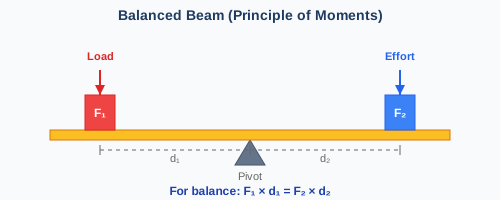
A uniform beam of length 4.0 m is balanced on a pivot at its center. A 60 N force acts downward at a distance of 1.5 m from the pivot. The diagram shows the setup. What does the calculation show for the balancing force F needed at the opposite end of the beam?
Detailed Explanation
**Why A (45 N) is Correct:**
This is a **torque balance** problem. For equilibrium, clockwise torque must equal counterclockwise torque.
**The Calculation:**
- Torque = Force × Distance from pivot
- Clockwise torque: 60 N × 1.5 m = 90 N⋅m
- For balance: F × 2.0 m = 90 N⋅m
- Therefore: F = 90 ÷ 2.0 = **45 N**
**Why Other Answers Are Wrong:**
- **30 N**: Used wrong distance (likely 1.5 m instead of 2.0 m)
- **60 N**: Incorrectly assumed forces must be equal (ignores different distances)
- **90 N**: Confused torque value with force value
**Helpful Tips:**
1. **Always identify the pivot point first**
2. **Measure distances from the pivot, not beam ends**
3. **Remember: Force closer to pivot needs MORE force to balance**
4. **Set up equation: Torque₁ = Torque₂**
The balancing force is less than 60 N because it acts farther from the pivot!
This is a **torque balance** problem. For equilibrium, clockwise torque must equal counterclockwise torque.
**The Calculation:**
- Torque = Force × Distance from pivot
- Clockwise torque: 60 N × 1.5 m = 90 N⋅m
- For balance: F × 2.0 m = 90 N⋅m
- Therefore: F = 90 ÷ 2.0 = **45 N**
**Why Other Answers Are Wrong:**
- **30 N**: Used wrong distance (likely 1.5 m instead of 2.0 m)
- **60 N**: Incorrectly assumed forces must be equal (ignores different distances)
- **90 N**: Confused torque value with force value
**Helpful Tips:**
1. **Always identify the pivot point first**
2. **Measure distances from the pivot, not beam ends**
3. **Remember: Force closer to pivot needs MORE force to balance**
4. **Set up equation: Torque₁ = Torque₂**
The balancing force is less than 60 N because it acts farther from the pivot!
4.3 - Electric circuits Extended
A wire carries a current of 2.0 A in a magnetic field of strength 0.50 T. The length of wire in the field is 0.30 m. Which is the maximum force on the wire?
Detailed Explanation
**Why A (0.30 N) is correct:**
The magnetic force on a current-carrying wire is calculated using: **F = BIL sin θ**
Where:
- B = magnetic field strength (0.50 T)
- I = current (2.0 A)
- L = length of wire (0.30 m)
- θ = angle between current and magnetic field
For **maximum force**, sin θ = 1 (when θ = 90°)
F = 0.50 × 2.0 × 0.30 × 1 = **0.30 N**
**Why other answers are wrong:**
- They likely used incorrect formulas or forgot the sin θ factor
- Some may have calculated force at different angles (sin θ < 1)
**Helpful tips:**
- Maximum force occurs when wire is **perpendicular** to magnetic field
- Remember the formula: F = BIL (when perpendicular)
- Units check: Tesla × Ampere × meter = Newton
- Always identify what the question asks for (maximum vs. actual force)
The magnetic force on a current-carrying wire is calculated using: **F = BIL sin θ**
Where:
- B = magnetic field strength (0.50 T)
- I = current (2.0 A)
- L = length of wire (0.30 m)
- θ = angle between current and magnetic field
For **maximum force**, sin θ = 1 (when θ = 90°)
F = 0.50 × 2.0 × 0.30 × 1 = **0.30 N**
**Why other answers are wrong:**
- They likely used incorrect formulas or forgot the sin θ factor
- Some may have calculated force at different angles (sin θ < 1)
**Helpful tips:**
- Maximum force occurs when wire is **perpendicular** to magnetic field
- Remember the formula: F = BIL (when perpendicular)
- Units check: Tesla × Ampere × meter = Newton
- Always identify what the question asks for (maximum vs. actual force)
Why Topic Practice Quiz?
- Fresh questions: Not from past papers, so you can save those for full exam practice
- Syllabus-aligned: Every question targets specific Cambridge IGCSE topics
- Full explanations: Learn from detailed solutions showing why each answer is correct or wrong
- Topic filtering: Focus on specific areas you need to improve