📝 Full Exam Simulation - 40 Questions
Practice under exam conditions! Complete all 40 questions to simulate a full Cambridge IGCSE Physics MCQ paper. All questions are original and not from past papers.
Questions
40
Topics Covered
36
Format
MCQ
An electric motor is used to raise a load of mass 60 kg through a vertical height of 15 m at a steady speed. The motor draws electrical power from the supply at a rate of 500 W and is 40% efficient. Taking g=10 N/kg, how long does the lift take?
Detailed Explanation
The motor must supply more energy than it usefully delivers because it is only 40% efficient, so divide the lifting work (mgh) by the efficiency to get the input energy, then divide by the input power to get the time (45 s).
A car starts from rest and accelerates uniformly at 2.5 m/s2 for 8.0 s. It then travels at constant speed for 12 s, and finally decelerates uniformly to rest in a further 5.0 s. What is the total distance travelled by the car?
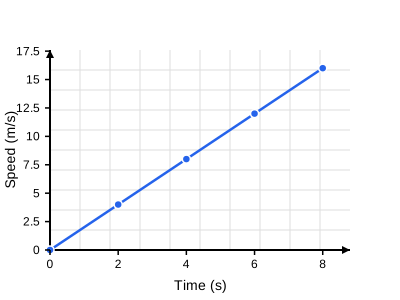
Detailed Explanation
Break the motion into three phases and add the distances; the accelerating and decelerating phases cover only half of (max speed x time) because the speed is changing, so each is a triangle on a speed-time graph while the middle phase is a rectangle.
A current-carrying wire is placed in a uniform magnetic field. State the three factors that determine the magnitude of the force on the wire.
Detailed Explanation
Force on a Current-Carrying Wire in a Magnetic Field
Why the correct answer is right: The magnetic force on a wire follows the equation: F = BIL
- B = magnetic field strength (Tesla)
- I = current in the wire (Amperes)
- L = length of wire in the field (meters)
These three factors directly multiply together to give the force magnitude.
Key concept: When electric current flows through a wire in a magnetic field, the moving charges experience a force that transfers to the wire itself.
Helpful tips:
- Remember "BIL" as your formula
- All three factors must be present - no current means no force, no magnetic field means no force, no wire length means no force
- The force is maximized when the wire is perpendicular to the magnetic field
- This principle is used in electric motors and loudspeakers
Note: The angle between wire and field affects force direction but these three factors determine the magnitude.
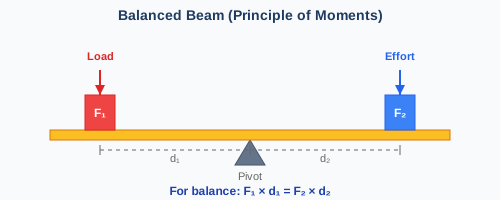
A uniform beam of length 4.0 m is balanced on a pivot at its center. A 60 N force acts downward at a distance of 1.5 m from the pivot. The diagram shows the setup. What does the calculation show for the balancing force F needed at the opposite end of the beam?
Detailed Explanation
Why 45 N is correct: For a balanced beam the clockwise and anticlockwise moments about the pivot must be equal (the principle of moments: force × perpendicular distance). The 60 N force acts 1.5 m from the pivot, giving a moment of 60 × 1.5 = 90 N·m. The balancing force F acts at the far end, which is half of the 4.0 m beam = 2.0 m from the pivot, so F × 2.0 = 90, giving F = 45 N.
Common mistakes: Answering 60 N comes from assuming the two forces must be equal and forgetting that they act at different distances. Getting 80 N comes from inverting the distance ratio (multiplying 60 by 2.0/1.5 instead of balancing the moments). Getting 180 N comes from using the full 4.0 m length, or multiplying the 90 N·m moment by 2.0 m instead of dividing by it.
A rectangular coil of 3 turns is connected in series with a 2.0Ω resistor to a 12V supply of negligible internal resistance. The coil wire itself has a total resistance of 4.0Ω. One side of the coil, of length 0.25m, lies at right angles to a uniform magnetic field of flux density 0.40T. What is the total magnetic force acting on that side of the coil?
Detailed Explanation
First use the series resistance (4.0 + 2.0 = 6.0 ohm) and Ohm's law to find I = 2.0 A, then apply F = BIL for one wire and multiply by the 3 turns to get 0.60 N. Skipping the series resistor or the number of turns each lands you on a wrong but plausible value.
A student uses iron filings to investigate the magnetic field around a bar magnet. Which diagram should the student plot to show the correct field pattern?
Detailed Explanation
Why D is Correct: Magnetic field lines always flow from the north pole to the south pole in smooth, curved paths. The lines are denser (closer together) near the poles because the magnetic field is strongest there. Iron filings naturally align with these invisible field lines, revealing this characteristic pattern.
Why Other Options are Wrong:
- Straight lines: Magnetic fields curve around the magnet, never forming straight lines except directly along the magnet's axis
- Lines going from south to north: This violates the fundamental rule of magnetic field direction
- Evenly spaced lines: Field strength varies, so lines must be closer at poles where the field is strongest
Helpful Tips:
- Remember: "North to South" for field direction
- Closer lines = stronger field (like near the poles)
- Iron filings act like tiny compass needles, showing field direction
- The pattern looks similar to how hair stands up around a charged balloon
A d.c. motor has its magnetic field direction reversed and its current direction reversed. What happens to the direction of rotation?
Detailed Explanation
Why C is Correct ✓
The direction of rotation remains the same because the motor's torque depends on the interaction between TWO factors:
- Magnetic field direction
- Current direction (which determines armature magnetic field)
When you reverse BOTH factors simultaneously, they cancel each other out. It's like multiplying two negative numbers - you get a positive result!
Why Other Options Are Wrong ❌
- "Rotation reverses": This only happens when you change ONE factor, not both
- "Motor stops": The motor still has torque and will continue running
- "Speed changes": Direction changes don't affect the magnitude of torque
Helpful Memory Tip 💡
Remember the "Double Negative Rule":
- Reverse one thing = rotation reverses
- Reverse two things = rotation stays the same
Think of it like steering a car - if you reverse both the steering wheel AND flip the front/back of the car, you'll still turn the same way relative to your destination!
A 6Ω resistor and a 12Ω resistor are connected in parallel, and this combination is connected in series with a 2Ω resistor across a battery of e.m.f. 18V with no internal resistance. What is the power dissipated in the 6Ω resistor?
Detailed Explanation
You must first reduce the network (parallel then series) to get the total current, then split the current back into the 6 ohm branch before using P = I^2 R. The full battery voltage is not across the 6 ohm resistor because the 2 ohm series resistor takes a share.
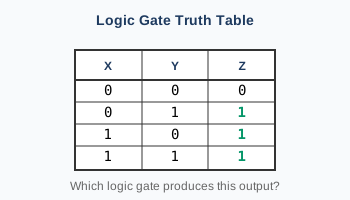
A logic circuit has three inputs X, Y and W and one output Z. It is built from three gates connected in stages: first an AND gate combines X and Y to give signal P; then an OR gate combines X and W to give signal Q; finally a NAND gate combines P and Q to give the output Z. For how many of the 8 possible input combinations of X, Y and W is the output Z equal to 1?
Detailed Explanation
Work column by column: P = X AND Y is 1 in only the two rows where X and Y are both 1, and in both of those Q is also 1, so the final NAND outputs 0 there and outputs 1 everywhere else, giving 6 ones.
A spring obeys Hooke's law. On its own, it has a natural length of 10 cm and stretches to a length of 13 cm when a load of 6 N hangs from its lower end. Two of these identical springs are then joined end to end (in series) to form a single longer spring, and a load of 8 N is hung from the bottom of the combination. What is the total extension of the two-spring combination?
Detailed Explanation
Each spring's stiffness is k = 2 N/cm, and because springs in series both feel the full 8 N load, each stretches 4 cm, so the two together stretch 8 cm in total.
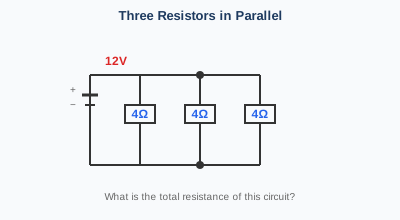
A circuit diagram shows a 12V battery connected to three 4Ω resistors in parallel. What does this show about total resistance?
Detailed Explanation
For identical resistors in parallel, divide one resistance by the number of resistors: 4Ω ÷ 3 = 1.33Ω. The total is always smaller than any single resistor.
An unknown logic gate has two inputs and one output. The gate symbol has a flat input side and a curved, D-shaped output side. What type of gate is this?
Detailed Explanation
The AND gate symbol is a D-shape: a flat straight back for the two inputs and a smooth curved front for the output. Because there is no bubble (NAND) and there are two inputs (not NOT), it must be an AND gate.
Three identical resistors are connected to identical batteries. Circuit X has one resistor, Circuit Y has two resistors in series, and Circuit Z has two resistors in parallel. The diagrams show the current in each circuit. Which diagram correctly shows the relative magnitudes of current?
Detailed Explanation
Why this is correct: With identical batteries (same voltage V) and identical resistors (each R), use I = V/R for each circuit. Two resistors in series double the total resistance to 2R, giving the smallest current (V/2R); the single resistor has resistance R, giving a medium current (V/R); two resistors in parallel halve the total resistance to R/2, giving the largest current (2V/R). So the ranking is series smallest, single in the middle, parallel largest — the choice with the single resistor at medium, the series pair smallest, and the parallel pair largest.
Common mistakes: Many students mix up series and parallel and claim the series circuit has the largest current — but adding a resistor in series adds resistance and reduces current. Others forget that parallel resistors give less total resistance (R/2), and therefore more current, not less. Remember: more paths for the current means lower resistance and higher current.
An electric heater is marked "120V,720W". It is connected to a 120V supply through a long cable whose total resistance is 4Ω. The heater itself behaves as a fixed resistor. How much energy does the heater transfer in 100s?
Detailed Explanation
The cable's resistance drops the current below the rated value, so the heater runs at 500 W, not its marked 720 W; over 100 s it transfers 50 kJ. You must find the heater's resistance, the series current, then its actual power before working out the energy.
State what happens to the average distance between particles when a liquid is heated at constant volume.
Detailed Explanation
Why the correct answer is right:
When a liquid is heated at constant volume, the container size stays fixed. Since liquids have particles that are already close together and relatively incompressible, the average distance between particles remains approximately the same. The added heat energy increases particle movement (kinetic energy) but doesn't significantly change spacing.
Why other answers are wrong:
- "Distance increases" would be correct if volume could expand, but we're told volume is constant
- "Distance decreases" would require compression, which isn't happening here
Helpful tips:
- Key phrase: "constant volume" = container size is fixed
- Remember: liquids are nearly incompressible (particles already tightly packed)
- Heat at constant volume → more particle vibration, not more spacing
- Think of heating soup in a sealed, rigid container - particles move faster but stay roughly the same distance apart
The constraint of constant volume is crucial to this answer!
A sound wave travels through three unknown media: air, water, and steel. In which medium does sound travel fastest?
Detailed Explanation
Why Steel is Correct: Sound travels fastest through steel because it's the densest, most rigid material. Sound waves move by transferring energy between particles - the closer and more tightly bound the particles are, the faster energy transfers. Steel's molecules are packed extremely tight with strong bonds, creating an efficient "highway" for sound waves.
Why Others are Wrong:
- Air: Gas particles are spread far apart with weak connections, making sound transfer slow (~343 m/s)
- Water: Liquid particles are closer than air but still less organized than solids (~1500 m/s)
- Steel: Solid particles are tightly packed and organized (~5000+ m/s)
Helpful Tips:
- Remember: Solids > Liquids > Gases for sound speed
- Think of it like a chain reaction - tighter connections = faster reactions
- Exception: Temperature affects speed too (warmer = faster in same medium)
Equal masses of different substances are heated with the same energy. What determines which substance has the smallest temperature rise?
Detailed Explanation
Why D is Correct: Specific heat capacity tells us how much energy is needed to raise 1 gram of a substance by 1°C. When equal masses receive equal energy, the substance with the highest specific heat capacity will have the smallest temperature rise because it "absorbs" more energy per degree of temperature change.
Think of it like a sponge - substances with high specific heat capacity are like big sponges that soak up lots of energy without getting much hotter.
Why Others Are Wrong:
- Lowest specific heat capacity → largest temperature rise (not smallest)
- Density and molecular structure don't directly determine temperature change from heating
Helpful Tips:
- Remember: Q = mcΔT (energy = mass × specific heat × temperature change)
- Water has high specific heat capacity - that's why oceans moderate Earth's temperature
- Metals typically have low specific heat capacity - they heat up quickly
Describe how to use a measuring cylinder to find the volume of an irregularly shaped solid object that sinks in water.
Detailed Explanation
Why this is correct: This is the displacement method. Note the water level before adding the object, fully submerge the object, then read the new (higher) level. The rise in level — found by subtracting the initial reading from the final reading — equals the volume of water pushed aside, which is exactly the volume of the solid.
Common mistakes: Adding the two readings instead of subtracting them gives a number about twice too big and has no physical meaning. Trying to catch the overflowing water needs a displacement (eureka) can, not an ordinary measuring cylinder filled to the brim. Measuring the dimensions with a ruler and multiplying only works for regular shapes like cubes, so it fails for an irregular object.
A metal rod is heated at one end. State what happens to the particles in the metal as thermal energy is conducted along the rod.
Detailed Explanation
Heat Conduction in Metals 🔥
Why D is correct: When a metal rod is heated, thermal energy makes particles vibrate faster and with greater amplitude. However, in solids, particles are held in fixed positions by strong bonds - they can't move freely like in liquids or gases. The vigorous vibrations transfer energy to neighboring particles, conducting heat along the rod.
Why other answers are wrong:
- If particles moved freely, the metal would melt/become liquid
- If particles stopped vibrating, the rod would cool down instead
- If particles broke bonds completely, the metal structure would collapse
Helpful tips:
- Remember: Solids = fixed positions, vibrating particles
- Think of particles as balls connected by springs - they shake but stay in place
- Heat = increased particle movement (vibration)
- Metals conduct heat well because their particles are closely packed and transfer vibrations efficiently
Key concept: Thermal conduction = energy transfer through vibrations, not particle movement!
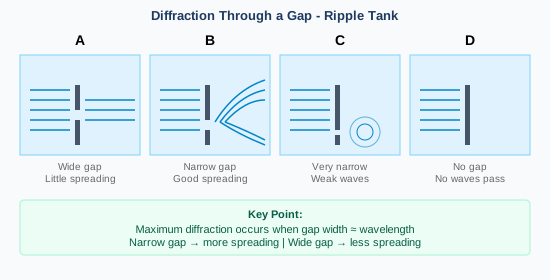
Water waves pass through a narrow gap in a barrier. The gap width is similar to the wavelength of the waves. Name what happens to the wavelength of the waves after passing through the gap.
Detailed Explanation
When waves diffract through a gap they spread out, but their speed and frequency do not change, so the wavelength stays exactly the same. Only the pattern of the wave spreads, not the wavelength itself.
A cork floating on water is made to bob up and down by a passing wave. The cork completes 12 full oscillations in 48 s. The distance between two adjacent wave crests on the water is 8 m. How long does this wave take to travel a distance of 80 m across the pond?
Detailed Explanation
The bobbing gives the period (4 s), so the frequency is 0.25 Hz; the crest spacing is the wavelength (8 m), so v = f x lambda = 2 m/s, and travelling 80 m at 2 m/s takes 40 s.
A wave has frequency 50 Hz and wavelength 6.8 m. Which equation should be used to calculate the wave speed?
Detailed Explanation
Why A is Correct: v = fλ is the fundamental wave equation where:
- v = wave speed (what we're finding)
- f = frequency (50 Hz - given)
- λ = wavelength (6.8 m - given)
This equation directly relates the three key wave properties and is perfect when you have frequency and wavelength.
Why Other Options Are Wrong:
- v = f/λ - This would give units of Hz/m = s⁻²m⁻¹, which isn't speed
- v = λ/f - This gives units of m/Hz = m·s, also not speed (m/s)
- v = f + λ - Adding different units (Hz + m) is meaningless
Helpful Tips:
- Remember: Wave speed = frequency × wavelength
- Check units: (Hz)(m) = (s⁻¹)(m) = m/s ✓
- Think logically: Higher frequency OR longer wavelength = faster wave
- This equation works for ALL types of waves (sound, light, water, etc.)
A rectangular coil of 2 turns lies between the poles of a magnet so that each turn has one long side of length 0.20 m in a uniform magnetic field of 0.50 T, perpendicular to the field. The coil is connected to a supply that delivers 18 W of electrical power at 6.0 V. The magnetic force on the coil acts vertically and can just lift a small mass. Taking g=10 N/kg, what is the largest mass the coil can lift?
Detailed Explanation
Get the current from P = VI, then use the in-field length 0.40 m (2 turns x 0.20 m) in F = BIL to get 0.60 N, and finally divide by g to convert that lifting force into a mass of 60 g.
A buzzer on a survey boat acts as a fixed-frequency sound source. To find the speed of sound in air, an operator sounds it once toward a cliff 680m away and hears a single echo 4.0s later. In air the buzzer's sound has a wavelength of 0.40m. The boat then lowers the buzzer into the sea, where the speed of sound is 1360m/s. What is the wavelength of the buzzer's sound in the water?
Detailed Explanation
Double the cliff distance to get v_air = 340 m/s, use v = flambda to get the source frequency 850 Hz, then apply v = flambda in water (same frequency, faster speed) to get 1360/850 = 1.6 m.
What is the unit of gravitational field strength?
Detailed Explanation
Gravitational Field Strength Unit: N/kg
Why N/kg is correct: Gravitational field strength measures the gravitational force per unit mass at a point. Since:
- Force is measured in Newtons (N)
- Mass is measured in kilograms (kg)
- Field strength = Force ÷ Mass
The unit is N/kg (Newtons per kilogram).
Why other options are wrong:
- N·kg: This would be force × mass, not force ÷ mass
- kg/N: This is the inverse relationship (mass per force)
- m/s²: While gravitational field strength numerically equals acceleration due to gravity, the question asks for field strength units specifically
Helpful tip: Remember that "per" means division! Gravitational field strength tells you how many Newtons of force act on each kilogram of mass. On Earth, g = 9.8 N/kg, meaning every kilogram experiences 9.8 N of gravitational force.
A student observes a wave pattern on an oscilloscope screen. Describe what the student must check to determine if the wave is regular.
Detailed Explanation
Why C is Correct: To determine if a wave is regular, you need to verify it has consistent periodicity. This means measuring the distance between identical points on consecutive waves (like peak to peak or trough to trough) across the entire screen. If these spacings are identical, the wave has a constant period and is therefore regular.
Why Other Options Are Wrong:
- Checking only amplitude (wave height) isn't enough - waves can have consistent amplitude but irregular timing
- Looking at just one cycle doesn't show the pattern's consistency
- Measuring frequency at one point doesn't reveal variations across time
Helpful Tips:
- Use the oscilloscope's grid lines to measure distances accurately
- Pick the same reference point on each wave (like peaks)
- Check at least 3-4 consecutive cycles
- A regular wave will have evenly spaced, repeating patterns
Remember: Regularity = consistent spacing between cycles!
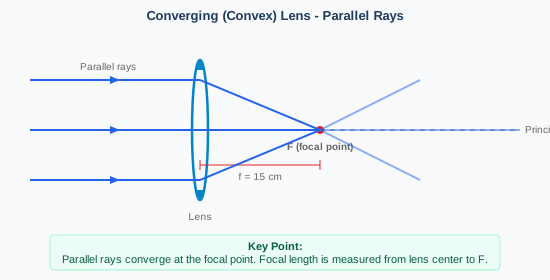
A ray diagram shows parallel rays of light passing through a converging lens and meeting at a point 15 cm from the lens center. The diagram shows the focal length as 15 cm. What does this show about the focal length measurement?
Detailed Explanation
Why D is Correct: When parallel rays of light pass through a converging lens, they meet at the focal point. The distance from the lens center to this focal point is the focal length. Since the rays meet 15 cm from the lens center, and the diagram shows focal length = 15 cm, this confirms the measurement is accurate.
Why Other Options Are Wrong:
- Any answer suggesting the measurement is incorrect ignores the fundamental definition of focal length
- The focal point location directly determines focal length - there's no error here
Helpful Tips:
- Remember: Focal length = distance from lens center to focal point
- Key rule: Parallel rays always converge at the focal point in converging lenses
- Visual check: If parallel rays meet at the marked focal point, your focal length is correct
- This is how focal length is actually measured in practice!
Bottom line: The diagram shows a perfectly correct focal length measurement.
A source of sound waves moves towards a stationary observer. What happens to the wavelength of the sound waves detected by the observer?
Detailed Explanation
Why C is Correct: When a sound source moves toward you, the waves get "bunched up" or compressed. The source is essentially chasing its own waves, making them closer together. This creates shorter wavelengths that reach your ears.
Why Other Options Are Wrong:
- "Wavelength increases" - This would happen if the source moved AWAY from you
- "Wavelength stays the same" - This ignores the relative motion between source and observer
- "No sound is detected" - Motion doesn't eliminate sound, just changes its properties
Helpful Tips:
- Memory trick: Moving toward = waves compressed = shorter wavelength
- Think of a siren approaching: the pitch sounds higher because shorter wavelengths = higher frequency
- This is the Doppler Effect - crucial for understanding radar, astronomy, and medical ultrasounds
- Remember: toward = compressed/shorter, away = stretched/longer
An open rectangular tank has a horizontal base measuring 0.5 m by 0.4 m. The empty tank has a mass of 6 kg. It is filled with oil of density 800 kg/m3 to a depth of 0.5 m, then stood on a level floor. Taking g=10 N/kg, what pressure does the filled tank exert on the floor?
Detailed Explanation
Build the force in stages: get the oil's volume, turn it into mass with density, add the tank's mass, convert the whole thing to a weight with g, then divide that weight by the base area to get the pressure (4300 Pa). Skipping the tank's mass, using water's density, or mis-reading a dimension each lands you on a wrong but tempting answer.
A radioactive nuclide 90232X undergoes a decay chain of four emissions in this order: alpha, alpha, beta-minus, alpha. How many neutrons are in the nucleus of the final stable daughter nuclide?
Detailed Explanation
Track A and Z separately through the chain: alpha emission gives A-4, Z-2 while beta-minus gives A unchanged, Z+1; then neutrons = final A minus final Z = 220 - 85 = 135.
Describe what happens when a liquid changes to a gas at its boiling point.
Detailed Explanation
What Happens When Liquid Boils:
Why B is Correct: At the boiling point, liquid molecules have enough energy to escape as gas throughout the entire liquid, not just at the surface. This creates bubbles of vapor that rise to the surface, causing the rapid, vigorous bubbling we see when water boils.
Why Other Answers Are Wrong:
- If it said "only at the surface" → That's regular evaporation, not boiling
- If it said "molecules slow down" → Wrong! They actually speed up and gain energy
- If it said "temperature keeps rising" → Wrong! Temperature stays constant during boiling
Helpful Tips:
- Evaporation = slow, surface-only (like puddles drying)
- Boiling = fast, throughout entire liquid (bubbles everywhere)
- At boiling point, added heat goes into changing state, not raising temperature
- Think: bubbles = boiling, no bubbles = just evaporation
A hiker walks 300 m due east in 100 s, then immediately walks 400 m due north in a further 100 s. By how much does the magnitude of her average speed exceed the magnitude of her average velocity for the whole journey?
Detailed Explanation
Average speed uses total path length (700 m) while average velocity uses the straight-line displacement (500 m from Pythagoras); dividing each by the 200 s total gives 3.5 m/s and 2.5 m/s, a difference of 1.0 m/s.
State the location of electrons in an atom and their charge.
Detailed Explanation
Where Are Electrons and What's Their Charge?
Correct Answer: Outside the nucleus, negative charge
Why This is Right:
Electrons orbit around the nucleus in electron shells/energy levels, similar to planets orbiting the sun. They carry a negative electrical charge (-1).
Why Other Options Are Wrong:
- Inside the nucleus: Only protons (+) and neutrons (neutral) are in the nucleus
- Positive charge: Electrons are always negative; protons are positive
- No charge: Electrons definitely have charge (negative)
Memory Tips:
- "Electrons are External" - they're outside the nucleus
- "Negative Nancy" - electrons are negative (opposite of protons)
- Think of the atom like a solar system: nucleus = sun (center), electrons = planets (orbiting outside)
- Remember: Protons are Positive, Electrons are nEgative (opposite letters in alphabet!)
The negative electrons are attracted to the positive protons, keeping them in orbit around the nucleus.
An electric water heater operates from a 200 V supply and draws a current of 5 A. Only 80% of the electrical energy it takes from the supply is transferred usefully to the water as thermal energy. For how long must the heater operate to deliver 20000 J of useful thermal energy to the water?
Detailed Explanation
Work out the input power with P = VI, scale it down by the 80% efficiency to get the useful (heating) power, then use t = E/P with the useful energy and useful power to get 25 s.
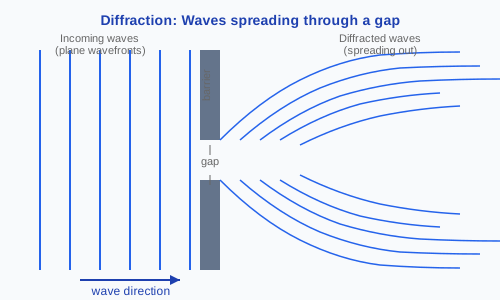
A sonar transmitter sends a sound pulse of frequency 50kHz through water, where the speed of sound is 1500m/s. The pulse then passes into a steel ship's hull, where the speed of sound is 6000m/s. What is the frequency and wavelength of the pulse inside the steel?
Detailed Explanation
When a wave crosses into a new medium its frequency stays the same, but because the speed increases the wavelength increases too (lambda = v/f).
A toy crane uses a simple d.c. motor with a coil spinning between the poles of a permanent magnet. The motor is too weak to lift a load, so an engineer lists four separate changes, each made on its own while everything else stays the same: (1) wind more turns of wire onto the coil, (2) swap the magnet for a stronger one, (3) connect a higher-voltage battery so a larger current flows, (4) make the connecting wires longer. Which set of changes would, by itself, increase the turning effect of the motor?
Detailed Explanation
The force on the motor coil increases when the magnetic field is stronger, the current is larger, or there are more turns of wire. Lengthening the connecting wires does none of these, so only changes 1, 2 and 3 help.
A stone of mass 4.0kg is dropped from rest and falls for 2.0s before hitting the ground. During the fall, air resistance removes 20% of the kinetic energy the stone would otherwise have had. On impact the stone embeds itself 0.40m into the ground before stopping. Assuming the ground exerts a constant average resisting force, calculate that force. (Take g=10m/s2 and ignore the stone's weight during the embedding.)
Detailed Explanation
Chain kinematics to get the impact speed, then kinetic energy, then keep only the 80% that survives air resistance, and finally use work = force x distance to get the ground's average resisting force: 1600 N.
A liquid-in-glass thermometer works by thermal expansion. Which property of the liquid is most important for the thermometer to give accurate temperature readings?
Detailed Explanation
Why A is Correct: For accurate temperature readings, the liquid must expand uniformly (linearly) with temperature changes. This means equal temperature increases produce equal volume increases. When expansion is uniform, you can mark the thermometer scale evenly, and each degree change moves the liquid the same distance up the tube.
Why Other Options are Wrong:
- If expansion isn't uniform, the scale markings would be uneven and readings inaccurate
- Properties like color or density don't affect measurement accuracy
- Very rapid expansion might make readings hard to see, but uniformity is more critical
Helpful Tips:
- Think "uniform = accurate scale"
- Mercury and alcohol work well because they expand predictably
- Imagine if the liquid expanded a lot for the first 10°C but barely moved for the next 10°C - your thermometer would be useless!
- Linear expansion allows consistent, reliable measurements
An open-topped tank has a square base of side 0.20 m. It is filled to a depth of 1.5 m with oil of density 800 kg/m3. Atmospheric pressure acting on the oil surface is 100000 Pa and g=10 N/kg. What is the total downward force exerted on the inside of the base of the tank?
Detailed Explanation
The base feels both the air pressing on the oil's surface and the oil's own weight, so add atmospheric pressure to ρgh before multiplying by the base area (remember to square the side length).
A bar magnet is moved at constant speed towards a stationary coil, then held stationary inside the coil for several seconds. What happens to the induced voltage in the coil?
Detailed Explanation
Why D is Correct: Induced voltage depends on changing magnetic flux, not just the presence of a magnetic field. When the magnet moves toward the coil, the magnetic field strength through the coil increases, creating a changing flux that induces maximum voltage. When stationary inside the coil, even though the magnetic field is strongest, it's not changing - so induced voltage drops to zero.
Why Other Options Are Wrong:
- "Zero while moving" ignores that moving magnets create changing flux
- "Maximum while stationary" confuses field strength with changing flux
- "Constant throughout" misses that only flux changes matter
Helpful Tips:
- Remember Faraday's Law: Induced voltage = rate of change of magnetic flux
- Key word: "changing" - no change = no induced voltage
- Think of it like speed vs. acceleration - a fast car (strong field) at constant velocity (stationary magnet) has zero acceleration (no induced voltage)
Why Topic Practice Quiz?
- Fresh questions: Not from past papers, so you can save those for full exam practice
- Syllabus-aligned: Every question targets specific Cambridge IGCSE topics
- Full explanations: Learn from detailed solutions showing why each answer is correct or wrong
- Topic filtering: Focus on specific areas you need to improve