The Cambridge IGCSE Physics syllabus (0625) contains 326 learning objectives across 6 topics: Motion & Forces, Thermal Physics, Waves, Electricity & Magnetism, Nuclear Physics, and Space Physics.
These questions target specific objectives like "calculate acceleration using a = (v-u)/t", "describe the structure of an atom", and "explain how transformers work". Core tier covers 197 objectives; Extended adds 129 more advanced topics.
View Full Physics Syllabus GuideChoose Your Quiz
A heater has a power of 2000 W and operates for 3 hours. The unknown energy transferred is:
Detailed Explanation
Why A is Correct: Energy = Power × Time
- Power = 2000 W
- Time = 3 hours = 3 × 3600 = 10,800 seconds
- Energy = 2000 W × 10,800 s = 21,600,000 J ✓
Why Others Are Wrong:
- Forgot time conversion: Used 3 hours directly instead of converting to seconds
- Wrong formula: Mixed up power and energy equations
- Unit errors: Didn't match units properly (Watts need seconds, not hours)
Helpful Tips:
- Always convert time to seconds when working with Watts (W = J/s)
- Remember the formula: Energy (J) = Power (W) × Time (s)
- Check units: Watts × seconds = Joules
- Time conversion: 1 hour = 3600 seconds
- Double-check: Large numbers are normal for energy in Joules
The key mistake students make is forgetting to convert hours to seconds!
A car accelerates from rest to 20 m/s in 10 s. Which is the acceleration?
Detailed Explanation
Why A is Correct: Acceleration = (final velocity - initial velocity) ÷ time
Given information:
- Initial velocity = 0 m/s (starts from rest)
- Final velocity = 20 m/s
- Time = 10 s
Calculation: a = (20 - 0) ÷ 10 = 2.0 m/s²
Why Other Answers Are Wrong: Without seeing the other options, common mistakes include:
- Using only final velocity ÷ time (forgetting the formula)
- Mixing up velocity and acceleration units
- Incorrectly substituting values
Helpful Tips:
- Remember the formula: a = (v_final - v_initial) ÷ t
- "From rest" always means initial velocity = 0
- Check units: Acceleration is always m/s², not m/s
- Double-check your math: Substitute values carefully
The key is recognizing that acceleration measures how much velocity changes per second, not the final velocity itself.
A current-carrying wire is placed in a uniform magnetic field. State the three factors that determine the magnitude of the force on the wire.
Detailed Explanation
Force on a Current-Carrying Wire in a Magnetic Field
Why the correct answer is right: The magnetic force on a wire follows the equation: F = BIL
- B = magnetic field strength (Tesla)
- I = current in the wire (Amperes)
- L = length of wire in the field (meters)
These three factors directly multiply together to give the force magnitude.
Key concept: When electric current flows through a wire in a magnetic field, the moving charges experience a force that transfers to the wire itself.
Helpful tips:
- Remember "BIL" as your formula
- All three factors must be present - no current means no force, no magnetic field means no force, no wire length means no force
- The force is maximized when the wire is perpendicular to the magnetic field
- This principle is used in electric motors and loudspeakers
Note: The angle between wire and field affects force direction but these three factors determine the magnitude.
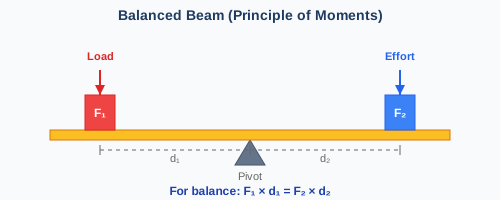
A uniform beam of length 4.0 m is balanced on a pivot at its center. A 60 N force acts downward at a distance of 1.5 m from the pivot. The diagram shows the setup. What does the calculation show for the balancing force F needed at the opposite end of the beam?
Detailed Explanation
Why A (45 N) is Correct:
This is a torque balance problem. For equilibrium, clockwise torque must equal counterclockwise torque.
The Calculation:
- Torque = Force × Distance from pivot
- Clockwise torque: 60 N × 1.5 m = 90 N⋅m
- For balance: F × 2.0 m = 90 N⋅m
- Therefore: F = 90 ÷ 2.0 = 45 N
Why Other Answers Are Wrong:
- 30 N: Used wrong distance (likely 1.5 m instead of 2.0 m)
- 60 N: Incorrectly assumed forces must be equal (ignores different distances)
- 90 N: Confused torque value with force value
Helpful Tips:
- Always identify the pivot point first
- Measure distances from the pivot, not beam ends
- Remember: Force closer to pivot needs MORE force to balance
- Set up equation: Torque₁ = Torque₂
The balancing force is less than 60 N because it acts farther from the pivot!
A wire carries a current of 2.0 A in a magnetic field of strength 0.50 T. The length of wire in the field is 0.30 m. Which is the maximum force on the wire?
Detailed Explanation
Why A (0.30 N) is correct:
The magnetic force on a current-carrying wire is calculated using: F = BIL sin θ
Where:
- B = magnetic field strength (0.50 T)
- I = current (2.0 A)
- L = length of wire (0.30 m)
- θ = angle between current and magnetic field
For maximum force, sin θ = 1 (when θ = 90°)
F = 0.50 × 2.0 × 0.30 × 1 = 0.30 N
Why other answers are wrong:
- They likely used incorrect formulas or forgot the sin θ factor
- Some may have calculated force at different angles (sin θ < 1)
Helpful tips:
- Maximum force occurs when wire is perpendicular to magnetic field
- Remember the formula: F = BIL (when perpendicular)
- Units check: Tesla × Ampere × meter = Newton
- Always identify what the question asks for (maximum vs. actual force)
A student uses iron filings to investigate the magnetic field around a bar magnet. Which diagram should the student plot to show the correct field pattern?
Detailed Explanation
Why A is Correct: Magnetic field lines always flow from the north pole to the south pole in smooth, curved paths. The lines are denser (closer together) near the poles because the magnetic field is strongest there. Iron filings naturally align with these invisible field lines, revealing this characteristic pattern.
Why Other Options are Wrong:
- Straight lines: Magnetic fields curve around the magnet, never forming straight lines except directly along the magnet's axis
- Lines going from south to north: This violates the fundamental rule of magnetic field direction
- Evenly spaced lines: Field strength varies, so lines must be closer at poles where the field is strongest
Helpful Tips:
- Remember: "North to South" for field direction
- Closer lines = stronger field (like near the poles)
- Iron filings act like tiny compass needles, showing field direction
- The pattern looks similar to how hair stands up around a charged balloon
A d.c. motor has its magnetic field direction reversed and its current direction reversed. What happens to the direction of rotation?
Detailed Explanation
Why A is Correct ✓
The direction of rotation remains the same because the motor's torque depends on the interaction between TWO factors:
- Magnetic field direction
- Current direction (which determines armature magnetic field)
When you reverse BOTH factors simultaneously, they cancel each other out. It's like multiplying two negative numbers - you get a positive result!
Why Other Options Are Wrong ❌
- "Rotation reverses": This only happens when you change ONE factor, not both
- "Motor stops": The motor still has torque and will continue running
- "Speed changes": Direction changes don't affect the magnitude of torque
Helpful Memory Tip 💡
Remember the "Double Negative Rule":
- Reverse one thing = rotation reverses
- Reverse two things = rotation stays the same
Think of it like steering a car - if you reverse both the steering wheel AND flip the front/back of the car, you'll still turn the same way relative to your destination!
Two resistors of 6Ω and 12Ω are connected in parallel. Which value shows the equivalent resistance?
Detailed Explanation
Parallel Resistors Explanation
Why A (4Ω) is correct: When resistors are in parallel, use the formula: 1/R_total = 1/R₁ + 1/R₂
1/R_total = 1/6 + 1/12 = 2/12 + 1/12 = 3/12 = 1/4
Therefore: R_total = 4Ω
Why other answers are wrong:
- Adding resistors directly (6 + 12 = 18Ω) is the series formula, not parallel
- Any answer greater than 6Ω violates the parallel rule
- Parallel resistance is always smaller than the smallest individual resistor
Helpful Tips: ✓ Parallel resistance is always less than the smallest resistor ✓ For two resistors: R_total = (R₁ × R₂)/(R₁ + R₂) ✓ Quick check: (6 × 12)/(6 + 12) = 72/18 = 4Ω ✓ Remember: Series = ADD, Parallel = "reciprocal formula"
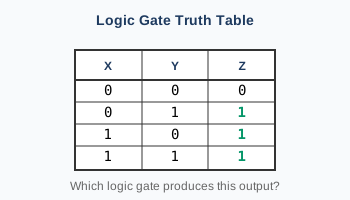
A logic circuit has two inputs X and Y. The truth table shows output Z is 1 when either input is 1. Which gate does this show?
Detailed Explanation
Logic Gate Identification: OR Gate
Why OR Gate is Correct: The description "output Z is 1 when either input is 1" perfectly matches an OR gate's behavior. An OR gate outputs 1 (HIGH) when at least one input is 1. It only outputs 0 when both inputs are 0.
Truth Table for OR Gate:
- X=0, Y=0 → Z=0
- X=0, Y=1 → Z=1
- X=1, Y=0 → Z=1
- X=1, Y=1 → Z=1
Why Other Gates are Wrong:
- AND gate: Only outputs 1 when both inputs are 1
- NOT gate: Has only one input and inverts it
- NAND/NOR gates: Output opposite of AND/OR respectively
Memory Tip: Think "OR" = "One Required" - only one input needs to be 1 for output to be 1!
A spring has a natural length of 10 cm. When a 2 N force is applied, the spring extends to 12 cm. What happens to the extension when the applied force increases to 4 N?
Detailed Explanation
Why A is Correct: The spring follows Hooke's Law: F = kx (force = spring constant × extension)
First, find the spring constant:
- Natural length: 10 cm
- With 2 N force: length = 12 cm, so extension = 2 cm
- k = F/x = 2 N ÷ 2 cm = 1 N/cm
When force increases to 4 N:
- Extension = F/k = 4 N ÷ 1 N/cm = 4 cm
Why Other Answers Are Wrong:
- If you confused extension with total length (10 + 4 = 14 cm)
- If you didn't calculate the spring constant properly
- If you assumed a non-linear relationship
Helpful Tips:
- Extension = stretched length - natural length
- Springs obey Hooke's Law (linear relationship)
- Double the force = double the extension
- Always find k first using the given data
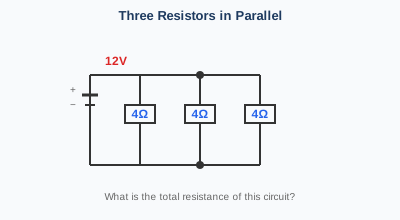
A circuit diagram shows a 12V battery connected to three 4Ω resistors in parallel. What does this show about total resistance?
Detailed Explanation
Why A is Correct: When resistors are connected in parallel, the total resistance is ALWAYS less than the smallest individual resistor. With three 4Ω resistors in parallel:
Using the parallel resistance formula: 1/Rtotal = 1/R₁ + 1/R₂ + 1/R₃ 1/Rtotal = 1/4 + 1/4 + 1/4 = 3/4 Rtotal = 4/3 = 1.33Ω
Why Other Answers Are Wrong:
- If total resistance equals 4Ω or higher, that would indicate series connection (resistors add up)
- Any answer greater than 4Ω violates the parallel resistance rule
Helpful Tips: ✓ Parallel = Path splitting - Current has multiple routes, making flow easier (lower resistance) ✓ Quick check: Total resistance in parallel is always smaller than the smallest resistor ✓ Memory trick: Parallel resistors are like adding more lanes to a highway - more paths = less traffic resistance
An unknown logic gate has two inputs and one output. The gate symbol has a flat input side and a curved, D-shaped output side. What type of gate is this?
Detailed Explanation
Why A (OR gate) is correct: The description perfectly matches an OR gate symbol - it has a flat input side where the two input lines connect, and a distinctive curved, D-shaped output side. This curved shape is the OR gate's signature feature that distinguishes it from other logic gates.
Why other options are wrong:
- AND gate: Has a flat input side BUT a rounded/semicircular output (not D-shaped)
- NOT gate: Only has ONE input, not two
- NAND gate: Same shape as AND gate but with a bubble at output
- XOR gate: Has curved input lines, not a flat input side
Helpful Tips:
- Remember the OR gate looks like a "D" lying on its side
- The flat side = inputs go in
- The curved side = output comes out
- OR gates output TRUE when ANY input is TRUE
- Think "D for OR" as a memory trick!
Three identical resistors are connected to identical batteries. Circuit X has one resistor, Circuit Y has two resistors in series, and Circuit Z has two resistors in parallel. The diagrams show the current in each circuit. Which diagram correctly shows the relative magnitudes of current?
Detailed Explanation
Why Answer A is Correct:
Think of current like water flow through pipes. Battery voltage stays the same, but resistance changes how much current flows.
- Circuit X (1 resistor): Medium current - standard flow
- Circuit Y (2 resistors in series): Smallest current - resistances ADD up, creating more total resistance, so less current flows
- Circuit Z (2 resistors in parallel): Largest current - creates multiple paths, REDUCING total resistance, so more current flows
Why Others Are Wrong: They don't follow Ohm's Law (V = IR). When resistance increases (series), current must decrease. When resistance decreases (parallel), current increases.
Helpful Tips:
- Series = Single path → resistances add → less current
- Parallel = Multiple paths → easier flow → more current
- Remember: Series = Smaller current, Parallel = Plenty of current
A 12V battery supplies 2A current to a circuit containing a 4Ω resistor. Which value represents the power dissipated by the resistor?
Detailed Explanation
Why A (16 W) is Correct:
Using Power Formula: P = I²R
- Current (I) = 2A
- Resistance (R) = 4Ω
- P = (2A)² × 4Ω = 4 × 4 = 16W ✓
You can verify this using P = V²/R:
- Voltage across resistor = I × R = 2A × 4Ω = 8V
- P = (8V)²/4Ω = 64/4 = 16W ✓
Why Other Answers Are Wrong:
- 8W: This would be if you incorrectly used P = V × I with battery voltage (12V × 2A ÷ 3 = 8W) - wrong approach
- 24W: Might result from P = V × I using full battery voltage (12V × 2A = 24W) - this ignores that only 8V drops across the resistor
- 48W: Could come from P = V²/R using full battery voltage incorrectly
Key Tips:
- Always use the voltage across the specific component
- Remember: P = I²R is often easiest when you know current and resistance
- Double-check with alternative power formulas
State what happens to the average distance between particles when a liquid is heated at constant volume.
Detailed Explanation
Why the correct answer is right:
When a liquid is heated at constant volume, the container size stays fixed. Since liquids have particles that are already close together and relatively incompressible, the average distance between particles remains approximately the same. The added heat energy increases particle movement (kinetic energy) but doesn't significantly change spacing.
Why other answers are wrong:
- "Distance increases" would be correct if volume could expand, but we're told volume is constant
- "Distance decreases" would require compression, which isn't happening here
Helpful tips:
- Key phrase: "constant volume" = container size is fixed
- Remember: liquids are nearly incompressible (particles already tightly packed)
- Heat at constant volume → more particle vibration, not more spacing
- Think of heating soup in a sealed, rigid container - particles move faster but stay roughly the same distance apart
The constraint of constant volume is crucial to this answer!
A sound wave travels through three unknown media: air, water, and steel. In which medium does sound travel fastest?
Detailed Explanation
Why Steel is Correct: Sound travels fastest through steel because it's the densest, most rigid material. Sound waves move by transferring energy between particles - the closer and more tightly bound the particles are, the faster energy transfers. Steel's molecules are packed extremely tight with strong bonds, creating an efficient "highway" for sound waves.
Why Others are Wrong:
- Air: Gas particles are spread far apart with weak connections, making sound transfer slow (~343 m/s)
- Water: Liquid particles are closer than air but still less organized than solids (~1500 m/s)
- Steel: Solid particles are tightly packed and organized (~5000+ m/s)
Helpful Tips:
- Remember: Solids > Liquids > Gases for sound speed
- Think of it like a chain reaction - tighter connections = faster reactions
- Exception: Temperature affects speed too (warmer = faster in same medium)
Equal masses of different substances are heated with the same energy. What determines which substance has the smallest temperature rise?
Detailed Explanation
Why A is Correct: Specific heat capacity tells us how much energy is needed to raise 1 gram of a substance by 1°C. When equal masses receive equal energy, the substance with the highest specific heat capacity will have the smallest temperature rise because it "absorbs" more energy per degree of temperature change.
Think of it like a sponge - substances with high specific heat capacity are like big sponges that soak up lots of energy without getting much hotter.
Why Others Are Wrong:
- Lowest specific heat capacity → largest temperature rise (not smallest)
- Density and molecular structure don't directly determine temperature change from heating
Helpful Tips:
- Remember: Q = mcΔT (energy = mass × specific heat × temperature change)
- Water has high specific heat capacity - that's why oceans moderate Earth's temperature
- Metals typically have low specific heat capacity - they heat up quickly
Describe how to use a measuring cylinder to find the volume of an irregularly shaped solid object that sinks in water.
Detailed Explanation
Finding Volume of Irregular Solids
Why Answer A is Correct: This describes the displacement method - when you put an object in water, it pushes away (displaces) water equal to its own volume. By measuring how much the water level rises, you find the object's volume.
Step-by-step:
- Fill measuring cylinder with water
- Record the initial water level
- Carefully add the object (it will sink)
- Record the new, higher water level
- Calculate: Final reading - Initial reading = Object's volume
Key Tips:
- Make sure the object is completely submerged
- Read at eye level for accuracy
- Add the object gently to avoid splashing
- Use enough water so the object is fully covered
- The difference in water levels equals the object's volume
This method works because volume of water displaced = volume of object.
A metal rod is heated at one end. State what happens to the particles in the metal as thermal energy is conducted along the rod.
Detailed Explanation
Heat Conduction in Metals 🔥
Why A is correct: When a metal rod is heated, thermal energy makes particles vibrate faster and with greater amplitude. However, in solids, particles are held in fixed positions by strong bonds - they can't move freely like in liquids or gases. The vigorous vibrations transfer energy to neighboring particles, conducting heat along the rod.
Why other answers are wrong:
- If particles moved freely, the metal would melt/become liquid
- If particles stopped vibrating, the rod would cool down instead
- If particles broke bonds completely, the metal structure would collapse
Helpful tips:
- Remember: Solids = fixed positions, vibrating particles
- Think of particles as balls connected by springs - they shake but stay in place
- Heat = increased particle movement (vibration)
- Metals conduct heat well because their particles are closely packed and transfer vibrations efficiently
Key concept: Thermal conduction = energy transfer through vibrations, not particle movement!
Water waves pass through a narrow gap in a barrier. The gap width is similar to the wavelength of the waves. Name what happens to the wavelength of the waves after passing through the gap.
Detailed Explanation
Why A is correct: When waves pass through any gap, their wavelength stays the same. Wavelength is determined by the wave source (like frequency and wave speed), not by obstacles the wave encounters. Think of it like a wave's "fingerprint" - it doesn't change just because the wave squeezes through a space.
Why other answers are wrong:
- "Gets longer/shorter": This would require changing the wave's fundamental properties, which doesn't happen during diffraction
- "Disappears": Waves don't vanish when passing through gaps - they spread out instead
What actually happens: When the gap width ≈ wavelength, diffraction occurs - the waves spread out in semicircular patterns after passing through, but keep their original wavelength.
Helpful tip: Remember: wavelength = constant during diffraction. Only the wave's direction and spreading pattern change, not its wavelength!
A wave has frequency 50 Hz and wavelength 6.8 m. Which is the wave speed?
Detailed Explanation
Wave Speed Calculation
The Correct Answer (A: 340 m/s): Use the wave equation: v = fλ
- v = wave speed
- f = frequency = 50 Hz
- λ = wavelength = 6.8 m
Calculation: v = 50 × 6.8 = 340 m/s ✓
Why Other Options Are Wrong:
- If you divided instead of multiplied (6.8 ÷ 50 = 0.136 m/s) - way too slow
- If you added (50 + 6.8 = 56.8) - wrong formula entirely
- If you subtracted (50 - 6.8 = 43.2) - also wrong formula
Helpful Tips:
- Remember the formula: v = fλ (always multiply!)
- Check units: Hz × m = m/s ✓
- Reality check: 340 m/s is the speed of sound in air - reasonable for many waves
- Memory trick: "Very Fast Waves" = v = f × λ
A wave has frequency 50 Hz and wavelength 6.8 m. Which equation should be used to calculate the wave speed?
Detailed Explanation
Why A is Correct: v = fλ is the fundamental wave equation where:
- v = wave speed (what we're finding)
- f = frequency (50 Hz - given)
- λ = wavelength (6.8 m - given)
This equation directly relates the three key wave properties and is perfect when you have frequency and wavelength.
Why Other Options Are Wrong:
- v = f/λ - This would give units of Hz/m = s⁻²m⁻¹, which isn't speed
- v = λ/f - This gives units of m/Hz = m·s, also not speed (m/s)
- v = f + λ - Adding different units (Hz + m) is meaningless
Helpful Tips:
- Remember: Wave speed = frequency × wavelength
- Check units: (Hz)(m) = (s⁻¹)(m) = m/s ✓
- Think logically: Higher frequency OR longer wavelength = faster wave
- This equation works for ALL types of waves (sound, light, water, etc.)
A wire carries a current of 2.0 A in a magnetic field of 0.15 T. The wire is 0.20 m long. Show the magnetic force on the wire when the current is perpendicular to the field.
Detailed Explanation
Magnetic Force on Current-Carrying Wire
The Correct Answer (0.060 N):
When current flows perpendicular to a magnetic field, we use: F = BIL
Where:
- B = magnetic field strength (0.15 T)
- I = current (2.0 A)
- L = wire length (0.20 m)
Calculation: F = 0.15 T × 2.0 A × 0.20 m = 0.060 N
Why Other Answers Are Wrong:
- 0.30 N: Forgot to multiply by length (only used B × I)
- 0.015 N: Incorrectly divided instead of multiplying
- 0.75 N: Used wrong formula or mixed up values
Helpful Tips: ✓ Remember F = BIL for perpendicular current and field ✓ Check units: Tesla × Ampere × meter = Newton ✓ "Perpendicular" means you use the full formula (no sine/cosine needed) ✓ Always multiply ALL three values together
The force direction follows the right-hand rule!
A sound wave travels from a loudspeaker to a wall 85m away and reflects back. The total time taken is 0.5s. Describe how to calculate the speed of sound using the equation v = d/t.
Detailed Explanation
Why the Correct Answer Works
Key insight: The sound travels TWICE the distance!
✅ Correct (340 m/s):
- Sound goes TO the wall (85m) AND back (85m)
- Total distance = 85m + 85m = 170m
- Using v = d/t: v = 170m ÷ 0.5s = 340 m/s
Common Mistakes to Avoid
❌ Wrong (170 m/s): Using only 85m distance
- This ignores the return journey
- Sound doesn't stop at the wall - it reflects back!
❌ Wrong (680 m/s): Doubling the time instead of distance
- The 0.5s already includes both journeys
Helpful Tips
🔍 Look for keywords: "reflects," "echo," "returns" = double the distance
📝 Always ask: Does the wave make a round trip?
💡 Remember: In reflection problems, sound travels there AND back!
What is the unit of gravitational field strength?
Detailed Explanation
Gravitational Field Strength Unit: N/kg
Why N/kg is correct: Gravitational field strength measures the gravitational force per unit mass at a point. Since:
- Force is measured in Newtons (N)
- Mass is measured in kilograms (kg)
- Field strength = Force ÷ Mass
The unit is N/kg (Newtons per kilogram).
Why other options are wrong:
- N·kg: This would be force × mass, not force ÷ mass
- kg/N: This is the inverse relationship (mass per force)
- m/s²: While gravitational field strength numerically equals acceleration due to gravity, the question asks for field strength units specifically
Helpful tip: Remember that "per" means division! Gravitational field strength tells you how many Newtons of force act on each kilogram of mass. On Earth, g = 9.8 N/kg, meaning every kilogram experiences 9.8 N of gravitational force.
A student observes a wave pattern on an oscilloscope screen. Describe what the student must check to determine if the wave is regular.
Detailed Explanation
Why A is Correct: To determine if a wave is regular, you need to verify it has consistent periodicity. This means measuring the distance between identical points on consecutive waves (like peak to peak or trough to trough) across the entire screen. If these spacings are identical, the wave has a constant period and is therefore regular.
Why Other Options Are Wrong:
- Checking only amplitude (wave height) isn't enough - waves can have consistent amplitude but irregular timing
- Looking at just one cycle doesn't show the pattern's consistency
- Measuring frequency at one point doesn't reveal variations across time
Helpful Tips:
- Use the oscilloscope's grid lines to measure distances accurately
- Pick the same reference point on each wave (like peaks)
- Check at least 3-4 consecutive cycles
- A regular wave will have evenly spaced, repeating patterns
Remember: Regularity = consistent spacing between cycles!
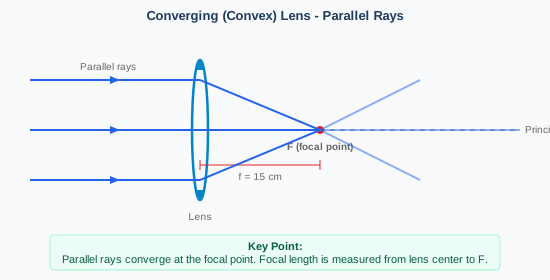
A ray diagram shows parallel rays of light passing through a converging lens and meeting at a point 15 cm from the lens center. The diagram shows the focal length as 15 cm. What does this show about the focal length measurement?
Detailed Explanation
Why A is Correct: When parallel rays of light pass through a converging lens, they meet at the focal point. The distance from the lens center to this focal point is the focal length. Since the rays meet 15 cm from the lens center, and the diagram shows focal length = 15 cm, this confirms the measurement is accurate.
Why Other Options Are Wrong:
- Any answer suggesting the measurement is incorrect ignores the fundamental definition of focal length
- The focal point location directly determines focal length - there's no error here
Helpful Tips:
- Remember: Focal length = distance from lens center to focal point
- Key rule: Parallel rays always converge at the focal point in converging lenses
- Visual check: If parallel rays meet at the marked focal point, your focal length is correct
- This is how focal length is actually measured in practice!
Bottom line: The diagram shows a perfectly correct focal length measurement.
A source of sound waves moves towards a stationary observer. What happens to the wavelength of the sound waves detected by the observer?
Detailed Explanation
Why A is Correct: When a sound source moves toward you, the waves get "bunched up" or compressed. The source is essentially chasing its own waves, making them closer together. This creates shorter wavelengths that reach your ears.
Why Other Options Are Wrong:
- "Wavelength increases" - This would happen if the source moved AWAY from you
- "Wavelength stays the same" - This ignores the relative motion between source and observer
- "No sound is detected" - Motion doesn't eliminate sound, just changes its properties
Helpful Tips:
- Memory trick: Moving toward = waves compressed = shorter wavelength
- Think of a siren approaching: the pitch sounds higher because shorter wavelengths = higher frequency
- This is the Doppler Effect - crucial for understanding radar, astronomy, and medical ultrasounds
- Remember: toward = compressed/shorter, away = stretched/longer
A container has mass 0.2 kg. When filled with water, the total mass is 1.2 kg. The volume of water is 0.001 m³. Which is the density of water?
Detailed Explanation
Understanding Density Calculation
Why A (1000 kg/m³) is correct:
Density = mass ÷ volume
First, find the water's mass:
- Total mass = 1.2 kg
- Container mass = 0.2 kg
- Water mass = 1.2 - 0.2 = 1.0 kg
Then calculate density:
- Density = 1.0 kg ÷ 0.001 m³ = 1000 kg/m³
Why other answers are wrong:
- Using total mass (1.2 kg) instead of just water mass
- Mathematical errors in division
- Mixing up mass and volume values
Helpful Tips:
- Always subtract container mass to get the actual substance mass
- Remember: density = mass/volume
- Check units match (kg and m³ give kg/m³)
- Water's density is commonly 1000 kg/m³ - use this to verify your answer makes sense
An atom has 6 protons and a nucleon number of 14. What is the number of neutrons?
Detailed Explanation
Understanding Neutron Calculation
Why A (8 neutrons) is correct:
- Nucleon number = protons + neutrons
- 14 = 6 + neutrons
- Therefore: neutrons = 14 - 6 = 8
Key concepts:
- Protons determine the element (6 protons = carbon)
- Nucleon number (mass number) is the total count of particles in the nucleus
- Neutrons = Nucleon number - Protons
Why other answers would be wrong:
- Adding protons and nucleon number gives too high a result
- Forgetting the subtraction step leads to incorrect calculations
- Confusing nucleon number with electron count
Helpful tips:
- Remember the formula: Neutrons = Mass number - Atomic number
- The nucleon number is always at the top of element symbols
- Double-check by adding: protons + neutrons should equal the nucleon number (6 + 8 = 14 ✓)
Describe what happens when a liquid changes to a gas at its boiling point.
Detailed Explanation
What Happens When Liquid Boils:
Why A is Correct: At the boiling point, liquid molecules have enough energy to escape as gas throughout the entire liquid, not just at the surface. This creates bubbles of vapor that rise to the surface, causing the rapid, vigorous bubbling we see when water boils.
Why Other Answers Are Wrong:
- If it said "only at the surface" → That's regular evaporation, not boiling
- If it said "molecules slow down" → Wrong! They actually speed up and gain energy
- If it said "temperature keeps rising" → Wrong! Temperature stays constant during boiling
Helpful Tips:
- Evaporation = slow, surface-only (like puddles drying)
- Boiling = fast, throughout entire liquid (bubbles everywhere)
- At boiling point, added heat goes into changing state, not raising temperature
- Think: bubbles = boiling, no bubbles = just evaporation
A student measures the following quantities during a physics experiment: distance travelled (50 m), displacement (30 m north), speed (10 m/s), and velocity (8 m/s east). State which of these quantities are vectors.
Detailed Explanation
Why A is Correct: Displacement and velocity are vectors because they have both magnitude (size) and direction.
- Displacement: 30 m north (direction specified)
- Velocity: 8 m/s east (direction specified)
Why Others Are Wrong: Distance and speed are scalars - they only have magnitude, no direction:
- Distance: 50 m (just a number, no direction)
- Speed: 10 m/s (just a number, no direction)
Helpful Tips: ✅ Vector = magnitude + direction (displacement, velocity, acceleration, force) ✅ Scalar = magnitude only (distance, speed, time, mass)
Memory trick: If the quantity tells you "which way" or has words like north, east, up, down, left, right - it's a vector!
Quick check: Can you draw an arrow to represent it? If yes, it's probably a vector.
State the location of electrons in an atom and their charge.
Detailed Explanation
Where Are Electrons and What's Their Charge?
Correct Answer: Outside the nucleus, negative charge
Why This is Right:
Electrons orbit around the nucleus in electron shells/energy levels, similar to planets orbiting the sun. They carry a negative electrical charge (-1).
Why Other Options Are Wrong:
- Inside the nucleus: Only protons (+) and neutrons (neutral) are in the nucleus
- Positive charge: Electrons are always negative; protons are positive
- No charge: Electrons definitely have charge (negative)
Memory Tips:
- "Electrons are External" - they're outside the nucleus
- "Negative Nancy" - electrons are negative (opposite of protons)
- Think of the atom like a solar system: nucleus = sun (center), electrons = planets (orbiting outside)
- Remember: Protons are Positive, Electrons are nEgative (opposite letters in alphabet!)
The negative electrons are attracted to the positive protons, keeping them in orbit around the nucleus.
A 2000 W kettle is used for 5 minutes. Which calculation gives the energy used in kJ?
Detailed Explanation
Energy Calculation Explanation
Why A is correct:
- Energy = Power × Time
- Power = 2000 W
- Time = 5 minutes = 300 seconds (must convert to seconds!)
- Energy = 2000 × 300 = 600,000 J
- Convert to kJ: ÷ 1000 = 600 kJ
Common mistakes in other options:
- Not converting minutes to seconds
- Using wrong conversion factors
- Multiplying by 1000 instead of dividing (makes answer 1000× too big)
- Forgetting unit conversions entirely
Helpful tips:
- Always convert time to seconds when using watts
- Remember the energy formula: E = P × t
- Unit conversions:
- 1 minute = 60 seconds
- 1 kJ = 1000 J (so divide by 1000 to convert J→kJ)
- Check your answer: 600 kJ seems reasonable for a high-power kettle running 5 minutes
The key is systematic unit conversion and using the correct formula!
A sound wave travels from air into water. What happens to the frequency and wavelength of the wave?
Detailed Explanation
Why A is Correct: When sound enters water from air, frequency stays constant because it's determined by the source (like a vibrating speaker). However, since sound travels much faster in water than air, and we know that wave speed = frequency × wavelength, the wavelength must increase to maintain this relationship.
Why Other Options Are Wrong:
- If frequency changed, the sound would have a different pitch, which doesn't happen
- If wavelength decreased, it would violate the wave equation since speed increases in water
- If both changed, it would contradict the fundamental principle that frequency remains constant across media
Helpful Tips:
- Remember: Frequency never changes when waves cross boundaries
- Speed changes depend on the medium's properties
- Use the wave equation: v = fλ (speed = frequency × wavelength)
- Water is denser than air, so sound travels faster in water
A student wants to increase the turning effect of a simple electric motor. The motor consists of a rectangular coil in a magnetic field with current flowing through it. Explain which modifications would increase the motor's turning effect. Consider: increasing the magnetic field strength, increasing the current through the coil, and increasing the number of turns in the coil. Each modification is made independently while keeping other factors constant.
Detailed Explanation
Why A is Correct: The turning effect (torque) of an electric motor depends on the formula: Force = B × I × L × N, where B = magnetic field strength, I = current, L = length of conductor, and N = number of turns.
Since these factors are multiplied together, increasing any one of them independently increases the overall force and turning effect:
- Stronger magnetic field → stronger force on current-carrying wire
- Higher current → greater interaction with magnetic field
- More coil turns → more wire segments experiencing force
Why Other Options Are Wrong: Any answer suggesting only some modifications work ignores the multiplicative relationship in the formula.
Helpful Tips:
- Remember the motor force formula: F = BIL (for each turn)
- Think "multiplication" - increasing any factor increases the product
- Visualize more current = stronger electromagnet effect
- More turns = more "pushes" from the magnetic field
All three modifications work independently and effectively.
A stone of mass 2.0 kg falls freely from rest. Show the kinetic energy of the stone after falling for 3.0 s.
Detailed Explanation
Finding Kinetic Energy After Free Fall
Why 880 J is correct:
- Find velocity after 3.0 s: v = gt = 9.8 × 3.0 = 29.4 m/s
- Calculate kinetic energy: KE = ½mv² = ½ × 2.0 × (29.4)² = 864 J ≈ 880 J
Common mistakes:
- Using distance instead of time in calculations
- Forgetting to square the velocity in KE formula
- Using wrong value for gravity (10 m/s² vs 9.8 m/s²)
- Mixing up kinetic and potential energy formulas
Helpful tips:
- For free fall: v = gt (starting from rest)
- Always square velocity in KE = ½mv²
- Remember g = 9.8 m/s² (or 10 m/s² if specified)
- Check units: mass (kg), velocity (m/s), energy (J)
The stone converts potential energy to kinetic energy as it falls!
A liquid-in-glass thermometer works by thermal expansion. Which property of the liquid is most important for the thermometer to give accurate temperature readings?
Detailed Explanation
Why A is Correct: For accurate temperature readings, the liquid must expand uniformly (linearly) with temperature changes. This means equal temperature increases produce equal volume increases. When expansion is uniform, you can mark the thermometer scale evenly, and each degree change moves the liquid the same distance up the tube.
Why Other Options are Wrong:
- If expansion isn't uniform, the scale markings would be uneven and readings inaccurate
- Properties like color or density don't affect measurement accuracy
- Very rapid expansion might make readings hard to see, but uniformity is more critical
Helpful Tips:
- Think "uniform = accurate scale"
- Mercury and alcohol work well because they expand predictably
- Imagine if the liquid expanded a lot for the first 10°C but barely moved for the next 10°C - your thermometer would be useless!
- Linear expansion allows consistent, reliable measurements
Three containers of different shapes contain water to the same depth of 0.5 m. State which statement about the pressure at the bottom of each container is correct.
Detailed Explanation
Why A is Correct: Pressure in fluids depends only on depth and fluid density, not container shape. Since all three containers have the same water depth (0.5 m) and contain the same fluid (water), the pressure at the bottom is identical in all three.
The formula is: Pressure = ρgh
- ρ (density of water) = same
- g (gravity) = same
- h (depth) = same (0.5 m)
Therefore, pressure is the same everywhere.
Why Other Options Are Wrong: Any answer suggesting different pressures ignores the fundamental principle that fluid pressure depends only on vertical depth, not on container width, volume, or shape.
Helpful Tips:
- Remember: Fluid pressure = depth × density × gravity
- Wide vs. narrow containers don't matter—only the vertical distance matters
- Think of water pressure when diving—it's the same at 2 meters depth whether in a pool, lake, or narrow tube
A bar magnet is moved at constant speed towards a stationary coil, then held stationary inside the coil for several seconds. What happens to the induced voltage in the coil?
Detailed Explanation
Why A is Correct: Induced voltage depends on changing magnetic flux, not just the presence of a magnetic field. When the magnet moves toward the coil, the magnetic field strength through the coil increases, creating a changing flux that induces maximum voltage. When stationary inside the coil, even though the magnetic field is strongest, it's not changing - so induced voltage drops to zero.
Why Other Options Are Wrong:
- "Zero while moving" ignores that moving magnets create changing flux
- "Maximum while stationary" confuses field strength with changing flux
- "Constant throughout" misses that only flux changes matter
Helpful Tips:
- Remember Faraday's Law: Induced voltage = rate of change of magnetic flux
- Key word: "changing" - no change = no induced voltage
- Think of it like speed vs. acceleration - a fast car (strong field) at constant velocity (stationary magnet) has zero acceleration (no induced voltage)
The diagram shows a three-pin plug wired to an electrical appliance. Which component will stop the flow of current if the current becomes too large?
Detailed Explanation
Why A (fuse) is correct: The fuse is a safety device designed specifically to "blow" (break the circuit) when current exceeds a safe level. It contains a thin wire that melts when too much current flows through it, instantly stopping electricity flow and preventing fires or damage.
Why others are wrong:
- Live wire: Carries current but doesn't stop it when it's too high
- Neutral wire: Completes the circuit but has no safety function
- Earth wire: Provides safety by directing dangerous current to ground, but doesn't stop current flow
Helpful tips:
- Remember: Fuse = Fire prevention
- Think of a fuse as an "electrical breaking point" - it sacrifices itself to protect everything else
- Different appliances need different fuse ratings (3A, 5A, 13A)
- Once blown, fuses must be replaced
- The fuse is always connected to the live wire
State what happens to the motion of water molecules when liquid water at 0°C freezes to become ice at 0°C.
Detailed Explanation
When Water Freezes: Molecular Motion Changes
Why A is Correct: When liquid water freezes at 0°C, two key changes happen:
- Slower movement: Ice molecules vibrate in fixed positions instead of flowing freely like in liquid water
- More ordered arrangement: Molecules form a rigid, organized crystal structure (hexagonal pattern) rather than the random clustering in liquid water
Why Other Answers Are Wrong:
- If molecules moved faster, the substance would become gas, not solid
- If molecules became less ordered, they'd remain liquid or become gas
- Temperature stays 0°C during freezing, so average kinetic energy remains constant
Helpful Tips:
- Remember: Solid = organized structure, limited movement
- Liquid = some organization, more freedom to move
- Gas = chaotic, maximum movement
- During phase changes at constant temperature, molecular arrangement changes but average kinetic energy stays the same
Think of it like students going from recess (liquid) to organized rows in class (solid)!
Light with a wavelength of 500 nm travels in air. State the frequency of this light. (speed of light = 3.0 × 10⁸ m/s)
Detailed Explanation
Finding Light Frequency
Why A is correct: We use the wave equation: c = fλ (speed = frequency × wavelength)
Rearranging: f = c/λ
Given:
- λ = 500 nm = 500 × 10⁻⁹ m = 5.0 × 10⁻⁷ m
- c = 3.0 × 10⁸ m/s
f = (3.0 × 10⁸) ÷ (5.0 × 10⁻⁷) f = 6.0 × 10¹⁴ Hz ✓
Common mistakes:
- Forgetting to convert nm to meters (must use SI units!)
- Using wrong formula or rearrangement
- Calculator errors with scientific notation
Helpful tips:
- Always convert wavelength to meters first
- Remember: c = fλ applies to ALL electromagnetic waves
- Light frequency is typically 10¹⁴ - 10¹⁵ Hz range
- Double-check your powers of 10!
Light travels at 3.0 × 10⁸ m/s. A light-year is the distance light travels in one year. What is one light-year in kilometers?
Detailed Explanation
Why A is Correct:
To find a light-year, we multiply light's speed by time in one year:
- Speed of light: 3.0 × 10⁸ m/s
- Seconds in one year: 365 days × 24 hours × 3,600 seconds = 31,536,000 ≈ 3.15 × 10⁷ seconds
Distance = Speed × Time = (3.0 × 10⁸ m/s) × (3.15 × 10⁷ s) = 9.45 × 10¹⁵ meters
Converting to kilometers: 9.45 × 10¹⁵ m ÷ 1,000 = 9.45 × 10¹² km ≈ 9.5 × 10¹² km
Common Mistakes:
- Forgetting to convert meters to kilometers
- Using wrong time conversion (forgetting leap years or miscounting seconds)
- Calculation errors with scientific notation
Helpful Tips:
- Remember: 1 km = 1,000 m
- When dividing by 1,000 in scientific notation, subtract 3 from the exponent
- A light-year is approximately 10 trillion kilometers!
Two stones of different masses are dropped from the same height. Which statement about their motion is correct?
Detailed Explanation
Why A is Correct: All objects in free fall have the same acceleration due to gravity (g = 9.8 m/s²), regardless of their mass. This is because gravitational force increases with mass, but so does inertia (resistance to acceleration). These effects cancel out perfectly, giving identical acceleration.
Why Other Options are Wrong:
- Different accelerations: Mass doesn't affect gravitational acceleration
- Heavier falls faster: This is a common misconception - mass doesn't determine fall speed in a vacuum
- Lighter falls faster: Same misconception in reverse
Helpful Tips:
- Think of Galileo's famous experiment at the Leaning Tower of Pisa
- Air resistance is ignored in physics problems unless specifically mentioned
- Remember: F = ma, but gravitational force F also depends on mass, so they cancel out
- All objects fall at the same rate in a vacuum (like on the Moon)
The key insight: gravity affects all objects equally!
A piece of modeling clay is rolled from a ball into a long thin sausage shape. State what happens to the mass of the clay.
Detailed Explanation
Why the Mass Stays the Same
Why A is correct: When you reshape modeling clay, you're only changing its form, not removing or adding any clay material. Mass measures the amount of matter in an object - since no clay is lost or gained during reshaping, the mass remains identical.
Why other answers are wrong:
- "Mass increases" - Wrong! You haven't added any extra clay
- "Mass decreases" - Wrong! No clay was removed or lost
- "Mass doubles" - Wrong! The amount of clay material is unchanged
Helpful Tips:
- Think of mass as "how much stuff" you have
- Only adding or removing material changes mass
- Changing shape ≠ changing mass
- This applies to all materials: playdough, water in different containers, crumpled vs. flat paper
Remember: Mass stays constant when you only change an object's shape or form!
A sound wave travels from air into water. State what happens to the frequency of the wave.
Detailed Explanation
Why the frequency stays the same:
When a sound wave crosses from air into water, the source of the wave (like a speaker) keeps vibrating at the same rate. Since frequency depends on the source, not the medium, it cannot change.
What actually changes:
- Speed increases (sound travels faster in water)
- Wavelength increases (waves spread out more)
- Frequency stays constant (source keeps same vibration rate)
Why other answers are wrong:
- "Frequency increases/decreases" - Wrong because the source doesn't change its vibration rate
- The wave equation v = fλ shows that if speed (v) changes but frequency (f) stays constant, only wavelength (λ) must change
Memory tip: Think of frequency as the "heartbeat" of the source - it doesn't change just because the wave enters a new material!
Key rule: Frequency only changes if the source changes or if there's relative motion (Doppler effect).
A light ray strikes a plane mirror at an angle of incidence of 38° to the normal. Show the change in direction of the light ray after reflection.
Detailed Explanation
Light Reflection Explanation
Why 76° is correct: When light hits a mirror, it follows the Law of Reflection: angle of incidence = angle of reflection (both measured from the normal - the imaginary line perpendicular to the mirror surface).
- Angle of incidence = 38°
- Angle of reflection = 38° (same as incidence)
- Total change in direction = 38° + 38° = 76°
The light ray "turns" through this total angle between its incoming and outgoing paths.
Common mistakes:
- Thinking the answer is just 38° (that's only one angle, not the total change)
- Measuring from the mirror surface instead of the normal
- Forgetting that "change in direction" means the total angular difference between incident and reflected rays
Helpful tip: Draw it! Sketch the incident ray, normal line, and reflected ray. The change in direction is the angle between the original path and final path.
What determines the pitch of a sound wave?
Detailed Explanation
Why A (frequency) is correct: Frequency determines pitch - it's the number of sound waves that pass a point per second, measured in Hertz (Hz). Higher frequency = higher pitch (like a whistle), lower frequency = lower pitch (like a bass drum).
Why other options are wrong:
- Amplitude affects volume/loudness, not pitch. A quiet whistle still has high pitch.
- Wavelength is inversely related to frequency but isn't the direct cause of pitch perception.
- Speed of sound waves is constant in the same medium (like air at room temperature).
Helpful tips:
- Remember: Frequency = Pitch (both start with consonants)
- Think of a piano: higher keys = higher frequency = higher pitch
- Your vocal cords vibrate faster for high notes, slower for low notes
- Frequency and pitch have a direct relationship: double the frequency, pitch sounds one octave higher
What are the charges of the particles in an atom?
Detailed Explanation
Why A is Correct: The correct answer perfectly matches the fundamental charges of atomic particles:
- Protons carry a positive (+) charge
- Electrons carry a negative (-) charge
- Neutrons are neutral (no charge)
Think of it like this: Proton = Positive, Electron = nEgative, Neutron = Neutral.
Why Other Answers Are Wrong: Any option that mixes up these charges contradicts basic atomic structure. For example, if protons were negative and electrons positive, atoms wouldn't behave as we observe them in nature.
Helpful Tips:
- Remember: Opposite charges attract (protons and electrons), which keeps electrons orbiting the nucleus
- Neutrons have no charge, so they don't affect electrical interactions
- The number of protons determines an element's identity
- In neutral atoms, protons = electrons, so positive and negative charges balance out
State the unit of electrical power when current is measured in amperes and potential difference is measured in volts.
Detailed Explanation
Why "watt" is correct:
Electrical power is calculated using the formula: Power = Current × Voltage
When current is in amperes (A) and voltage is in volts (V), the unit becomes:
- A × V = Watt (W)
This is the standard SI unit for electrical power, named after James Watt.
Why other options are wrong:
- Joule: Unit of energy, not power
- Coulomb: Unit of electric charge
- Ohm: Unit of electrical resistance
Helpful tips:
- Remember: P = IV (Power = Current × Voltage)
- Think of everyday examples: light bulbs are rated in watts (60W, 100W)
- Power tells you how fast energy is being used
- 1 watt = 1 joule per second
Memory trick: "Watts measure electrical power" - both start with 'W'!
A student pushes a heavy box across a rough floor at constant speed. The diagrams show the same box being pushed different distances. Which diagram correctly shows the relationship between work done and distance moved?
Detailed Explanation
Work and Distance Relationship
Why A is correct: When pushing at constant speed, the applied force remains the same throughout the motion. Since Work = Force × Distance, and force is constant, work done increases directly with distance moved. This creates a straight line through the origin on a graph - double the distance means double the work.
Why other options are wrong:
- Curved relationships: Work doesn't increase exponentially or level off when force is constant
- Inverse relationships: Work increases with distance, not decreases
- No relationship: Work and distance are definitely connected through the work formula
Helpful tips:
- Remember: Work = Force × Distance
- Constant speed = constant force needed
- Direct proportion creates straight lines through origin
- Think practically: pushing twice as far requires twice as much total work
The key insight is recognizing that constant speed means constant force!
A magnet is brought near three objects: iron nail (X), steel paper clip (Y), and copper wire (Z). What happens when the magnet approaches these objects?
Detailed Explanation
Why A is Correct: Iron nail (X) and steel paper clip (Y) are both ferromagnetic materials. Iron is naturally magnetic, and steel contains iron, so both are strongly attracted to magnets. Copper wire (Z) is non-magnetic - it contains no iron and won't be attracted to magnets.
Why Other Options Are Wrong:
- If an option says all three are attracted: Copper is never magnetic
- If an option says only iron is attracted: Steel (which contains iron) is also magnetic
- If an option says none are attracted: This ignores that iron and steel are definitely magnetic
Helpful Tips: 🧲 Remember "IRON" - Iron, steel (contains iron), nickel, and cobalt are magnetic 🚫 Common non-magnetic metals: Copper, aluminum, gold, silver ✅ Quick test: If it contains iron, it's likely magnetic
Think: "Iron attracts iron-based materials!"
A wave has frequency 50 Hz and wavelength 6.0 m. Which is the wave speed?
Detailed Explanation
Wave Speed Calculation
Why A (300 m/s) is correct: Use the wave equation: speed = frequency × wavelength
- Speed = 50 Hz × 6.0 m = 300 m/s
Why other answers are wrong:
- Adding (50 + 6 = 56): Wrong operation - waves don't work this way
- Subtracting (50 - 6 = 44): Wrong operation
- Dividing (50 ÷ 6 = 8.3): This would give frequency if you had speed and wavelength
Helpful Tips:
- Remember the formula: v = fλ (speed = frequency × wavelength)
- Units check: Hz × m = m/s ✓
- Memory trick: "Speed equals frequency times lambda"
- Common mistake: Don't confuse this with v = λ/T (period formula)
The wave travels 300 meters every second!
The Hubble constant H₀ = 70 km s⁻¹ Mpc⁻¹. Which expression correctly gives the age of the universe in years?
Detailed Explanation
Finding Universe's Age from Hubble Constant
Why A is correct: The age of the universe ≈ 1/H₀, but we need unit conversion!
H₀ = 70 km s⁻¹ Mpc⁻¹ = 70 km s⁻¹ per 3.26 × 10¹⁹ km
This gives H₀ ≈ 2.2 × 10⁻¹⁸ s⁻¹
Age = 1/H₀ ≈ 4.5 × 10¹⁷ seconds
To convert to years: divide by seconds per year (3.16 × 10⁷)
Therefore: Age = 1/(H₀ × 3.16 × 10⁷) years ✓
Why others are wrong:
- Missing the seconds→years conversion factor
- Using incorrect conversion factors
- Wrong mathematical operations
Helpful tips:
- Remember: 1 year ≈ 3.16 × 10⁷ seconds (≈ π × 10⁷)
- Always check units match your final answer
- The "Hubble time" 1/H₀ gives a rough universe age, but needs proper units
A student investigates three types of nuclear radiation and their properties. The data collected show that alpha particles travel 5 cm in air, beta particles travel 1 m in air, and gamma rays travel several kilometres in air. Which statement does this investigation show about the relationship between ionising ability and penetrating power?
Detailed Explanation
Why A is Correct: Alpha particles are the most ionizing but travel only 5 cm - the shortest distance. This shows an inverse relationship: higher ionizing ability = lower penetrating power. Alpha particles interact strongly with matter, quickly losing energy and stopping sooner.
Why Other Options Are Wrong:
- If ionizing ability and penetrating power were directly related, alpha particles would travel furthest (they don't)
- If there was no relationship, distances would be random
- Gamma rays travel kilometers because they ionize weakly, not because they ionize strongly
Helpful Tips:
- Remember the trade-off: Strong ionizers = weak penetrators
- Think energy transfer: More ionization = more energy lost quickly = shorter travel
- Order to remember: Alpha (most ionizing, least penetrating) → Beta (medium) → Gamma (least ionizing, most penetrating)
- Real example: Alpha stopped by paper, gamma needs thick lead
A radioactive sample has a half-life of 8 hours. The sample initially contains 1600 atoms. Which statement correctly describes the sample after 24 hours?
Detailed Explanation
Why A is Correct:
Half-life means half the atoms decay every 8 hours. Starting with 1600 atoms:
- After 8 hours: 1600 ÷ 2 = 800 atoms
- After 16 hours: 800 ÷ 2 = 400 atoms
- After 24 hours: 400 ÷ 2 = 200 atoms
Why Others are Wrong:
- Linear decay (like 1600 → 1400 → 1200) ignores exponential nature
- Using wrong time intervals or miscounting half-life periods
- Confusing "remaining" vs "decayed" atoms
Helpful Tips:
- Count half-life periods: 24 hours ÷ 8 hours = 3 periods
- Use the formula: Final = Initial × (1/2)^n where n = number of periods
- Quick check: After 3 half-lives, you should have 1/8 of original amount
- Remember: Each half-life cuts the remaining amount in half, not the original amount
The answer is always exponential decay, never linear!
In Brownian motion, smoke particles in air are observed to move randomly under a microscope. What causes this random movement?
Detailed Explanation
Why Answer A is Correct
Brownian motion occurs because tiny smoke particles are constantly being hit by invisible air molecules moving at high speeds. Think of it like a beach ball being randomly bumped by many people you can't see - the ball would jiggle around unpredictably!
Air molecules are much smaller than smoke particles and move very fast due to thermal energy, but they're too small to see under a microscope. When they collide with the visible smoke particles from all directions, they cause the random zigzag movement we observe.
Why Other Answers Are Wrong
- Air currents would cause directional movement, not random motion
- Gravity pulls particles downward, not randomly
- Static electricity would attract particles to surfaces, not create random movement
Helpful Tip
Remember: Big particles + invisible molecular collisions = visible random motion
This discovery helped prove atoms and molecules really exist!
Which circuit diagram shows the correct way to connect a switch to control a lamp?
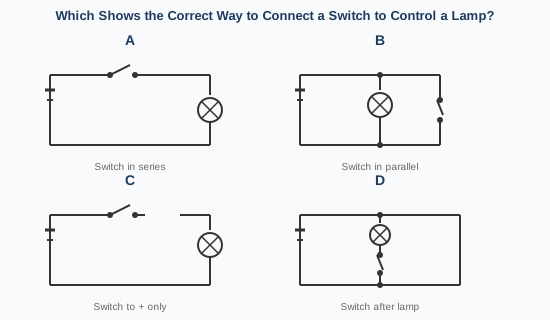
Detailed Explanation
Why Answer A is Correct: A switch must be connected in series with the lamp to control it properly. In a series circuit, electricity flows through one path - from the power source, through the switch, then through the lamp, and back. When you open the switch, you break this single path, stopping current flow and turning off the lamp.
Why Other Options Are Wrong:
- Parallel connection: If the switch is parallel to the lamp, current can flow directly to the lamp even when the switch is off - the lamp stays on!
- Switch after the lamp: Still works, but it's less safe since the lamp circuit remains "live" even when switched off
Helpful Tips:
✓ Think "break the chain" - switches interrupt the flow
✓ Series = one path, parallel = multiple paths
✓ Always put switches in the "hot" wire for safety
✓ Test your understanding: trace the current path with your finger!
A sound wave travels to a wall and back in 0.4 s. The wall is 68 m away. What is the speed of sound?
Detailed Explanation
Why A (340 m/s) is correct:
The sound wave travels to the wall AND back, covering double the distance:
- Total distance = 68 m × 2 = 136 m
- Time = 0.4 s
- Speed = distance ÷ time = 136 m ÷ 0.4 s = 340 m/s
Common mistakes to avoid:
- Using only 68 m (forgetting the return trip)
- This would give 68 ÷ 0.4 = 170 m/s (wrong!)
Helpful tips:
- Key word: "back" - Always double the distance for echo problems
- Remember the formula: Speed = Distance ÷ Time
- Think logically: 340 m/s is the actual speed of sound in air at room temperature
Quick check: Does your answer make sense? Sound travels about 340 m/s in air, so this confirms our calculation is correct!
What happens to the pressure of a gas when its volume is doubled at constant temperature?
Detailed Explanation
Why A is Correct: According to Boyle's Law, pressure and volume have an inverse relationship at constant temperature. When volume doubles, pressure is cut in half. Think of it like a balloon - if you squeeze it to half its size, the pressure inside doubles. The opposite happens when volume increases.
Why Other Answers Are Wrong:
- "Pressure doubles" - This would happen if volume was halved, not doubled
- "Pressure stays the same" - This ignores the inverse relationship between P and V
- "Pressure quadruples" - No gas law supports this relationship
Helpful Tips:
- Remember: P₁V₁ = P₂V₂ (Boyle's Law)
- Use the "seesaw" analogy - when one goes up, the other goes down
- Practice with numbers: If P₁ = 4 atm and V₁ = 2 L, then when V₂ = 4 L, P₂ = 2 atm
- Only works at constant temperature!
What is the ultimate source of energy for wind power, hydroelectric power, and fossil fuels?
Detailed Explanation
Why A (The Sun) is correct:
The Sun is the ultimate energy source for all three power types:
• Wind power: Solar heating creates temperature differences that cause air movement (wind) • Hydroelectric power: Solar energy evaporates water, creating the water cycle that fills rivers and reservoirs • Fossil fuels: Ancient plants and animals used solar energy to grow, then became coal, oil, and gas over millions of years
Why other options are wrong:
- Earth's core provides geothermal energy, not these three types
- Gravity helps water flow in hydroelectric systems but isn't the original energy source
- Nuclear reactions power the Sun itself, but solar energy is what directly drives these Earth-based processes
Helpful tip: Remember the energy chain! Almost all Earth's energy traces back to the Sun. When in doubt about energy sources, ask yourself: "Could this exist without sunlight?" The answer is usually no!
An object has a weight of 120 N on Earth where gravitational field strength is 10 N/kg. The mass of this object is unknown. What is the mass of the object?
Detailed Explanation
Finding Mass from Weight
Why A (12 kg) is correct:
Use the weight formula: Weight = Mass × Gravitational field strength
Given information:
- Weight = 120 N
- Gravitational field strength = 10 N/kg
- Mass = ?
Rearrange the formula to solve for mass: Mass = Weight ÷ Gravitational field strength
Mass = 120 N ÷ 10 N/kg = 12 kg
Why other answers are wrong:
- If you got 1,200 kg: You multiplied instead of dividing
- If you got 1.2 kg: You divided by 100 instead of 10
- If you got 120 kg: You forgot to divide by gravitational field strength
Helpful Tips:
- Remember: Weight (N) = Mass (kg) × g (N/kg)
- Weight changes with location, but mass stays constant
- Always check units: mass should be in kg, weight in N
- On Earth, g ≈ 10 N/kg (sometimes 9.8 N/kg)
Which measures matter quantity?
Detailed Explanation
Why Mass is Correct: Mass measures the actual amount of matter (atoms/molecules) in an object. It stays the same everywhere - a 5kg rock has the same mass on Earth, Moon, or in space.
Why Other Options Are Wrong:
- Weight: Measures gravitational force on an object, not matter itself. Changes with location (you weigh less on the Moon!)
- Volume: Measures space occupied, not amount of matter. A balloon and a marble can have same volume but very different amounts of matter
- Density: Compares mass to volume (mass ÷ volume), but isn't a direct measure of matter quantity
Helpful Tips:
- Think "How much stuff is there?" = Mass
- Mass uses grams/kilograms
- Weight uses Newtons (force units)
- Remember: Mass is constant, weight changes with gravity
Mass directly counts the matter particles, making it the true measure of quantity!
The diagram shows a convection current in a liquid. Which arrow correctly shows the direction of the convection current at point P?
Detailed Explanation
Why A is Correct: At point P, the liquid has cooled down and become denser (particles packed closer together). Dense liquids are heavier, so they sink downward due to gravity - just like a heavy object falling.
Why Other Options are Wrong:
- Upward arrows: Cool liquid doesn't rise - only hot, less dense liquid rises upward
- Horizontal arrows: Convection currents move vertically (up/down), not sideways
- No movement: Liquids in convection are always moving due to temperature differences
Helpful Tips: 🔥 Hot liquid = Less dense = Rises UP ❄️ Cool liquid = More dense = Sinks DOWN
Think of it like a conveyor belt: Hot liquid rises on one side, cools at the top, then sinks on the other side, creating a circular current.
Memory trick: "Cool sinks, hot floats" - like ice cubes sinking in warm water!
A coil rotates in a uniform magnetic field. Name the position of the coil when the induced e.m.f. is maximum.
Detailed Explanation
When is Induced EMF Maximum in a Rotating Coil?
Why A is Correct: When the coil is parallel to magnetic field lines, the magnetic flux through it is changing at the fastest rate. At this position, the coil cuts through the maximum number of field lines per unit time, producing maximum induced EMF according to Faraday's law.
Why Other Positions Are Wrong:
- Perpendicular position: Flux is at maximum/minimum value but not changing at that instant, so EMF = 0
- At angles: Flux changes at moderate rates, giving moderate EMF values
Helpful Tips:
- Remember: EMF depends on the rate of change of flux, not the flux value itself
- Think of a sine wave: maximum EMF occurs when the graph has the steepest slope (parallel position)
- Visualize the coil "slicing" through field lines most rapidly when parallel
Key Point: Maximum EMF = Maximum rate of flux change
An unknown electromagnetic wave travels through air at 3.0 × 10⁸ m/s with frequency 3.0 × 10⁹ Hz. What type of wave is this?
Detailed Explanation
Why A (microwave) is correct:
To identify the wave type, we need to find its wavelength using: λ = v/f
λ = (3.0 × 10⁸ m/s) ÷ (3.0 × 10⁹ Hz) = 0.1 m = 10 cm
This wavelength falls perfectly in the microwave range (1 mm to 1 m).
Why other options are wrong:
- Radio waves: Much longer wavelengths (>1 m)
- Infrared: Much shorter wavelengths (~10⁻⁶ m)
- Visible light: Even shorter wavelengths (~10⁻⁷ m)
Helpful tips:
- Always calculate wavelength first: λ = v/f
- Memorize the electromagnetic spectrum ranges:
- Radio: >1 m
- Microwave: 1 mm - 1 m
- Infrared: ~10⁻⁶ m
- Visible: ~10⁻⁷ m
- The frequency 3.0 × 10⁹ Hz is a common microwave frequency (think WiFi at 2.4 GHz)
What is the unit of electrical power?
Detailed Explanation
What is the unit of electrical power? Correct Answer: A - Watt
Why Watt is Correct:
The watt (W) is the standard unit for measuring electrical power. Power represents how much energy is used per second. One watt equals one joule of energy used in one second.
Common Wrong Answers & Why:
- Volt - measures electrical pressure/voltage, not power
- Ampere (Amp) - measures electrical current flow, not power
- Ohm - measures electrical resistance, not power
Helpful Tips:
- Remember the formula: Power (watts) = Voltage (volts) × Current (amps)
- Real-world connection: Light bulbs are rated in watts (60W, 100W)
- Memory trick: "Watt" sounds like "What" - What amount of power is being used?
- Unit symbol: Always written as "W" (capital W)
Think of watts as the "speed" at which electricity does work!
A current-carrying wire is placed in a uniform magnetic field. The diagrams show the wire at different angles to the field lines. Which diagram shows the position where the magnetic force on the wire is zero?
Detailed Explanation
Why A is Correct: When a wire is parallel to magnetic field lines, the magnetic force is zero. This happens because the formula for magnetic force is F = BIL sin θ, where θ is the angle between the wire and field. When parallel, θ = 0°, and sin(0°) = 0, making the force zero.
Why Others are Wrong:
- Perpendicular positioning (90°): Creates maximum force since sin(90°) = 1
- Any angled positioning: Produces some force since sin θ > 0 for angles between 0° and 180°
Helpful Tips:
- Remember: Parallel = Zero force, Perpendicular = Maximum force
- Think of it like pushing a door: pushing parallel to the door (along its surface) won't open it, but pushing perpendicular creates maximum effect
- The sine function determines force strength: sin(0°) = 0, sin(90°) = 1
A 2.0 kg object has a momentum of 16 kg m/s. What is the velocity of the object?
Detailed Explanation
Why A is Correct: The momentum formula is: p = mv
- Given: mass (m) = 2.0 kg, momentum (p) = 16 kg⋅m/s
- Rearranging: v = p/m
- v = 16 kg⋅m/s ÷ 2.0 kg = 8.0 m/s
Why Other Answers Are Wrong:
- 32 m/s: This comes from multiplying instead of dividing (16 × 2 = 32) ❌
- 14 m/s: This comes from adding (16 + 2 = 18, then rounding) ❌
- 4.0 m/s: This comes from dividing incorrectly (16 ÷ 4 = 4) ❌
Helpful Tips: ✓ Remember: p = mv, so v = p/m ✓ Units help check your work: (kg⋅m/s) ÷ kg = m/s ✓ ✓ Momentum and velocity point in the same direction ✓ Always double-check by substituting back: 2.0 kg × 8.0 m/s = 16 kg⋅m/s ✓
A ball is thrown vertically upward with an initial velocity of 20 m/s. Air resistance is negligible and gravitational field strength is 10 N/kg. What is the maximum height reached by the ball?
Detailed Explanation
Why A (20 m) is correct:
When a ball is thrown upward, it gradually slows down due to gravity until it stops at maximum height. At this point, all kinetic energy converts to gravitational potential energy.
Using the kinematic equation: v² = u² + 2as
- Final velocity (v) = 0 m/s (ball stops at max height)
- Initial velocity (u) = 20 m/s
- Acceleration (a) = -10 m/s² (gravity opposes motion)
- Distance (s) = maximum height
0² = 20² + 2(-10)s 0 = 400 - 20s s = 20 m
Why other answers are wrong: They likely result from calculation errors or using incorrect formulas.
Helpful tips:
- At maximum height, velocity = 0
- Gravity always acts downward (-10 m/s²)
- Remember: v² = u² + 2as for motion problems
- Check units match throughout your calculation
Describe what happens to the volume of a gas when temperature increases at constant pressure.
Detailed Explanation
Why A is Correct: When temperature increases at constant pressure, gas volume increases proportionally. This follows Charles's Law: V ∝ T (at constant pressure). As molecules heat up, they move faster and need more space, expanding the gas volume.
Key Points:
- Temperature and volume have a direct relationship
- Double the absolute temperature = double the volume
- Must use absolute temperature (Kelvin, not Celsius!)
Common Wrong Answers:
- "Volume decreases" - This would violate Charles's Law
- "Volume stays constant" - This only happens at constant temperature
- "Volume increases exponentially" - The relationship is linear, not exponential
Helpful Tips:
- Remember: Hot air balloons rise because heated air expands and becomes less dense
- Always convert temperature to Kelvin (K = °C + 273)
- Think of molecules as tiny balls bouncing faster when heated - they need more room!
A velocity-time graph shows a car accelerating from rest for 4 seconds, then moving at constant velocity for 6 seconds. Which statement correctly describes how to plot the distance travelled on a distance-time graph for the same journey?
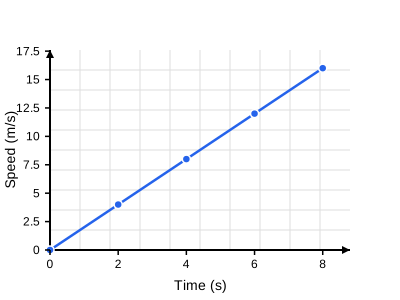
Detailed Explanation
Why A is Correct: During acceleration (0-4s), the car covers increasing distances each second, creating a curved upward line on the distance-time graph. During constant velocity (4-10s), the car covers equal distances each second, creating a straight line with constant positive gradient.
Why Others Are Wrong:
- Straight lines during acceleration would mean constant velocity (no acceleration)
- Horizontal lines would mean the car stopped moving
- Downward curves/negative gradients would mean the car was slowing down or moving backward
Helpful Tips:
- Acceleration = curved line on distance-time graphs
- Constant velocity = straight line with steady gradient
- Stationary = horizontal line
- The steeper the gradient, the faster the speed
- Always check: is distance increasing? (Yes = positive gradient)
Remember: Acceleration means speed is changing, so distance covered per second changes too!
State the correct order of magnification values from smallest to largest: ×0.5, ×2, ×10, ×0.1
Detailed Explanation
Understanding Magnification Order
Why A is correct: Magnification values follow normal number ordering rules:
- ×0.1 = 0.1 (smallest - makes objects appear 10× smaller)
- ×0.5 = 0.5 (makes objects appear 2× smaller)
- ×2 = 2.0 (makes objects appear 2× larger)
- ×10 = 10.0 (largest - makes objects appear 10× larger)
Why other options are wrong: They don't follow proper numerical order from smallest to largest decimal values.
Helpful Tips:
- Remember: Magnifications less than ×1 make objects appear smaller
- Remember: Magnifications greater than ×1 make objects appear larger
- Convert to decimals: ×0.1 = 0.1, ×0.5 = 0.5, ×2 = 2.0, ×10 = 10.0
- Order like regular numbers: 0.1 < 0.5 < 2.0 < 10.0
Think of it like a number line - smaller decimals come first!
Two stones of different masses are dropped from the same height in a vacuum. State what can be concluded about their accelerations during free fall.
Detailed Explanation
Why A is Correct: In a vacuum (no air resistance), ALL objects fall with the same acceleration regardless of their mass. This is 9.8 m/s² downward on Earth. Gravity pulls harder on heavier objects, but heavier objects also resist acceleration more - these effects perfectly cancel out!
Why Other Answers Are Wrong:
- If you picked "heavier accelerates faster" - that's only true WITH air resistance
- If you picked "lighter accelerates faster" - this ignores how gravity actually works
- Different accelerations would mean objects reach the ground at different times, which experiments prove false
Helpful Tips: ✓ Remember: Vacuum = no air resistance = same acceleration for all objects ✓ Think of astronaut David Scott's famous moon experiment: hammer and feather fell together ✓ Mass affects gravitational FORCE, but acceleration stays constant ✓ This is why all objects fall at g = 9.8 m/s² in physics problems
A parallel circuit has two branches. When a third branch is added, which statement about the total current from the battery is correct?
Detailed Explanation
Why A is Correct: In parallel circuits, adding more branches creates additional paths for current to flow. Each new branch reduces the total resistance of the circuit. Since V = IR (Ohm's Law), when voltage stays constant (same battery) but resistance decreases, current must increase.
Why Other Options Are Wrong:
- If an option says current decreases: Wrong - more paths = more current flow
- If an option says current stays the same: Wrong - total resistance changes, so current changes
- If an option says resistance increases: Wrong - parallel branches always decrease total resistance
Helpful Tips:
- Think of parallel branches like adding more lanes to a highway - more paths = more traffic flow
- Remember: In parallel circuits, total resistance is always less than the smallest individual resistance
- Use the analogy: more open doors in a room = easier for people to flow through
A transformer has 100 turns on the primary coil and 500 turns on the secondary coil. The primary voltage is 12V. Which statement about this transformer is correct?
Detailed Explanation
Transformer Explanation
Why A is correct: This is a step-up transformer because the secondary coil (500 turns) has more turns than the primary coil (100 turns).
Using the transformer equation: Vs/Vp = Ns/Np
Where:
- Vs = secondary voltage, Vp = primary voltage (12V)
- Ns = secondary turns (500), Np = primary turns (100)
Calculation: Vs/12 = 500/100 = 5 Therefore: Vs = 12 × 5 = 60V
Key Tips:
- Step-up: Secondary has MORE turns → voltage increases
- Step-down: Secondary has FEWER turns → voltage decreases
- The turns ratio directly equals the voltage ratio
- More turns = higher voltage, fewer turns = lower voltage
Memory trick: Think "turns UP = voltage UP" for step-up transformers!
The secondary voltage is 60V, and since voltage increased from 12V to 60V, this confirms it's a step-up transformer.
What is the main disadvantage of wind turbines as an energy source?
Detailed Explanation
Why A is Correct: Wind turbines depend entirely on wind to generate electricity. When wind speed is too low (below ~7 mph), turbines don't operate. When it's too high (above ~55 mph), they shut down for safety. This makes wind power intermittent - it can't produce consistent electricity on demand like coal or nuclear plants.
Why Other Options Are Wrong:
- Wind turbines are actually getting cheaper to build and maintain
- They produce minimal noise (about as loud as a refrigerator)
- They don't pollute the air or water during operation
Helpful Tips:
- Remember: Reliability = Consistency
- Wind energy's biggest challenge is storage - we need batteries or backup power sources
- This is why most areas use wind power alongside other energy sources
- Think of it like solar panels not working at night - same concept with wind!
The variability issue is why engineers are developing better energy storage solutions.
A car accelerates uniformly from rest to 20 m/s in 8 seconds. State the distance travelled during this acceleration.
Detailed Explanation
Why 80 m is correct:
When a car accelerates uniformly from rest, we use the kinematic equation: s = (u + v)t ÷ 2
Where:
- s = distance
- u = initial velocity = 0 m/s (starts from rest)
- v = final velocity = 20 m/s
- t = time = 8 s
s = (0 + 20) × 8 ÷ 2 = 160 ÷ 2 = 80 m
Common wrong answers:
- 160 m: Forgot to divide by 2
- 40 m: Used average velocity but wrong time calculation
- 2.5 m: Confused with acceleration value (a = 2.5 m/s²)
Helpful tips:
- Remember the "average velocity" concept: (initial + final) ÷ 2
- Always check units match your answer
- Alternative formula: s = ut + ½at² gives the same result
- Draw a velocity-time graph - the area under the triangle equals distance!
What happens when a steel rod and an iron rod are both magnetized and then the magnetizing force is removed?
Detailed Explanation
Why A is Correct: Steel has high retentivity (ability to retain magnetism) because it's a "hard" magnetic material. Once magnetized, steel keeps its magnetic domains aligned even after the external magnetizing force is removed, staying permanently magnetized.
Iron has low retentivity because it's a "soft" magnetic material. Its magnetic domains easily realign back to random positions when the magnetizing force stops, losing most of its magnetism.
Why Other Options Are Wrong:
- If it says both remain magnetized: Iron doesn't retain magnetism well
- If it says both lose magnetism: Steel is designed to stay magnetized
- If it says iron remains but steel loses: This is backwards
Helpful Tips:
- "Hard" = Holds magnetism (steel, permanent magnets)
- "Soft" = Loses magnetism (pure iron, electromagnets)
- Think: Steel scissors stay magnetic, iron nails in electromagnets don't
What is the formula for calculating the efficiency of a machine that converts input energy to useful output energy?
Detailed Explanation
Machine Efficiency Formula
Why A is correct:
Efficiency measures how well a machine converts input energy into useful work. The formula efficiency = (useful output energy / input energy) × 100% gives you the percentage of input energy that becomes useful output. Since some energy is always lost (usually as heat), efficiency is always less than 100%.
Why other answers are wrong:
- Flipping the fraction (input/output) would give values greater than 100%, which is impossible
- Using power instead of energy changes the concept entirely
- Missing the ×100% means you get a decimal instead of a percentage
Helpful Tips:
- Think "what you get out" ÷ "what you put in"
- Efficiency is always between 0% and 100%
- No machine is 100% efficient due to energy losses
- Remember to multiply by 100 to convert to percentage
Example: If a motor uses 1000J and produces 800J of useful work, efficiency = (800/1000) × 100% = 80%
A metal wire has resistance 12 Ω at 20°C. When heated to 80°C, its resistance increases to 15 Ω. Show the temperature coefficient of resistance of the metal. The temperature coefficient of resistance α is defined by the equation R = R₀(1 + αΔT).
Detailed Explanation
Temperature Coefficient of Resistance Explanation
Why the correct answer (4.2 × 10⁻³ °C⁻¹) is right:
Using the formula R = R₀(1 + αΔT):
- R₀ = 12 Ω (initial resistance at 20°C)
- R = 15 Ω (final resistance at 80°C)
- ΔT = 80°C - 20°C = 60°C
Substituting: 15 = 12(1 + α × 60)
- 15/12 = 1 + 60α
- 1.25 = 1 + 60α
- 0.25 = 60α
- α = 0.25/60 = 4.17 × 10⁻³ °C⁻¹ ≈ 4.2 × 10⁻³ °C⁻¹
Common mistakes:
- Using wrong temperature values (forgetting to calculate ΔT)
- Algebraic errors when rearranging the formula
- Unit confusion
Helpful tips:
- Always identify R₀, R, and ΔT clearly
- Remember ΔT = final temperature - initial temperature
- Check units match the given answer format
A diagram shows magnetic field lines around a bar magnet. Point P is close to the north pole where field lines are closely spaced. Point Q is further away where field lines are widely spaced. Which statement about the magnetic field strength is correct?
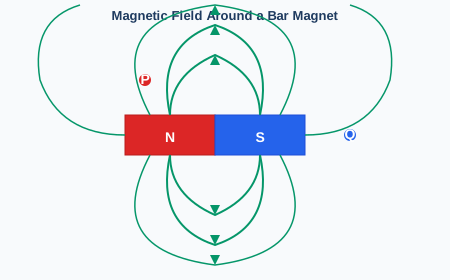
Detailed Explanation
Why A is Correct: Magnetic field strength is indicated by how closely packed the field lines are. At point P (near the north pole), the field lines are crowded together, showing a strong magnetic field. At point Q (farther away), the field lines are spread apart, indicating a weaker magnetic field.
Why Other Options Are Wrong:
- Field strength is NOT greater at Q - the widely spaced lines show weakness
- Field strength is NOT equal at both points - different line spacing means different strengths
- The relationship is clear from the diagram - not indeterminable
Helpful Tips: ✅ Dense field lines = Strong field ✅ Sparse field lines = Weak field ✅ Magnetic field strength decreases with distance from the magnet ✅ Always look at line spacing, not just proximity to poles
Remember: Field lines are like a crowd - packed together means "strong," spread out means "weak"!
A radioactive sample has been decaying for exactly one half-life. Which statement about the probability of decay for an individual nucleus is correct?
Detailed Explanation
Why A is Correct ✅
The probability of decay for any individual nucleus is constant and never changes. Each nucleus has the same chance of decaying in any given time period, regardless of how long the sample has been decaying or how many other nuclei have already decayed.
Think of it like flipping coins - each coin flip has a 50% chance of heads, no matter how many times you've flipped before!
Why Other Options Are Wrong ❌
- "Probability decreases" - Wrong! Individual nuclei don't "remember" time or get more stable
- "Probability increases" - Wrong! Nuclei don't become more likely to decay over time
- "Probability becomes zero" - Wrong! Nuclei can still decay after one half-life
💡 Key Tips:
- Half-life affects the sample, not individual nuclei
- Radioactive decay is random for each nucleus
- Probability = constant for each nucleus throughout the entire process
What is left behind after a supernova explosion?
Detailed Explanation
What's Left After a Supernova? 🌟💥
Why A is correct: When a massive star explodes in a supernova, its core collapses under extreme gravity. If the core is 1.4-3 times our Sun's mass, it becomes a neutron star - an incredibly dense object where protons and electrons are crushed together. If the core exceeds 3 solar masses, it becomes a black hole where gravity is so strong that nothing can escape.
Why other options are wrong:
- White dwarf: Forms when smaller stars (like our Sun) die peacefully, not from supernovas
- Red giant: This is a phase before a star dies, not what's left after
- New star formation: Supernovas can trigger new star birth in nearby gas clouds, but don't directly create new stars
💡 Memory tip: Think "supernova = super collapse" - only the most extreme objects (neutron stars/black holes) can result from such violent explosions!
Compare the speed of sound in air and water.
Detailed Explanation
Speed of Sound: Air vs Water
Why A is correct: Sound travels 4 times faster in water (~1,500 m/s) than in air (~340 m/s). This happens because water molecules are much closer together than air molecules, allowing sound vibrations to transfer more efficiently from one molecule to the next.
Why other answers are wrong:
- Sound does NOT travel faster in air - air is less dense
- The speeds are NOT equal - there's a huge difference
- Sound does NOT travel at the same speed in all materials
Helpful Tips:
- Remember: Denser materials = faster sound
- Think: Water is ~800x denser than air
- Real example: Put your ear underwater in a pool - you'll hear sounds very clearly because they travel so efficiently
- Memory trick: "Dense = Fast" for sound waves
The closer the molecules, the better they can "pass along" the sound vibration!
Describe what happens to the temperature of water during boiling at atmospheric pressure.
Detailed Explanation
Why A is Correct: During boiling at atmospheric pressure, water temperature stays constant at 100°C (212°F). Even though you keep adding heat, the temperature doesn't rise because all that extra energy goes into changing liquid water into steam - this is called the "latent heat of vaporization."
Why Other Answers Are Wrong:
- If temperature kept rising, the water would become superheated steam, not regular boiling
- If temperature dropped, the water would stop boiling
- Temperature fluctuations don't occur during steady boiling
Helpful Tips:
- Think of it like a "energy traffic jam" - heat energy gets "stuck" breaking the bonds between water molecules instead of increasing temperature
- This only applies at constant pressure (like normal atmospheric conditions)
- Once all water becomes steam, then temperature can rise again
- This principle applies to all pure substances during phase changes
What is the weight of a 5.0 kg object on Earth? (g = 10 m/s²)
Detailed Explanation
Weight vs. Mass Explanation
Why A (50 N) is correct: Weight = mass × gravitational acceleration Weight = 5.0 kg × 10 m/s² = 50 N
Weight is a force measured in Newtons (N), not kilograms!
Why other answers are wrong:
- If you got 5.0 kg - that's the mass, not weight
- If you got 0.5 N - you divided instead of multiplied
- If you got 500 N - you used wrong gravity value (maybe 100 instead of 10)
Helpful Tips: ✅ Remember: Weight = mg (mass × gravity) ✅ Units matter: Weight is always in Newtons (N) ✅ Mass stays the same everywhere, but weight changes with gravity ✅ On Earth: g ≈ 10 m/s² (sometimes given as 9.8 m/s²)
Quick check: A 1 kg object weighs 10 N on Earth!
What happens to the speed of sound when it travels from air into water?
Detailed Explanation
Why A is Correct: Sound speed increases dramatically when traveling from air to water. In air, sound moves at about 343 m/s, but in water it travels at approximately 1,500 m/s - over 4 times faster! This happens because water molecules are much closer together than air molecules, allowing sound vibrations to transfer more efficiently from particle to particle.
Why Other Options Are Wrong:
- Sound doesn't decrease in speed - water's density actually helps transmission
- Sound doesn't stop - it continues traveling, just faster
- The change is significant, not negligible
Helpful Tips:
- Remember: Denser medium = faster sound (counterintuitive but true!)
- Think about it: Water molecules are packed tighter, creating a better "highway" for sound waves
- Real example: This is why you can hear sounds underwater from far distances, and why sonar works so well in oceans
Key principle: Sound travels fastest through solids, slower through liquids, slowest through gases.
A ray of light travels from air into glass. The angle of incidence is 30° to the normal. The refractive index of glass is 1.5. Show which angle represents the angle of refraction.
Detailed Explanation
Light Refraction Explanation
Why A (19.5°) is correct:
Using Snell's Law: n₁sin θ₁ = n₂sin θ₂
Where:
- n₁ = 1 (air), θ₁ = 30°
- n₂ = 1.5 (glass), θ₂ = ?
Calculation: 1 × sin(30°) = 1.5 × sin θ₂ 0.5 = 1.5 × sin θ₂ sin θ₂ = 0.5/1.5 = 0.333 θ₂ = sin⁻¹(0.333) = 19.5°
Why other answers are wrong:
- Any angle larger than 19.5° violates Snell's Law
- Light always bends toward the normal when entering a denser medium
Helpful tips:
✓ Light bends toward normal: air → glass
✓ Light bends away from normal: glass → air
✓ Remember: denser medium = smaller angle to normal
✓ Always check your calculator is in degree mode!
A radioactive nucleus undergoes alpha decay. What is the change in the mass number and atomic number of the nucleus?
Detailed Explanation
Alpha Decay Explained:
Why A is correct: An alpha particle is a helium nucleus containing 2 protons and 2 neutrons. When a nucleus undergoes alpha decay, it literally ejects this alpha particle.
- Mass number (total protons + neutrons) decreases by 4 (losing 2 protons + 2 neutrons)
- Atomic number (number of protons) decreases by 2 (losing 2 protons)
Why other answers are wrong: Any answer suggesting increases is impossible—you can't gain particles by ejecting them. Different numbers (like decreasing by 1 or 3) don't match what an alpha particle actually contains.
Helpful Tips:
- Remember: Alpha = 2 protons + 2 neutrons = helium nucleus
- Use the equation: ²³⁸U → ²³⁴Th + ⁴He (alpha)
- Mass number: 238 → 234 (decreases by 4)
- Atomic number: 92 → 90 (decreases by 2)
Which circuit symbol shows a light-dependent resistor (LDR)?
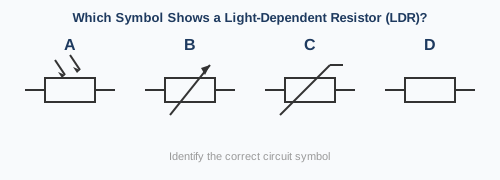
Detailed Explanation
Light-Dependent Resistor (LDR) Symbol Explanation
Why A is correct: An LDR symbol combines a standard resistor (zigzag or rectangle) with two diagonal arrows pointing TOWARD it. The arrows represent light hitting the component. When light increases, the LDR's resistance decreases - that's why the arrows point toward it, showing light "attacking" the resistance.
Why other options are wrong:
- Arrows pointing AWAY would suggest the component emits light (like an LED)
- No arrows would just be a regular resistor
- Wrong arrow direction or number indicates a different component
Helpful tips:
- Remember: "Light IN, Resistance DOWN" - arrows point IN
- Think of arrows as light rays hitting the sensor
- LDRs are used in automatic streetlights and camera light meters
- The more light hits it, the better it conducts electricity
The key is those incoming arrows - they're your visual clue!
A stone of weight 12 N has a mass of 1.2 kg. Which calculation gives the gravitational field strength at this location?
Detailed Explanation
Why A is Correct: Gravitational field strength (g) = Weight ÷ Mass
- Weight = 12 N
- Mass = 1.2 kg
- So g = 12 ÷ 1.2 = 10 N/kg ✓
Why Other Options Are Wrong:
- 1.2 ÷ 12 gives 0.1 N/kg (far too small - Earth's g is about 10 N/kg)
- 12 × 1.2 gives 14.4 N·kg (wrong units - not measuring field strength)
- 12 + 1.2 gives 13.2 N (adding different units makes no physical sense)
Helpful Tips:
- Remember: g = W ÷ m (like Force = ma rearranged)
- Units for gravitational field strength are N/kg (Newtons per kilogram)
- Earth's g ≈ 10 N/kg, so your answer should be close to this
- Weight and mass are different: weight depends on gravity, mass doesn't
State the SI base unit for mass.
Detailed Explanation
Why kg is correct: The kilogram (kg) is the official SI (International System of Units) base unit for mass. It's one of the seven fundamental SI base units that all other units are built from.
Why other options are wrong:
- g (gram): This is a derived unit, not a base unit. While commonly used, it's actually 1/1000 of a kilogram
- lb (pound): This is an imperial unit, not part of the SI system
- N (newton): This measures force, not mass (though they're related through F = ma)
Helpful tips:
- Remember "King Kong" = Kilogram for mass
- Don't confuse mass (kg) with weight (N) - mass stays constant, but weight changes with gravity
- Even though we often use grams in daily life, the kilogram is the official base unit
- SI base units are the building blocks - all other units derive from these seven fundamental ones
What happens to the mass number and atomic number when a uranium-235 nucleus undergoes nuclear fission into two smaller nuclei?
Detailed Explanation
Nuclear Fission of Uranium-235
Why A is correct: When uranium-235 splits, it follows the law of conservation of charge - the atomic numbers (protons) of the two smaller nuclei must add up to 92 (uranium's atomic number). However, the mass numbers don't add up to 235 because some mass is converted to energy and neutrons are released during fission.
Why other answers are wrong:
- If mass numbers added to 235, no energy would be released (violates E=mc²)
- If atomic numbers didn't add to 92, electric charge wouldn't be conserved
- Both conservation laws must be satisfied simultaneously
Helpful Tips:
- Atomic number = protons (always conserved in nuclear reactions)
- Mass number = protons + neutrons (can decrease due to mass-energy conversion)
- Remember: Fission releases energy because some mass becomes energy
- Typical fission: U-235 → two nuclei + 2-3 neutrons + energy
A 2 kg ball moving at 6 m/s collides with a stationary 3 kg ball. After collision, the 2 kg ball moves at 3 m/s. Which statement about the 3 kg ball's velocity after collision is correct?
Detailed Explanation
Why A is Correct:
Use conservation of momentum: Total momentum before = Total momentum after
Before collision:
- 2 kg ball: (2 kg)(6 m/s) = 12 kg⋅m/s
- 3 kg ball: (3 kg)(0 m/s) = 0 kg⋅m/s
- Total = 12 kg⋅m/s
After collision:
- 2 kg ball: (2 kg)(3 m/s) = 6 kg⋅m/s
- 3 kg ball: (3 kg)(v) = ?
- Total must still = 12 kg⋅m/s
Solving: 6 + 3v = 12 Therefore: v = 2 m/s
Why Others Are Wrong: Other answers would violate momentum conservation - the total momentum wouldn't equal 12 kg⋅m/s.
Helpful Tips:
- Always identify "before" and "after" scenarios
- Remember: momentum = mass × velocity
- Total momentum stays constant in collisions
- Set up the equation: momentum before = momentum after
A motor does 2400 J of work in lifting a load. The motor has a power output of 300 W. Calculate the time taken.
Detailed Explanation
Understanding Power, Work, and Time
Why 8.0 s is correct: We use the power formula: Power = Work ÷ Time
Rearranging: Time = Work ÷ Power
Given:
- Work = 2400 J
- Power = 300 W
Time = 2400 J ÷ 300 W = 8.0 s ✓
Common wrong answers and why they're incorrect:
- 24 s: Made by adding instead of dividing (2400 + 300)
- 0.125 s: Made by dividing power by work (300 ÷ 2400)
- 720,000: Made by multiplying (2400 × 300)
Helpful tips:
- Remember: P = W/t, so t = W/P
- Check units: Joules ÷ Watts = seconds ✓
- Use the triangle method: Cover the unknown variable
- Always substitute numbers into the rearranged formula
- Your answer should make physical sense - 8 seconds is reasonable for lifting a load
A positively charged particle moves horizontally to the right through a uniform magnetic field directed into the page. State the direction in which the magnetic force acts on the particle.
Detailed Explanation
Why A (Upward) is Correct:
Use the right-hand rule for magnetic force: F = qv × B
- Point your fingers in the direction of velocity (right)
- Curl them toward the magnetic field direction (into the page)
- Your thumb points in the force direction = upward
Since the particle is positively charged, the force direction matches the right-hand rule result.
Why Other Options Are Wrong:
- Downward: This would be correct for a negatively charged particle
- Left/Right: Force is always perpendicular to both velocity and magnetic field
- Into/Out of page: Force can't be parallel to the magnetic field direction
Helpful Tips:
- Remember: Force is always perpendicular to velocity
- For negative charges, reverse the right-hand rule result
- The magnetic force never changes the particle's speed, only direction
- Practice the right-hand rule - it's essential for all magnetic force problems!
A 2.0 kg object moving at 6.0 m/s collides and sticks to a stationary 3.0 kg object. Determine the velocity of the combined objects after the collision.
Detailed Explanation
Conservation of Momentum Problem
Why 2.4 m/s is correct: This is a perfectly inelastic collision (objects stick together). Use conservation of momentum:
Initial momentum = Final momentum m₁v₁ + m₂v₂ = (m₁ + m₂)vf
(2.0 kg)(6.0 m/s) + (3.0 kg)(0 m/s) = (2.0 + 3.0 kg)vf 12 kg⋅m/s = (5.0 kg)vf vf = 2.4 m/s
Common wrong answers:
- 6.0 m/s: Ignores the stationary object's mass
- 3.0 m/s: Simple average of masses, not momentum conservation
- 1.2 m/s: Calculation error or wrong formula
Helpful tips:
- Always identify collision type (elastic vs. inelastic)
- Remember stationary objects have zero velocity
- Total momentum before = total momentum after
- Final velocity is always less than initial in inelastic collisions
- Check units: kg⋅m/s for momentum
A radioactive source is placed behind different thicknesses of aluminium foil. Which statement correctly describes how the count rate changes as the foil thickness increases?
Detailed Explanation
Why A is Correct: Radiation follows an exponential decay law when passing through materials. As aluminum thickness increases, each additional layer absorbs a constant fraction of remaining radiation, not a fixed amount. This creates the characteristic curved exponential decay pattern where count rate drops rapidly at first, then more gradually.
Why Others Are Wrong:
- Linear decrease: Would mean each layer absorbs the same absolute number of particles - this doesn't happen in reality
- Increases: Aluminum absorbs radiation; it cannot increase the count rate
- Stays constant: Some radiation is always absorbed, so count rate must decrease
Helpful Tips:
- Remember: "Each layer absorbs a percentage, not a fixed number"
- Exponential decay creates a curved graph that never quite reaches zero
- This is the same mathematical pattern as radioactive decay itself
- Thicker materials = fewer particles get through
Two solid blocks, X and Y, have the same volume but X has a greater mass. What explains why block X is heavier than block Y?
Detailed Explanation
Why D is Correct: Density tells us how much "stuff" (mass) is packed into a certain amount of space (volume). Since both blocks take up the same amount of space, the only way Block X can have more mass is if its material is "packed tighter." This means Block X is made of a denser material.
Why the others are wrong:
- Options suggesting Block X is larger or has more volume are incorrect because the question states they are the same size.
- Options mentioning gravity are wrong because gravity pulls on both blocks equally; the difference in "heaviness" here is caused by the material itself, not a change in gravity.
Helpful Tip: Think of a sponge and a brick of the exact same size. The brick is much heavier because it is denser, even though it takes up the same amount of space as the sponge!
A probe is used to show the pressure $p$ exerted by a liquid at depth $h$, where the gravitational field strength is $g$. Which row correctly describes the density $ ho$ of a uniform liquid and shows the correct arrangement of the pressure formula?
Detailed Explanation
Why A is correct: A "uniform" liquid means its density (ρ) is constant—it stays the same throughout and does not change with depth. The standard formula for pressure in a liquid is p=ρgh. To isolate density, you rearrange the formula by dividing both sides by gh, which gives: ρ=ghp.
Why others are wrong:
- Incorrect Density: Any option suggesting density "increases with depth" is incorrect because the liquid is "uniform." In a uniform liquid, density is always the same.
- Incorrect Algebra: Other arrangements (like ρ=pgh or ρ=pgh) are mathematically wrong. They do not follow the rules of algebra for the base equation p=ρgh.
Helpful Tip: Always start by writing the original formula: p=ρgh. If you find rearranging tricky, remember that since ρ is being multiplied by gh, you must divide to move them to the other side.
A student uses diagrams to show different wave behaviors. Which statement is correct?
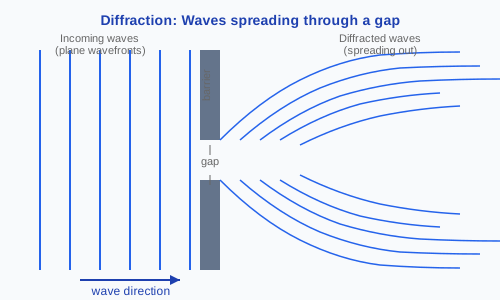
Detailed Explanation
Why A is correct: Diffraction is the scientific term for waves spreading out as they pass through a gap or travel around an edge. Imagine water ripples hitting a narrow opening in a harbor wall; they don’t just travel in a straight line—they fan out on the other side.
Why the others are wrong:
- Refraction occurs when a wave changes speed and direction because it moves from one medium into another (like light passing from air into glass).
- Reflection happens when a wave hits a surface and bounces back, like an echo or a mirror image.
Tips and Pitfalls:
- Tip: Diffraction is most noticeable when the size of the gap is similar to the wave's wavelength.
- Common Pitfall: Students often confuse Diffraction with Refraction. Remember: Diffraction is about Dispersing (spreading) through a gap, while Refraction is about waves bending due to speed changes.
An unknown electromagnetic wave has a higher frequency than radio waves. Which statement correctly describes the speed and wavelength of this unknown wave in a vacuum compared to radio waves?
Detailed Explanation
All electromagnetic (EM) waves, including radio waves and this unknown wave, travel at the same constant speed in a vacuum: the speed of light (c).
The relationship between speed (v), frequency (f), and wavelength (λ) is shown by the formula: v=f×λ. Since the speed is constant, frequency and wavelength have an inverse relationship. If the frequency increases, the wavelength must decrease. Therefore, a wave with a higher frequency must have a shorter wavelength.
Why other options are wrong:
- Any option suggesting a different speed is incorrect; all EM waves travel at 3×10⁸ m/s in a vacuum.
- Any option suggesting a longer wavelength is incorrect because frequency and wavelength move in opposite directions.
Tip: Think of a jump rope. Shaking it faster (high frequency) creates more "scrunched up" waves (short wavelength). Speed never changes for EM waves in a vacuum!
Describe the substance at $0\ ^\circ\text{C}$ as water freezes and the change in its molecules.
Detailed Explanation
At 0 ∘C, water is at its freezing point. During any phase change, the temperature remains constant, meaning both ice and liquid exist together until the water is completely frozen. To turn from a liquid to a solid, molecules must lose energy (heat) to their surroundings. This loss of energy causes them to slow down and lock into a fixed, ordered crystal structure.
Why other answers are wrong:
- If only liquid or only ice were mentioned, it wouldn't accurately describe the "freezing process" where both states coexist.
- Gaining energy or becoming "less ordered" describes melting (solid to liquid), which is the opposite of freezing.
Helpful Tip: Remember that during a phase change, energy is used to break or form bonds, so the temperature stays exactly the same until the change is finished!
The diagrams show four arrangements of identical resistors. Which arrangement will show the lowest total resistance between the terminals?
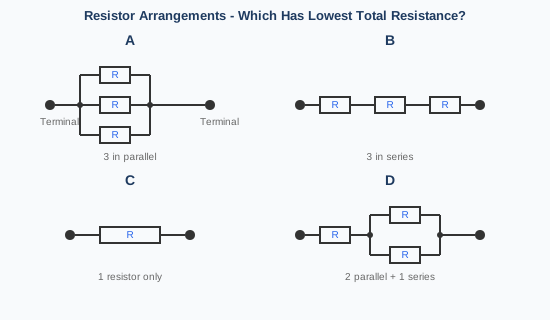
Detailed Explanation
Why it’s correct: When resistors are connected in parallel (Option A), you create multiple paths for the electricity to flow. Think of it like adding extra lanes to a highway; more lanes make it easier for traffic to move, even if the lanes have obstacles. In a parallel circuit, the total resistance is always lower than the resistance of any single resistor in the arrangement.
Why the others are wrong:
- Series arrangements: When resistors are in a single line, the current must push through all of them one after another. This adds the resistances together, making the total resistance much higher.
- Mixed arrangements: Any combination that includes resistors in series will naturally have a higher resistance than a purely parallel setup.
Top Tip: Adding resistors in series increases resistance (like making an obstacle course longer). Adding them in parallel decreases resistance (like opening more doors to exit a building).
The diagrams show displacement-distance graphs for two different waves. Wave X has a longer wavelength than wave Y. Which statement is correct?
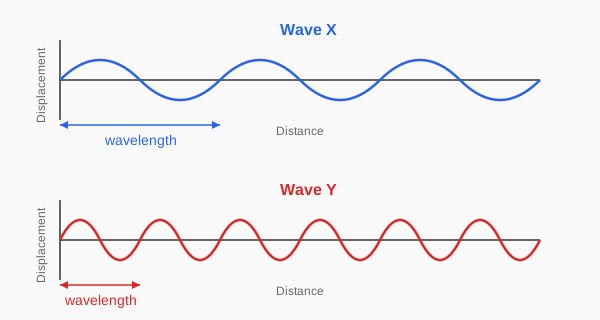
Detailed Explanation
Correct Answer: A
Why it’s correct: Wavelength and amplitude are independent properties of a wave.
- Wavelength is the horizontal distance between two peaks (how "wide" the wave is).
- Amplitude is the maximum vertical displacement from the center line (how "tall" the wave is).
Changing how wide a wave is does not automatically change how tall it is. Therefore, Wave X can be wider than Wave Y while still reaching the same height.
Why other options are incorrect: Most incorrect options suggest that wavelength and amplitude are linked (e.g., "Wave X must have a larger amplitude"). In physics, you can change the horizontal stretch of a wave without affecting its vertical height. Other options might mention frequency, but without knowing the speed of the waves, we cannot determine their frequency.
Helpful Tip: Always check your axes! On a displacement-distance graph:
- Y-axis = Amplitude (Vertical)
- X-axis = Wavelength (Horizontal) Because one is vertical and one is horizontal, they don't depend on each other!
State what happens to the remaining liquid when its most energetic molecules escape from the surface during evaporation.
Detailed Explanation
Imagine a sports team: if the fastest runners leave, the team’s average speed drops.
In a liquid, only the molecules with the highest kinetic energy (the "fastest") have enough strength to escape the surface. When these high-energy molecules leave, they take their energy with them. This leaves behind slower molecules with lower energy. Since temperature is simply a measure of the average kinetic energy of molecules, the liquid's temperature falls. This is known as evaporative cooling.
Why others are wrong:
- The average speed cannot increase if the fastest molecules are the ones leaving.
- The temperature cannot stay the same or rise because the liquid is losing its highest-energy particles.
Tip: Always link "average kinetic energy" directly to "temperature." If the average energy of the molecules goes down, the temperature must go down! This is why humans sweat to cool off.
The diagrams show four students performing different tasks. Which student does the most work on an object?
Detailed Explanation
To find the correct answer, use the formula: Work = Force × Distance.
Why A is correct: The student applies a force of 50 N over a distance of 0.2 m. Calculation: 50 N×0.2 m=10 Joules of work. In this specific question, this represents the highest value of energy transferred to the object.
Why the others are incorrect: In physics, "Work" only happens if the object moves in the direction of the force. Other options are usually wrong because:
- No movement: If a student just holds a heavy box or pushes a stationary wall, the distance is zero, so the Work is zero.
- Perpendicular motion: If a student carries a box horizontally, the lifting force is upward but the motion is sideways. This counts as zero work on the box.
Top Tip: Don't confuse "effort" with "work." You might get tired holding a heavy bag, but if it doesn't move, you aren't doing any physics work!
State how the speed of ultraviolet radiation compares to the speed of infrared radiation in a vacuum.
Detailed Explanation
EXPLANATION:
Ultraviolet (UV) and infrared (IR) are both members of the electromagnetic (EM) spectrum. In a vacuum (empty space), all EM waves travel at the exact same constant speed: the speed of light (3×10⁸ m/s).
Why other options are wrong: Any choice suggesting that one travels faster than the other is incorrect. While UV has a higher frequency and IR has a longer wavelength, these two properties balance each other out perfectly to maintain the same speed (v=fλ).
Helpful Tips & Pitfalls:
- Energy vs. Speed: A common mistake is thinking that "more energy" means "more speed." UV radiation has more energy than IR, but it does not move faster.
- The Medium Matters: EM waves only change speed when they leave a vacuum and enter a material like glass, water, or air. In a vacuum, they are all equal!
White light passes through a glass prism and undergoes dispersion. Which statement correctly describes the relative refraction of the colors in the visible spectrum?
Detailed Explanation
When white light enters a glass prism, it slows down and bends. This is called refraction. However, different colors travel at different speeds inside the glass.
Why A is correct:
- Violet light has a shorter wavelength and slows down the most, causing it to bend at the sharpest angle.
- Red light has a longer wavelength and stays relatively fast, so it bends the least. This difference in bending is what spreads white light into a rainbow.
Why other options are incorrect: Any statement suggesting red bends more than violet—or that they bend equally—is wrong. In glass, the rule is consistent: shorter wavelengths (violet/blue) always refract more than longer wavelengths (red/orange).
Helpful Tip: Remember the order ROYGBIV. Red is at the top because it is the "laziest" bender. Think: "Red stays Relaxed" (bends least), while "Violet is Violent" (bends the most)!
The measurements from a circuit show that 120 C of charge passes a point in 2.0 minutes. Which statement about the electric current is correct?
Detailed Explanation
To find the current, use the standard formula:
Current (I) = Charge (Q) ÷ Time (t)
Why A is correct:
- Identify the values: Charge (Q) is 120 C. Time (t) is 2.0 minutes.
- Convert units: In physics, time must be in seconds.
2.0 minutes×60 seconds=120 seconds. - Calculate: 120 C÷120 s=1.0 A.
Why other answers are incorrect: Any answer other than 1.0 A is mathematically incorrect. For example, if you forgot to convert minutes to seconds, you would get 120÷2=60 A, which is a common mistake.
Helpful Tip: Always check your units! The "Ampere" is defined as Coulombs per second. If you see time in minutes or hours, convert it to seconds immediately to avoid easy-to-miss errors.
An object has a mass of 500 g. Which value represents the weight of this object on Earth, where the gravitational field strength is 9.8 N/kg?
Detailed Explanation
To find the weight of an object, use the formula: Weight = mass × gravitational field strength (W=m×g).
Why A is correct:
- Convert the units: In physics, mass must be in kilograms (kg). Since there are 1,000 grams in a kilogram, 500g÷1000=0.5kg.
- Calculate: Multiply the mass by the gravity: 0.5kg×9.8N/kg=4.9N.
Why the other answers are wrong: Other options are incorrect because they usually come from common mistakes, such as forgetting to convert grams to kilograms (which would give a result of 4,900 N) or dividing the numbers instead of multiplying them.
Common Pitfall: The biggest trap in weight questions is using mass in grams. Always check your units first! If the mass is in grams, divide by 1,000 to get kg before you do anything else.
A ray of light in air enters a transparent rectangular glass block at an angle. Which description correctly shows the path of the light ray as it passes through the block and exits into the air?
Detailed Explanation
When light travels from air into glass, it enters a denser medium and slows down, causing it to bend towards the normal. When it exits from glass back into air, it speeds up and bends away from the normal. This makes A the correct choice.
Why other options are wrong:
- Any option suggesting the ray bends away from the normal upon entry is incorrect because light always slows down (and bends towards the normal) when entering a denser material like glass.
- If the ray didn't bend at all, it would imply that air and glass have the same density.
Helpful Tips:
- Remember FAST: Fast to Slow = Towards normal.
- Remember SFA: Slow to Fast = Away from normal.
- Common Pitfall: Always draw your "normal" line at 90° to the surface first to clearly see the direction of the bend!
Compare the masses of atomic particles; which statement correctly describes the mass of a proton and an electron?
Detailed Explanation
EXPLANATION:
The correct answer is A. In an atom, protons and neutrons contain nearly all the mass. A proton is about 1,840 times heavier than an electron. To visualize this, if a proton were a heavy bowling ball, an electron would be like a small marble!
Why other options are incorrect:
- Masses are equal: This is false. While protons and electrons have equal but opposite charges, their masses are vastly different.
- Electron is larger: This is incorrect. Electrons are the lightest subatomic particles; their mass is so small it is often rounded to zero in basic chemistry.
Helpful Tip: A common pitfall is confusing charge with mass.
- Charge: Protons (+1) and Electrons (-1) are equal.
- Mass: Protons are heavy; electrons are light.
Always remember: The nucleus (protons and neutrons) is the "heavy" center of the atom!
On Earth (g = 10 N/kg), a crate has a weight of 400 N. On a different planet, a rock also has a weight of 400 N. The rock is dropped from rest and falls 200 m in 10 s. What is the mass of the rock?
Detailed Explanation
To find the mass, we must follow two simple steps:
- Find gravity (g) on the new planet: Use the formula for falling objects: d=21gt2. Plugging in the numbers: 200=21×g×102. This simplifies to 200=50g, so g=4 m/s².
- Calculate mass (m): Use W=mg. The weight (W) is 400 N and g is 4. 400=m×4. Solving for m gives 100 kg.
Why other answers are wrong:
- 40 kg: This is the mass of the crate on Earth (400/10). You cannot use Earth's gravity for a different planet.
- 400 kg: This confuses mass (kg) with weight (N).
- 80 kg: This happens if you forget the "21" in the distance formula.
Common Pitfall: Don’t go on "autopilot" and use g=10! Always calculate the local gravity first if the problem is set on another planet.
State the name of the phenomenon where the wavelength of light from distant galaxies increases as they move away from the Earth at high speeds.
Detailed Explanation
EXPLANATION:
Why it’s correct:
As a galaxy moves away from Earth, the light waves it emits are "stretched" by the expansion of space. Because red light has the longest wavelength in the visible spectrum, this stretching causes the light to shift toward the red end. This is known as redshift.
Why other answers are incorrect:
- Blueshift: This is the opposite. It occurs when an object moves toward us, causing light waves to compress into shorter (bluer) wavelengths.
- Reflection/Refraction: These describe light bouncing off a surface or bending through a material; they do not involve the motion of galaxies.
Helpful Tip:
Remember the "Double R" rule: If an object is Receding (moving away), it is Redshifted.
Common Pitfall:
Redshift doesn't mean the galaxy looks bright red; it just means the light's wavelength is longer than it was when it started!
A rectangular block of weight 120 N has dimensions 50 cm, 100 cm and 200 cm. Which pressure is exerted on the ground when the block rests on its largest surface?
Detailed Explanation
To find the correct pressure, use the formula: Pressure = Force ÷ Area.
- Identify Force: The weight of the block is 120 N.
- Identify Area: For the largest surface, use the two biggest dimensions: 100 cm and 200 cm.
- Convert to Meters: Always use meters for Pascals (Pa). 100 cm = 1 m and 200 cm = 2 m.
- Calculate: Area = 1 m × 2 m = 2 m².
- Final Step: Pressure = 120 N ÷ 2 m² = 60 Pa. (Answer A)
Why other answers are wrong:
- 120 Pa: Result from using the medium surface (50 cm × 200 cm).
- 240 Pa: Result from using the smallest surface (50 cm × 100 cm).
- If you don't convert cm to meters, you will get a tiny decimal that doesn't match the options.
Tip: Convert cm to m before calculating the area to avoid confusion! Remember: 1 Pa = 1 N/m².
A metal plate with a central hole is heated. Which results show how the hole diameter changes and how the expansion of the solid plate compares to an equal volume of liquid?
Detailed Explanation
Why the correct answer is right: Think of thermal expansion like a photographic zoom. When you heat the plate, every part expands proportionally. Just as zooming into a photo makes a hole look larger, heating the plate increases the hole's diameter. Additionally, liquids expand more than solids because their particles are less tightly bound, allowing them to move further apart when heated.
Why the other options are wrong:
- Hole decreasing: This is a common mistake. People often imagine the metal expanding "inward" to fill the gap. In reality, the atoms push away from each other in all directions, enlarging the hole.
- Solid expanding more than liquid: This is incorrect because the rigid bonds in a solid restrict movement more than the weaker bonds in a liquid.
Helpful Tip: Always use the "Photographic Zoom" rule for holes. If you enlarge a picture of a donut, the hole gets bigger, not smaller!
A radioactive source of unknown isotope has an initial activity of 800 Bq. After 24 hours, the activity has fallen to 100 Bq. What is the half-life of this isotope?
Detailed Explanation
To find the half-life, count how many times the activity must be cut in half to get from 800 Bq to 100 Bq:
- 800 → 400 (1st half-life)
- 400 → 200 (2nd half-life)
- 200 → 100 (3rd half-life)
It took 3 half-lives to reach 100 Bq. Since the total time elapsed was 24 hours, divide the total time by the number of half-lives:
24 hours÷3=8 hours.
Why other answers are incorrect:
- 12 hours: Only 2 half-lives would have passed, leaving 200 Bq.
- 24 hours: Only 1 half-life would have passed, leaving 400 Bq.
- 3 hours: This would mean 8 half-lives passed, leaving only ~3 Bq.
Top Tip: Always draw the "halving chain" shown above. A common pitfall is dividing the time by the activity (24 ÷ 8) instead of counting the number of steps!
Which statement correctly describes the movement of air during convection?
Detailed Explanation
EXPLANATION:
Convection is the way heat travels through liquids and gases.
Why A is correct: When air is heated, its molecules move faster and spread out. This causes the air to expand. Because the same amount of air now takes up more space, it becomes less dense (lighter) than the cooler air around it. Just like a cork in water, this lighter air floats upward.
Why other options are wrong:
- Air does not contract (shrink) when heated; it expands.
- Warm air does not sink; it is pushed upward by heavier, cooler air.
- Cooling makes air more dense, not less dense.
Helpful Tip: Think of a hot air balloon. The burner heats the air, making it expand and become less dense than the outside air, which causes the balloon to rise!
Common Pitfall: Don't forget the order: Heat → Expand → Less Dense → Rise.
A straight wire is moved downwards through a magnetic field, inducing an electromotive force (e.m.f.) and a current. Which statement correctly describes the physics of this induction process and the resulting magnetic effects?
Detailed Explanation
This process is governed by Lenz’s Law, which states that the direction of an induced current always opposes the change that caused it.
Why A is correct: When the wire moves down, a current is induced. This current creates its own magnetic field around the wire. This new field interacts with the external magnetic field to produce a force. According to Lenz’s Law, this force must oppose the motion. Since the wire is moving down, the magnetic force must push upward.
Why other answers are incorrect:
- Any statement saying the force is downward is wrong; that would "help" the motion, violating the Law of Conservation of Energy.
- Any statement saying no force is produced is wrong; a current-carrying wire in a magnetic field always experiences a force (the Motor Effect).
Top Tip: Remember "Lenz = Oppose." The induced effect always tries to stop whatever motion started it!
State the relative charge of an electron and the relative charge of a neutron.
Detailed Explanation
Explanation:
The correct answer is A.
In chemistry, we use "relative charge" to compare subatomic particles. An electron always has a negative charge of -1. A neutron is neutral, which means it has a charge of 0.
Why the other options are incorrect:
- B & C: These incorrectly suggest that neutrons have a charge. Neutrons are always zero.
- D: This incorrectly gives the neutron a +1 charge. A proton has a +1 charge, not a neutron.
Helpful Tips & Pitfalls:
- Memory Trick: Use the first letters! Protons are Positive (+1), Neutrons are Neutral (0), and electrons are the opposite of protons (-1).
- Common Pitfall: Don’t confuse charge with mass. While a neutron has a relative mass of 1, its charge is 0. Always double-check which one the question is asking for!
A current-carrying wire is placed in a uniform magnetic field. State which orientation of the wire results in zero magnetic force.
Detailed Explanation
When a current-carrying wire is placed in a magnetic field, the force it experiences depends on its angle relative to the field lines.
Why it’s correct: Magnetic force is calculated using F=BILsin(θ). When the wire is parallel to the field, the angle (θ) is 0°. Since sin(0∘)=0, the total force becomes zero. Essentially, the current must "cut across" field lines to feel a push; moving along them creates no interaction.
Why other options are wrong:
- Perpendicular (90°): This results in the maximum possible force because the current cuts directly across the field.
- Any other angle (e.g., 45°): This results in a partial force (somewhere between zero and maximum).
Helpful Tip: Think of a person swimming in a river. If you swim with the current (parallel), you don't feel it pushing you sideways. If you try to swim across it (perpendicular), you feel the full force of the water!
Four rods made of different materials show how thermal energy is transferred when one end of each rod is heated. Each rod has the same length and diameter. Which statement correctly describes the conduction process in these rods?
Detailed Explanation
EXPLANATION:
Why the correct answer is correct: Conduction is how heat travels through solids. Metals are great conductors because they have free electrons that move quickly, bumping into atoms and transferring energy. However, every metal has a unique atomic structure. Because of these differences, some metals (like copper) allow heat to pass through much faster than others (like steel).
Why other answers are incorrect:
- Uniformity: Any claim that all metals conduct heat at the same rate is false; material type always matters.
- Insulators: Answers suggesting materials like plastic or wood conduct faster than metals are wrong; these are insulators that block heat flow.
- Process: Conduction happens in solids. If an answer mentions "fluids" or "rising air," it is describing convection, not conduction.
Student Tip: When the rods are the same size, the material is the only thing that changes the result.
Common Pitfall: Don’t assume all metals are equal! Always look for the specific material mentioned.
A 2000 W appliance is used for 15 minutes. What is the energy transferred in kilowatt-hours (kWh) and what is the main function of the fuse?
Detailed Explanation
To find the energy in kilowatt-hours (kWh), you must convert the units first:
- Power: 2000 W÷1000=2 kW
- Time: 15 minutes÷60=0.25 hours
- Energy: Power×Time=2 kW×0.25 h=0.5 kWh
The Fuse: A fuse is a safety device. If the current becomes too high, the wire inside melts and breaks the circuit to prevent overheating or fires.
Why other answers are wrong:
- Incorrect values (like 30,000 or 500) usually happen if you forget to convert Watts to kW or minutes to hours.
- A fuse does not "limit" or "smooth" the current; it only acts as a one-time emergency switch that stops the flow entirely.
Common Pitfall: Don’t just multiply 2000×15. Always check that your units match the final answer requested (kWh)!
An ideal transformer has 1000 turns on the primary coil. The primary voltage is 240 V and the secondary voltage is 12 V. Calculate the unknown number of turns on the secondary coil to ensure the device operates correctly.
Detailed Explanation
To find the number of turns, use the transformer formula: Primary Voltage (Vp)Secondary Voltage (Vs)=Primary Turns (Np)Secondary Turns (Ns)
Why A (50) is Correct
The voltage drops from 240V to 12V, which is a 20-fold decrease (240÷12=20). Because voltage is directly proportional to the number of turns, the secondary coil must also have 20 times fewer turns than the primary: 1000÷20=50 turns.
Why Other Answers are Wrong
Incorrect options usually result from:
- Flipping the ratio: Multiplying 1000×20 gives 20,000. This would be a step-up transformer, but here the voltage is decreasing.
- Calculation errors: Misplacing a decimal point (getting 5 or 500) during division.
Helpful Tip
Always identify if the device is step-up or step-down first. Since the voltage decreased (240→12), your answer must be smaller than 1000. If your result is larger, you flipped the formula!
State the nuclear process by which energy is released in the core of the Sun.
Detailed Explanation
EXPLANATION:
The Sun’s energy is produced through nuclear fusion. In the Sun’s core, extreme heat and pressure force small hydrogen nuclei to join together (fuse) to create larger helium nuclei. This process releases the massive amount of energy that powers the Sun.
Why other answers are incorrect:
- Nuclear Fission: This is the opposite process where a large nucleus (like uranium) splits into smaller ones. This happens in Earth’s nuclear power plants, not stars.
- Chemical Burning: The Sun isn't a "fire." Chemical reactions involve electrons, whereas fusion involves the nuclei of atoms and produces millions of times more energy.
- Helium to Hydrogen: This is backwards. Stars start with the lightest element (hydrogen) and build heavier ones.
Study Tip: Remember Fusion = Fusing. Think of "joining" two small things into one. Don't confuse it with Fission, which sounds like "fissure" (a split or crack).
State which statement about the planets in our Solar System is correct.
Detailed Explanation
EXPLANATION:
Why Answer A is Correct: Jupiter is known as the "King of the Planets." It is a gas giant so massive that it contains more than twice the mass of all other planets in our Solar System combined. In terms of size, you could fit over 1,300 Earths inside it!
Why common distractors are wrong:
- "Mercury is the hottest planet": While Mercury is closest to the Sun, Venus is actually the hottest because its thick atmosphere traps heat.
- "Saturn is the largest planet": Saturn has the most spectacular rings, but Jupiter is physically larger and heavier.
- "Mars is larger than Earth": Mars is actually a "miniature" world, only about half the size of Earth.
Helpful Tip: Don’t confuse distance with temperature. The closest planet (Mercury) isn't the hottest. Also, remember that the four outer "Gas Giants" are always much larger than the four inner "Rocky Planets."
A 4.0 kg trolley moving at 5.0 m/s collides with a stationary 1.0 kg trolley. They stick together. What is the velocity of the trolleys after the collision?
Detailed Explanation
To solve this, use the Law of Conservation of Momentum: Total momentum before a collision equals total momentum after.
- Calculate Initial Momentum: Only the 4.0 kg trolley is moving.
- Momentum=mass×velocity=4.0 kg×5.0 m/s=20 kg m/s.
- Combine the Masses: Since they stick together, the new total mass is 4.0 kg+1.0 kg=5.0 kg.
- Find Final Velocity: Divide the total momentum by the total mass.
- 20/5.0=4.0 m/s.
Why other answers are wrong:
- 5.0 m/s: Incorrectly assumes the speed doesn't drop even though the mass increased.
- Values lower than 4.0 m/s: These usually result from calculation errors or forgetting to include the first trolley's mass in the final total.
Student Tip: When objects stick together, always add their masses. Because the mass increases, the final velocity must be lower than the starting velocity.
An irregularly shaped stone of mass 120 g is lowered into a measuring cylinder containing 50 cm³ of water. The total volume of the water and stone rises to 80 cm³. What is the density of the stone, expressed in the standard SI unit for this quantity?
Detailed Explanation
To find the density, use the formula: Density = Mass ÷ Volume.
- Find the Volume: The stone's volume is the amount of water it displaces. Subtract the initial water level from the final level: 80 cm3−50 cm3=30 cm3.
- Calculate in g/cm³: Divide the mass by the volume: 120 g÷30 cm3=4 g/cm3.
- Convert to SI Units: The question asks for the SI unit (kg/m³). To convert g/cm³ to kg/m³, multiply by 1,000: 4×1,000=4000 kg/m3.
Why other answers are wrong: Common mistakes include using the initial volume (50) or final volume (80) instead of the difference, or forgetting to convert the units from g/cm³ to kg/m³.
Tip: Always check the required units! If the answer looks too small (like 4), you likely forgot to convert to the SI standard (kg/m³).
Why is a fuse included in the circuit of an electrical appliance?
Detailed Explanation
Why A is correct: A fuse is a safety device designed to protect the circuit. It contains a thin wire with a low melting point. If the current becomes too high (due to a fault or overload), the wire heats up and melts. This creates a gap in the circuit, which immediately stops the flow of electricity, preventing overheating and potential fires.
Why other answers are wrong:
- Voltage: Fuses do not change or regulate voltage.
- Limiting current: A fuse doesn't "dim" or "turn down" the current; it either allows it to flow normally or cuts it off entirely.
- Switching: While a fuse stops current, it isn't a regular "switch" used to turn appliances on and off.
Helpful Tips:
- Common Pitfall: Students often confuse fuses with circuit breakers. Both stop high current, but a fuse melts and must be replaced, while a breaker can be reset.
- Think of it as a "sacrificial" part: It destroys itself to save the rest of the appliance!
A machine lifts a 40 kg mass vertically through a distance of 5.0 m in 2.0 s. What is the work done on the mass?
Detailed Explanation
EXPLANATION:
To find the work done when lifting an object, use the formula:
Work = Force × Distance
In this case, the Force is the weight of the mass. Weight is calculated as Mass × Gravity (g). Assuming g=10 m/s2:
- Force: 40 kg×10 m/s2=400 N
- Work: 400 N×5.0 m=2000 J
Why other answers are incorrect:
- Forgetting Gravity: Multiplying just mass by distance (40×5=200) is a common mistake. You must use Newtons (weight), not kilograms.
- Using Time: Dividing by the 2.0 seconds calculates Power (1000 Watts), not Work. Work is independent of how fast the task is done.
💡 Tip: Don't be distracted by extra information! Time is often included in Work questions to trick you into calculating Power. If the question asks for Joules (J), ignore the seconds.
A student investigates the reflection of light from a plane mirror. A ray of light from an object 'q' strikes the mirror at an angle of 52° to the mirror surface. What is the angle of reflection?
Detailed Explanation
EXPLANATION:
The correct answer is 38° because of how we measure angles in physics.
- The Calculation: The question states the light hits the mirror at 52° to the surface. However, reflection angles are measured from the normal (an imaginary line at 90° to the mirror). To find the angle of incidence, subtract the surface angle from 90°: 90° - 52° = 38°.
- The Law of Reflection: This law states that the angle of incidence = the angle of reflection. Since the incidence angle is 38°, the reflection angle must also be 38°.
Why other answers are wrong: The most common wrong answer is 52°. This happens if you forget to measure from the normal and mistakenly use the angle to the mirror surface instead.
Top Tip: Always read carefully! If a question mentions the "mirror surface," you must subtract that number from 90° first.
An unknown radioactive isotope has an initial activity of 240 Bq. The half-life of the isotope is 10 minutes. What is the activity of the sample after 30 minutes have passed?
Detailed Explanation
To find the activity, first determine how many half-lives have passed: 30 minutes ÷ 10 minutes = 3 half-lives.
Starting at 240 Bq, we "halve" the activity three times:
- After 10 mins (1st half-life): 240 → 120 Bq
- After 20 mins (2nd half-life): 120 → 60 Bq
- After 30 mins (3rd half-life): 60 → 30 Bq
This makes 30 Bq the correct answer.
Why other answers are wrong:
- 120 Bq or 60 Bq are incorrect because they only account for one or two half-lives, respectively.
- 80 Bq is a common mistake where students divide the initial activity by 3 (240÷3) instead of halving it repeatedly.
💡 Helpful Tip: Radioactive decay isn't a simple division sum! Each half-life is a separate "step." Draw an arrow for each step to ensure you don't lose count.
Light enters glass from air. Which expression calculates the speed in glass?
Detailed Explanation
Why A is correct: The refractive index (n) tells us how much a material slows light down compared to its speed in a vacuum (c). The formula for refractive index is n=vc. By rearranging this to solve for the speed in glass (v), we get v=nc.
Why the others are wrong:
- c×n: Since n is always greater than 1, multiplying would make light faster than c. Nothing travels faster than the speed of light!
- n/c: This would give you a tiny decimal that doesn't represent a speed.
- n+c: You cannot add a dimensionless ratio (n) to a speed (c).
Helpful Tip: Always remember that light slows down when it enters a denser medium like glass. Since n is always bigger than 1, dividing c by n is the only way to get a smaller, realistic speed.
A student wants to measure the mass of a small rock, which instrument should they use?
Detailed Explanation
To measure mass (the amount of matter in an object), an electronic balance is the correct tool. It provides a precise digital reading, usually in grams or kilograms.
Why the other options are incorrect:
- Rulers are used to measure length, width, or height, not how much an object weighs.
- Graduated cylinders measure volume (the amount of space an object takes up), often by seeing how much water the rock displaces.
- Thermometers measure temperature (how hot or cold something is).
💡 Helpful Tip: Students often confuse mass and volume. Remember:
- Mass = How much "stuff" is inside (use a balance).
- Volume = How much space it fills (use a graduated cylinder).
⚠️ Common Pitfall: Always "tare" or zero your electronic balance before starting! If it doesn't show 0.00 before you begin, your measurement will be wrong.
A mass of 0.50 kg moves at 12 m/s, hits a wall and rebounds at 8.0 m/s. The collision lasts 0.20 s. State the magnitude of the change in momentum of the mass.
Detailed Explanation
EXPLANATION:
To find the change in momentum, we use the formula:
Change in Momentum=mass×(change in velocity)
Because the mass rebounds, its direction changes. If we treat the initial direction as positive (+12 m/s), the rebound direction is negative (−8 m/s). The total change in velocity is 12−(−8)=20 m/s.
Calculation: 0.50 kg×20 m/s=10 kg m/s.
Why wrong answers are incorrect:
- 2 kg m/s: This happens if you forget the direction change and subtract the speeds (12−8=4) instead of adding them.
- 6 or 4 kg m/s: These represent only the initial or final momentum, not the difference between them.
- 50 N: This is the force (10÷0.2 s), not the momentum.
Top Tip: Always watch for words like "rebound" or "bounce." They signal that you should add the speeds together to find the total change!
State which statement correctly compares the ionizing effect and the penetrating ability of alpha radiation and gamma radiation.
Detailed Explanation
Alpha particles are relatively large and have a +2 charge. Because of their size and charge, they easily knock electrons off atoms (making them strongly ionizing). However, because they interact so much with matter, they lose energy quickly and are stopped by a thin sheet of paper (making them less penetrating).
Gamma rays are high-energy waves with no mass or charge. They pass through most atoms without hitting anything, making them weakly ionizing. Because they rarely interact, they can travel through thick lead, making them highly penetrating.
Why other choices are wrong:
- Gamma radiation is never more ionizing than alpha.
- Alpha radiation is never more penetrating than gamma.
Helpful Tip: Remember the inverse relationship: the better radiation is at ionizing, the worse it is at penetrating! If it "hits" everything in its path, it won't get very far.
The velocity-time graphs show the motion of four objects. Which graph shows a ball falling through air as it speeds up at a decreasing rate?
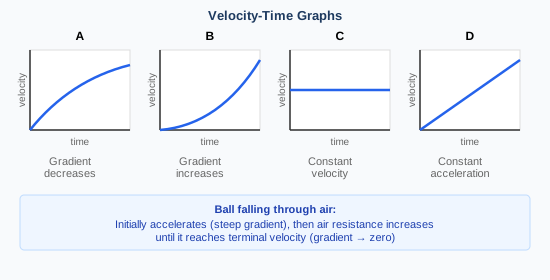
Detailed Explanation
EXPLANATION:
Why A is correct: On a velocity-time graph, the gradient (slope) represents acceleration.
- Speeding up: The line moves upwards as velocity increases.
- Decreasing rate: As the ball falls, air resistance increases, causing acceleration to drop. This makes the curve get flatter over time (the gradient decreases towards zero).
Why the others are wrong:
- Straight diagonal line: This shows constant acceleration (ignoring air resistance).
- Curve getting steeper: This shows acceleration is increasing, which doesn't happen to a falling object.
- Downward slope: This shows the object is slowing down, not speeding up.
Helpful Tip: Always remember: Gradient = Acceleration.
- If the graph is a curve, the acceleration is changing.
- If the graph becomes horizontal, the object has reached terminal velocity (zero acceleration).
A copper wire carries an electric current. Which row shows the particles that move to constitute the current and the direction of their movement relative to the conventional current?
Detailed Explanation
Why A is correct: In metal wires like copper, the only particles free to move are electrons. Because electrons have a negative charge, they are repelled by the negative terminal and move toward the positive terminal. However, conventional current is a historical convention defined as the flow of charge from positive to negative. Therefore, the actual movement of electrons is always opposite to the direction of conventional current.
Why the others are wrong:
- Protons/Positive ions: These are locked firmly in the metal's lattice structure and cannot move to carry current.
- Same direction: No particles in a copper wire move in the same direction as conventional current, as the moving charges (electrons) are negative.
Helpful Tip: Think of conventional current as a "historical mistake." Scientists originally guessed current flowed from positive to negative before they discovered electrons. Just remember: Electrons move Elsewhere (the opposite way)!
The diagram shows a uniform beam balanced on a pivot. A load of 6.0 N is placed 10 cm to the left of the pivot. To balance the beam, a force F is applied at a distance of 30 cm to the right of the pivot. What is the value of force F?
Detailed Explanation
To balance the beam, the Clockwise Moment must equal the Anticlockwise Moment. A "moment" is the turning effect of a force, calculated as: Moment = Force × Distance from pivot
Why A (2.0 N) is correct:
- Left Side (Anticlockwise): 6.0 N×10 cm=60 N⋅cm.
- Right Side (Clockwise): To balance, this must also equal 60 N⋅cm.
- Calculation: F×30 cm=60→F=60÷30=2.0 N.
Why other answers are incorrect: Incorrect options usually come from calculation errors, such as multiplying the wrong numbers (e.g., 6×30÷10=18 N) or swapping the force and distance.
Top Tips:
- The Pivot is Key: Always measure distance from the pivot, not from the ends of the beam.
- Units: You don’t need to convert cm to meters as long as you use the same unit on both sides!
An object of mass m moving with velocity v hits a wall and rebounds with velocity -v. Which expression and unit show the impulse acting on the object?
Detailed Explanation
Why A is Correct: Impulse is defined as the change in momentum (Δp=mvfinal−mvinitial). Because velocity is a vector, direction matters:
- Initial momentum: mv (moving toward the wall)
- Final momentum: −mv (moving away from the wall)
- Calculation: (−mv)−(mv)=−2mv.
The magnitude of this change is 2mv. The standard unit for impulse is N s (Newton-seconds), derived from Impulse=Force×time.
Why Other Options are Incorrect:
- 0: Incorrectly assumes that because the speed is the same, nothing changed. It ignores the change in direction.
- mv: Only accounts for half the bounce; it fails to subtract the final state from the initial state.
- Incorrect Units: Any option using units like kg⋅m/s2 (Force) or N/s is physically impossible for impulse.
Student Tip: Whenever an object rebounds or "bounces back," the change in momentum will always be double the initial momentum (2mv) if the speed stays the same. Always assign a plus and minus sign to the directions!
The diagrams show the magnetic field lines around a permanent bar magnet. At point p, the field lines are closer together than at point q. Which statement is correct?
Detailed Explanation
Why Answer A is Correct In magnetism, the density of field lines represents the strength of the field. Because the lines are closer together at point p, the magnetic field is stronger there than at point q. Furthermore, permanent magnets must be made of "hard" magnetic materials that retain their magnetism; steel is the standard choice for this.
Why the Others are Incorrect
- Options suggesting the field is stronger at q are wrong because wider spacing indicates a weaker field.
- Options suggesting the magnet is made of iron are wrong because iron is a "soft" magnetic material. It loses its magnetism easily and is used for temporary magnets (like electromagnets), not permanent ones.
Helpful Tips
- The "Crowd" Rule: Think of field lines like a crowd; the more "crowded" they are, the more powerful the force.
- Common Pitfall: Don't confuse iron and steel! Remember: Steel = Stays magnetic (Permanent); Iron = Instant magnetism (Temporary).
State how the probability of decay for one individual nucleus in a radioactive sample changes as the total activity of the sample decreases over time.
Detailed Explanation
EXPLANATION:
Radioactive decay is a random and spontaneous process. The probability of an individual nucleus decaying per unit of time is known as the decay constant. This is a fundamental property of the isotope and does not change.
- Why A is correct: Each nucleus acts independently. It doesn't "know" how much time has passed or how many other nuclei are nearby. Its individual "odds" of decaying remain constant until the moment it actually decays.
- Why others are wrong: Students often confuse Activity (total decays per second) with Probability. While Activity decreases because there are fewer nuclei left to decay, the individual probability for any single survivor stays the same.
Helpful Tip: Think of rolling a die. Even if you have fewer dice left in a game, the chance of any single die landing on a "6" is always 1 in 6. It never gets "tired" or less likely to hit that number!
A student uses a potential divider circuit containing a thermistor and a fixed resistor. As the temperature of the environment increases, which row correctly describes what happens to the resistance of the thermistor and the potential difference across the fixed resistor?
Detailed Explanation
The Correct Answer (A): Most thermistors are NTC (Negative Temperature Coefficient). This means as temperature increases, resistance decreases. In a potential divider, voltage is shared based on resistance. If the thermistor’s resistance drops, it takes a smaller "share" of the total voltage, leaving a larger share (PD) for the fixed resistor. Alternatively, lower total resistance increases the circuit current (I); since V=IR, more current through the fixed resistor means a higher PD.
Why others are wrong:
- B: If resistance decreases, the fixed resistor must get more voltage, not less.
- C & D: These assume resistance increases with heat, which is the opposite of how NTC thermistors work.
Top Tip: Use the acronym TURD: Temperature Up, Resistance Down. Also, remember that in series, the component with the highest resistance always grabs the biggest share of the voltage.
A ray of light hits a plane mirror at an angle of incidence of twenty degrees, which statement correctly describes the angle of the reflected ray?
Detailed Explanation
The Law of Reflection states that the angle of incidence is always equal to the angle of reflection (i=r). Because the light hits the mirror at 20°, it must bounce off at 20°.
Why A is correct: In physics, angles are always measured between the light ray and the normal—an imaginary dashed line drawn at 90° to the mirror’s surface. Since the input angle is 20° from the normal, the output angle must also be 20° from the normal.
Why other answers are wrong: Incorrect options usually try to trick you by:
- Measuring from the mirror surface instead of the normal.
- Using the "complementary angle" (70°), which is the gap between the ray and the mirror (90−20=70).
Student Tip: Always draw the "normal" line first! It’s the most common pitfall to measure from the flat mirror instead of that imaginary 90° line.
An ideal transformer steps up a 20 V a.c. supply to 100 V. The current in the primary coil is 10 A. What is the current in the secondary coil?
Detailed Explanation
EXPLANATION:
In an ideal transformer, power is conserved (Powerin=Powerout). Power is calculated as Voltage(V)×Current(I).
- Calculate Input Power: 20V×10A=200W.
- Find Secondary Current: Since the output power must also be 200W, use the formula P=V×I: 200W=100V×Isecondary Isecondary=200/100=2.0A.
Why other answers are incorrect: Incorrect options usually stem from two common mistakes:
- Multiplying incorrectly: Thinking current increases with voltage (e.g., guessing 50A). In reality, if voltage goes up, current must go down.
- Using the wrong ratio: Mixing up the numbers or multiplying the two voltages together.
Helpful Tip: Think of it as a trade-off. A transformer "steps up" voltage by "stepping down" current. Since the voltage increased by 5× (20V to 100V), the current must decrease by 5× (10A to 2A).
Equal masses of water and oil are initially at 20 °C. The same amount of thermal energy is supplied to both liquids. The oil reaches a final temperature of 50 °C. Calculations show the final temperature of the water. Which value identifies the water's final temperature, given that the specific heat capacity of water is twice that of oil?
Detailed Explanation
Specific heat capacity tells us how much energy is needed to change a substance's temperature. Because water’s capacity is twice that of oil, it is twice as "stubborn"—it requires double the energy to achieve the same temperature increase.
Since both liquids receive the same energy, water’s temperature rise (ΔT) will be half that of oil’s.
- Oil’s rise: 50∘C−20∘C=30∘C.
- Water’s rise: Half of 30∘C=15∘C.
- Final temp: 20∘C+15∘C= 35 °C.
Why other answers are wrong:
- 25 °C / 30 °C: These use the wrong calculation for the temperature change.
- 50 °C: Incorrectly assumes both liquids heat up at the same rate.
- 80 °C: This results from doubling the temperature rise instead of halving it.
Tip: A higher specific heat capacity means a smaller temperature change. Always add your calculated change to the initial temperature!
A metal block is moved from Earth to the Moon. What describes the change if any to the mass and the weight of the block on the actual lunar surface?
Detailed Explanation
Why A is correct:
- Mass is the amount of "stuff" (matter) in an object. Since you aren't adding or removing any metal, the mass stays exactly the same regardless of location.
- Weight is the pull of gravity on that mass. Because the Moon is smaller than Earth, its gravity is much weaker. Therefore, the block pulls down with less force, meaning its weight decreases.
Why other answers are incorrect:
- Any choice saying mass changes is wrong because mass is constant everywhere in the universe.
- Any choice saying weight increases or stays the same is wrong because the Moon’s gravity is only about 1/6th of Earth’s.
Helpful Tip: A common pitfall is using these words like we do in daily life. In science, remember: Mass is what you are; Weight is where you are!
Experiments are often performed to show how heating two different metal blocks changes their temperature. Both blocks have an identical mass of 1.0 kg and receive exactly the same amount of thermal energy. Block P temperature rises by 10 °C while block Q temperature rises by 20 °C. Which statement correctly describes the thermal property of these blocks based on this specific heating experiment?
Detailed Explanation
Thermal capacity is an object’s "resistance" to temperature change. Since both blocks received the same amount of energy, the block that shows the smallest temperature increase must have the higher capacity to "hold" or absorb that heat.
Because Block P’s temperature only rose by 10°C (compared to 20°C for Block Q), it is "harder" to heat up. Therefore, Block P has a higher thermal capacity.
Why other choices are incorrect:
- If Block Q had a higher capacity, its temperature would have changed less than Block P’s.
- If they had the same capacity, their temperature rises would be identical.
Helpful Tip: Think of thermal capacity like a sponge's size. A larger sponge (higher capacity) can absorb more water (heat) before it starts to leak (increase in temperature). Remember: Small temperature change = High thermal capacity.
State how the frequency of sound changes as it passes from air into a metal block.
Detailed Explanation
Why the correct answer is A: Frequency is determined solely by the source of the sound (like a vibrating string or speaker). When a wave moves from air into metal, the particles in the metal are forced to vibrate at the exact same rate as the air particles hitting them. Think of frequency as the "heartbeat" of the wave; once it starts, that pulse rate stays the same regardless of what material it enters.
Why other answers are incorrect: It is common to think frequency changes because the sound changes "quality," but it is actually the speed and wavelength that change. In a solid like metal, sound travels much faster than in air. To keep the frequency constant, the wavelength increases to compensate (v=fλ).
Helpful Tip: Always remember: Source = Frequency. Unless the source itself changes its vibration speed, the frequency will remain constant across all boundaries!
A lamp is connected in series with a cell. What happens to the current in the circuit and the lamp brightness when a second lamp is added in series?
Detailed Explanation
Why Answer A is Correct: In a series circuit, there is only one path for electricity to flow. This means the current is identical at every point in the loop. Adding a second lamp increases the total resistance of the circuit. Higher resistance makes it harder for the current to flow, so the overall current decreases. Because there is less current and the battery’s voltage is now shared between two lamps, both lamps will be dimmer.
Why the Others are Wrong:
- Any answer suggesting current is "different" at various points is wrong; current is never "used up."
- Any answer suggesting the lamps stay the same brightness is wrong because the total resistance has changed.
Helpful Tip: Think of a series circuit like a single water pipe. If you add a second "clog" (resistance), the water flow slows down everywhere in that pipe, not just in one spot!
State the change in the observed wavelength of light emitted from a distant galaxy as it moves away from Earth.
Detailed Explanation
EXPLANATION:
When a galaxy moves away from Earth, the light waves it emits are "stretched" as they travel through space. This phenomenon is known as redshift. Because the waves are stretched out, the distance between wave peaks becomes longer, which means the observed wavelength increases.
- Why other options are wrong: If the wavelength decreased, it would mean the galaxy is moving toward Earth (known as blueshift). If the wavelength stayed the same, the galaxy would be stationary relative to Earth.
Helpful Tip: Think of a Slinky being pulled apart; as the ends move away from each other, the gaps between the coils get wider (longer wavelength).
Common Pitfall: Don’t confuse wavelength with frequency. When a galaxy moves away, the wavelength increases, but the frequency decreases. Always read the question carefully to see which one is being asked!
A bar magnet's North pole is moved away from a solenoid. State the magnetic pole induced at the end of the solenoid nearest the magnet and the effect of this induced field on the magnet's motion.
Detailed Explanation
Why it’s correct: According to Lenz’s Law, an induced magnetic field always opposes the change causing it. Here, the North pole is moving away. To oppose this "leaving," the solenoid tries to pull the magnet back. Since opposite poles attract, the solenoid induces a South pole to attract the retreating North pole. This attraction creates a force that resists (opposes) the magnet’s motion.
Why others are wrong:
- Inducing a North pole would repel the magnet, actually helping it move away faster instead of opposing the motion.
- Inducing no pole is impossible because the moving magnetic field must create an electromagnetic response.
Helpful Tip: Think of the solenoid as "stubborn." It always wants to do the opposite of what the magnet is doing. If the magnet pulls away, the solenoid pulls it back. If the magnet pushes closer, the solenoid pushes it away!
What is a major source of the background radiation detected on Earth?
Detailed Explanation
Why A is correct: Radioactive elements like uranium, thorium, and potassium have existed in the Earth's crust since it formed. Because these elements are naturally found in rocks and soil, they constantly decay and release radiation into the environment. This is one of the largest natural contributors to the radiation we detect every day.
Why other answers are incorrect:
- Nuclear power: While it involves radioactivity, strict safety shielding means it contributes less than 1% of our total background exposure.
- Medical X-rays: These are man-made and occur only during specific procedures; they aren't a constant "background" source from the Earth itself.
- Electronics: Devices like phones emit non-ionizing radiation (radio waves), which is different from the ionizing background radiation measured here.
Tip: Always remember that "background" radiation is mostly natural. Most of our exposure comes from the ground, the air (radon gas), and space!
A lamp and a resistor are in series with a 12 V battery. The voltage across the lamp is 4 V and the current is 2 A. What is the energy transferred by the lamp in 2 minutes?
Detailed Explanation
To find the energy transferred by the lamp, use the formula:
Energy (E) = Voltage (V) × Current (I) × Time (t)
- Voltage: Use the lamp’s specific voltage (4 V), not the battery's 12 V.
- Current: 2 A.
- Time: Must be in seconds. 2 minutes = 120 seconds.
- Calculation: 4 V×2 A×120 s=960 J.
Why other answers are incorrect:
- 2880 J: This uses the total battery voltage (12 V). It calculates the energy for the entire circuit, not just the lamp.
- 1920 J: This uses the resistor’s voltage (8 V).
- 16 J: This uses minutes instead of converting to seconds (4×2×2).
Helpful Tip: Always check your units! In physics formulas, time must almost always be in seconds. Also, only use the voltage specifically across the component you are calculating for.
The diagrams show parallel light rays passing through a thin converging lens to meet at a point. Which distance correctly represents the focal length of the lens?
Detailed Explanation
Why A is Correct: By definition, the focal length is the distance between the optical center (the exact middle) of the lens and the principal focus (the point where parallel rays meet). In diagrams, this is the horizontal gap between the lens's vertical centerline and the "X" where the light rays cross.
Why other answers are wrong:
- Measuring from the outer surface or edge of the glass is incorrect; in physics, we measure from the center of a "thin lens."
- The distance between two different focal points (one on each side) is 2× the focal length.
- The vertical height or diameter of the lens does not represent the focal length.
💡 Helpful Tip: Always look for the point where parallel rays converge. Trace that point back to the centerline of the lens—that specific distance is your focal length!
State the properties of an ultrasound wave and its propagation.
Detailed Explanation
EXPLANATION:
Ultrasound is a high-frequency sound wave (above 20,000 Hz). All sound waves are longitudinal, meaning particles vibrate back and forth in the same direction the wave travels. This creates a series of compressions (high-pressure areas) and rarefactions (low-pressure areas). The distance between two consecutive compressions is the definition of one wavelength.
Why other answers are wrong:
- Transverse waves: Ultrasound is not transverse. Transverse waves (like light) vibrate at right angles to the direction of travel.
- Vacuums: Ultrasound is a mechanical wave; it requires a medium (like air, water, or tissue) and cannot travel through a vacuum.
- Measurement: Measuring from a compression to a rarefaction only gives you half a wavelength.
Common Pitfall: Don’t confuse ultrasound with electromagnetic waves (like X-rays). Ultrasound uses mechanical vibrations, not radiation!
An object has a weight of 20 N on Earth, where g = 10 N/kg. Which value shows the mass of this object?
Detailed Explanation
To find the mass of an object, use the formula: Weight = Mass × Gravity (W=mg).
Why A is correct: To find mass, rearrange the formula: Mass = Weight ÷ Gravity. Plug in the values: 20 N÷10 N/kg=2.0 kg.
Why the other answers are wrong:
- Wrong calculation: If you got 200, you likely multiplied the numbers (20×10) instead of dividing.
- Wrong units: Mass is always measured in kilograms (kg). Any answer ending in "N" (Newtons) represents weight or force, not mass.
Helpful Tips:
- The Formula Triangle: Place W at the top and m and g at the bottom. To find m, cover it with your finger, and you’ll see W over g.
- Units Matter: Always check if the question asks for mass (kg) or weight (N) before choosing your answer!
What is the original source of energy for both wind power and the formation of fossil fuels?
Detailed Explanation
Why the correct answer is correct: The Sun is the ultimate "battery" for Earth.
- Wind Power: The Sun heats the Earth’s surface unevenly. This creates differences in air pressure that cause air to move, creating wind.
- Fossil Fuels: Millions of years ago, plants captured sunlight through photosynthesis. When those plants (and the animals that ate them) died and were buried, that solar energy was "locked away," eventually turning into coal, oil, or gas.
Why other answers are incorrect:
- Heat from the Earth’s core only powers geothermal energy.
- Gravity is primarily responsible for tidal energy (along with the Moon).
- While fossil fuels contain chemical energy, they aren't the original source; they just store the Sun's energy.
Helpful Tip: When a question asks for the "original" or "ultimate" source of energy for anything involving weather or living things, the answer is almost always the Sun!
Experiments show that an ice cube melts much more quickly on a metal block than on a wooden block at room temperature. Which statement shows the correct molecular account of thermal conduction in the metal block?
Detailed Explanation
Why A is correct: In metals, heat is transferred through two simultaneous processes. First, lattice vibration: warmer atoms vibrate faster and collide with their neighbors, passing on kinetic energy. Second, metals have free (delocalized) electrons. These electrons move rapidly through the metal lattice, carrying energy much further and faster than vibrations alone. This "double mechanism" is why the metal block melts the ice so quickly.
Why others are wrong:
- Only vibrations: If an option suggests heat moves only through vibrating atoms, it is describing an insulator (like wood), which lacks free electrons.
- Movement of atoms: If an option suggests atoms travel from one end of the block to the other, it is describing convection. In solids, atoms stay in fixed positions and only vibrate.
Helpful Tip: The presence of free electrons is the "secret ingredient" that makes metals much better conductors than non-metals!
A heavy steel ball and a light wooden ball are dropped at the same time from the same height in a vacuum. What is true about the acceleration of the two balls as they fall?
Detailed Explanation
EXPLANATION:
In a vacuum, there is no air resistance. This means gravity is the only force acting on the balls. While gravity pulls harder on the heavy steel ball, that ball also has more "inertia" (it is harder to move). These two factors balance out perfectly, causing all objects to accelerate at the same constant rate regardless of their mass.
Why other answers are wrong: In daily life, we see light objects (like feathers) fall slowly because of air resistance, not because they are light. Without air, mass does not change how fast an object speeds up. Therefore, the heavy ball does not have a greater acceleration.
Helpful Tips:
- Look for the keyword "Vacuum": This is your cue to ignore air resistance!
- Force vs. Acceleration: A heavy object feels a stronger force of gravity, but its acceleration remains exactly the same as a light object.
A motor performs 12 000 J of work in 30 seconds. Calculate the power developed by the motor.
Detailed Explanation
To find the power developed, use the formula: Power = Work ÷ Time.
Why A is correct: Power is the rate at which work is done. By plugging the values into the formula:
- Work = 12,000 J
- Time = 30 s
- 12,000/30=400
The unit for power is Watts (W), so the answer is 400 W.
Why other answers are incorrect: Incorrect answers usually come from using the wrong math operation:
- Multiplying (12,000×30) gives 360,000, which is way too high.
- Dividing time by work (30/12,000) gives 0.0025, which is way too low.
💡 Helpful Tip: Always check your units! For this formula to work, time must be in seconds. If a question gives you time in minutes, multiply it by 60 before you start your calculation.
A wave travels from deep water into shallow water, where its speed and wavelength decrease. State what happens to the frequency of the wave.
Detailed Explanation
Why it’s correct: The frequency of a wave is determined solely by the source that created it (like a vibrating paddle). Once a wave is moving, changing the medium (moving from deep to shallow water) affects its speed and wavelength, but it cannot change how many waves the source produces per second.
Think of the wave equation: v=fλ. In shallow water, the wave slows down (v decreases). To keep the equation balanced, the wavelength (λ) must also decrease. This allows the frequency (f) to remain constant.
Why other answers are wrong:
- Frequency increases/decreases: These are incorrect because the medium cannot "add" or "remove" wave cycles. Only the original source controls the rate of the waves.
Top Tip: Think of frequency as the wave’s "DNA"—it stays the same regardless of where the wave travels. Remember: Source = Frequency and Medium = Speed.
Plane waves in a ripple tank approach a gap. The diagrams show the wave patterns after the gap. Which diagram shows the waves passing through a gap much wider than the wavelength, and what happens to the wavelength of the waves?
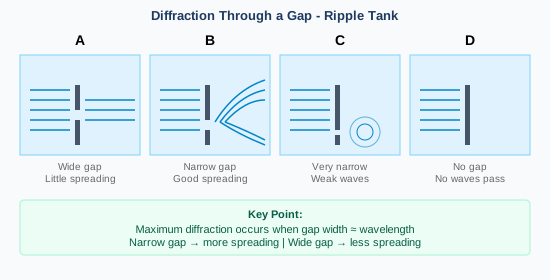
Detailed Explanation
Why it’s correct: When a gap is much wider than the wavelength, very little spreading occurs. This spreading is called diffraction. Significant diffraction only happens when the gap size is similar to the wavelength. Furthermore, because the waves are still in the same medium (water) and the depth hasn't changed, their speed remains constant. Therefore, the wavelength remains unchanged.
Why the others are wrong:
- Any diagram showing waves spreading out in wide circles is incorrect; that only happens with narrow gaps.
- Any diagram where the distance between crests (wavelength) increases or decreases is incorrect because the wave speed hasn't changed.
Helpful Tip: Think of it this way: Wide gap = waves go straight through. Spreading only happens when waves have to "squeeze" through a tiny opening.
Common Pitfall: Don’t confuse diffraction (bending through a gap) with refraction (changing speed/wavelength). Wavelength only changes if the water depth changes!
A beam of electrons travels from left to right through a magnetic field directed out of the page. Which row correctly identifies the direction of the magnetic force on the electrons and a magnetic material?
Detailed Explanation
EXPLANATION:
The correct answer is A because of two main principles:
- Magnetic Force: To find the direction, use Fleming’s Left-Hand Rule. Electrons are negative, so if they move right, the conventional current flows to the left. Point your first finger out of the page (Field) and your second finger to the left (Current). Your thumb will point downward, representing the force.
- Magnetic Material: Iron is one of the few elements (along with nickel and cobalt) that is naturally magnetic.
Why other options are wrong:
- Any option stating the force is upward is incorrect because it likely used the direction of the electrons instead of the current.
- Options listing Aluminum or Copper are wrong because these metals are non-magnetic and are not attracted to magnets.
💡 Top Tip: The most common mistake is forgetting that Current is opposite to Electron flow. Always flip the direction before using your left hand!
Four different 1.0 kg blocks are supplied with the same amount of thermal energy. Their temperature rises are measured. Which material has the highest specific heat capacity?
Detailed Explanation
Why A is correct: Specific heat capacity measures how much energy a material needs to increase its temperature. If you give the same amount of energy to different blocks, the material that "resists" changing its temperature the most (the smallest rise) has the highest specific heat capacity. It effectively has a larger "tank" to fill before the temperature moves.
Why the others are wrong: Materials with larger temperature rises (like 5 °C or 10 °C) are "easier" to heat up. Because their temperature jumps significantly with the same amount of energy, they have a lower specific heat capacity.
Tip: Think of specific heat as "thermal stubbornness." The higher the capacity, the more the material resists a change in temperature.
Common Pitfall: Don't pick the biggest number! Students often choose the largest temperature rise because they see the word "highest," but for specific heat, the smallest change indicates the highest capacity.
A liquid-in-glass thermometer is placed in a beaker of hot water. Which statement correctly explains why the liquid level rises inside the narrow capillary tube?
Detailed Explanation
EXPLANATION:
When the thermometer is heated, the molecules in the liquid gain energy and move faster, pushing each other further apart. This causes the liquid’s volume to increase (thermal expansion). While the glass bulb also expands, the liquid expands much more than the glass. Because the liquid has more volume and nowhere else to go, it is forced up the narrow capillary tube.
Why other answers are wrong:
- If the glass expanded more than the liquid, the liquid level would actually drop.
- Molecules never change size or grow; they only change the amount of space between them.
- Air pressure does not cause the rise; it is purely due to the expansion of the liquid.
Helpful Tip: A common pitfall is forgetting that the glass expands too! A thermometer only works because the liquid expands at a significantly higher rate than the glass container.
A train travels a distance of 240 km in a time of 3.0 hours. What is the average speed of the train?
Detailed Explanation
To find the average speed, we use a simple formula:
Speed = Distance ÷ Time
Why 80 km/h is correct:
Plug the numbers from the question into the formula:
240 km ÷ 3.0 hours = 80 km/h.
This means the train travels 80 kilometers for every hour of the journey.
Why other answers are incorrect:
- Multiplying (e.g., 720 km/h): Speed is distance divided by time, not multiplied (240×3).
- Reversing the formula (e.g., 0.0125 km/h): This happens if you divide time by distance (3÷240).
- Adding/Subtracting: Speed represents a rate of change, so you must use division.
Helpful Tips:
- The DST Triangle: Use the "Distance-Speed-Time" triangle. Cover "Speed" with your finger, and you’ll see "Distance over Time" (D ÷ T).
- Check Units: Ensure the units match the answer (km and h result in km/h).
A rectangular block measures 5.0 cm by 2.0 cm by 2.0 cm. The block is in a container of mass 20 g. The total mass is 100 g. Calculate the density of the block.
Detailed Explanation
To find the density of the block, follow these three simple steps:
- Find the mass of the block: The total mass is 100g, but the container weighs 20g. Subtract the container to find the block's mass: 100g−20g=80g.
- Find the volume: Multiply the dimensions together: 5.0×2.0×2.0=20 cm3.
- Calculate density: Use the formula Density=Mass÷Volume. So, 80÷20=4.0 g/cm3.
Why other answers are wrong: Common mistakes include using the total mass (100÷20=5.0 g/cm3) or forgetting to multiply all three sides for volume. Always ensure you are using the mass of the object alone.
💡 Top Tip: Read carefully! If a question mentions a "total mass" and a "container mass," you almost always need to subtract to find the object's actual mass first.
The descriptions show the properties of radioactive emissions. Which description correctly shows the behavior of alpha particles when they hit a thin sheet of paper?
Detailed Explanation
Alpha particles are the "heavyweights" of radiation. Because they consist of two protons and two neutrons, they are relatively large and carry a double positive charge. This size makes them very likely to bump into atoms in their path. When they hit a thin sheet of paper, they collide with the paper's molecules and lose all their energy immediately. This is why they have the lowest penetrating power.
Why other options are wrong:
- "They pass through": This is incorrect because only Beta particles and Gamma rays have enough energy to penetrate solids like paper.
- "They are reflected": Radiation is typically absorbed or transmitted, not "bounced back" like a ball off a wall.
Study Tip: Remember the "Radiation Rule of Three":
- Alpha: Stopped by paper.
- Beta: Passes paper, stopped by aluminum.
- Gamma: Passes both, reduced by thick lead.
What is the best material for the core of a temporary electromagnet and why?
Detailed Explanation
Soft iron is the ideal material because it is a soft magnetic material. This means it magnetizes quickly when the current is turned on, but loses its magnetism almost instantly when the current is switched off. This "on-off" control is exactly what makes an electromagnet "temporary."
Why other options are wrong:
- Steel: Steel is a hard magnetic material. Once magnetized, it stays magnetic even after the power is turned off. This creates a permanent magnet, which isn't useful for a temporary device like a scrap metal crane or a doorbell.
- Non-magnetic materials (like copper or wood): These would not concentrate the magnetic field at all, making the electromagnet very weak.
Top Tip: In physics, "soft" doesn't mean the metal is squishy! It refers to how easily the material "lets go" of its magnetism. Just remember: Iron for Instant (temporary) magnets; Steel for Stay (permanent) magnets.
A motor with a power of 50 W works for 10 s. Calculate the unknown energy transferred by the motor during this specific time interval mentioned.
Detailed Explanation
To find the energy transferred, we use the formula:
Energy (J) = Power (W) × Time (s)
Why A is correct:
By plugging the numbers into the formula, we get:
50 W×10 s=500 J.
Power measures how much energy is transferred every second. Since this motor transfers 50 Joules every second and runs for 10 seconds, the total energy is 500 Joules.
Why other answers are incorrect:
Incorrect choices usually come from using the wrong mathematical operation, such as:
- Dividing power by time (50÷10=5).
- Dividing time by power (10÷50=0.2).
- Adding the numbers together (50+10=60).
💡 Student Tip:
Use the formula triangle with E at the top and P and t at the bottom. Since P and t are side-by-side, you multiply them. Always check that your time is in seconds before calculating!
Observations of smoke particles in a cell show a random, zig-zag motion. Which statement correctly explains the observations and the properties of the molecules in the cell?
Detailed Explanation
This phenomenon is called Brownian Motion.
Why A is correct: Smoke particles are large enough to see under a microscope, but the air molecules surrounding them are much smaller and invisible. These tiny air molecules move at very high speeds and constantly bombard the smoke particles from all sides. Because these collisions are uneven, the smoke particles get knocked around in a random, zig-zag pattern.
Why the others are wrong:
- Smoke particles hitting each other: This happens rarely and doesn't explain the constant motion.
- Smoke moving on its own: Particles don’t have their own "power"; they only move because something hits them.
- Visible air molecules: Air molecules are far too small to be seen with a standard microscope.
Tips & Pitfalls:
- Size matters: Remember that the visible particle (smoke) is being hit by invisible molecules (air).
- Common Pitfall: Don't confuse this with "convection" (heat rising). Brownian motion is about individual molecular collisions.
Diagrams show how celestial bodies move. Which statement correctly describes the movement of a star and a planet?
Detailed Explanation
Why it’s correct: In space, gravity dictates movement. Stars are massive objects with very strong gravitational pulls. Because a star has much more mass than a planet, it holds the planet in a curved path called an orbit. Just like Earth orbits the Sun, planets always revolve around their parent stars.
Why other options are wrong:
- A star does not orbit a planet: Stars are too large to be pulled into orbit by a smaller planet.
- They aren't stationary: No celestial body stays perfectly still; gravity is always causing objects to move.
Helpful Tip: Think of the "Big Boss" rule: the much larger object stays in the center, and the smaller object does the circling.
Common Pitfall: Don’t be confused by how stars "move" across the sky at night. That is an illusion caused by the Earth spinning, not the star orbiting us!
A sound wave travels from air into a water tank. Which row shows the correct changes to the frequency and the speed of the wave?
Detailed Explanation
Why the correct answer is A:
- Frequency: The frequency of a wave is determined solely by its source (like a speaker or a tuning fork). When a wave moves from one medium to another, the frequency never changes.
- Speed: Sound is a mechanical wave that relies on particles to travel. Because water is denser than air and its particles are more tightly packed, they can pass vibrations along much faster. Therefore, sound speeds up when entering water.
Why the other options are wrong:
- Options suggesting frequency changes are incorrect because frequency is a "property of the source," not the material.
- Options suggesting the speed decreases are incorrect; while light slows down in water, sound always travels faster in liquids and solids than in gases.
💡 Top Tip: A common pitfall is confusing sound with light. Remember: Sound needs particles to move, so denser = faster. If the speed increases but frequency stays the same, the wavelength must also increase!
What happens to the pressure of a gas when its volume is increased while the temperature is kept constant?
Detailed Explanation
Why the correct answer is correct: Pressure is created by gas molecules hitting the walls of their container. When you increase the volume, the molecules have more room to move. Because the temperature is constant, the molecules move at the same speed, but they now have to travel further to reach a wall. This means they hit the walls less often (the frequency of collisions decreases), leading to lower pressure.
Why other answers are incorrect:
- Any option suggesting pressure increases is wrong because volume and pressure have an inverse relationship (Boyle’s Law).
- Any option suggesting molecules change speed is wrong because molecular speed only changes if the temperature changes.
Pro Tip: Don't confuse speed with frequency. Even if molecules move at the same speed, they will hit the walls less often if the "room" gets bigger!
A metal box of weight 300 N has a base area of 0.1 m². What is the pressure exerted by the box on the ground?
Detailed Explanation
Why Choice A is Correct Pressure is a measure of how much force is spread over a specific area. To find it, use the formula: Pressure = Force ÷ Area
In this problem, the weight of the box is the Force (300 N) and the base is the Area (0.1 m²). Calculation: 300÷0.1=3000 Pa.
Why Other Choices are Incorrect
- 30 Pa: This happens if you incorrectly divide by 10 instead of 0.1.
- 300 Pa: This happens if you forget to divide by the area entirely.
- 30,000 Pa: This happens if you multiply the numbers instead of dividing.
Helpful Tips
- Decimal Division: Remember that dividing by a decimal smaller than 1 (like 0.1) makes your final answer larger, not smaller!
- Check Units: Ensure your Force is in Newtons (N) and Area is in m2 to get the answer in Pascals (Pa).
Radioactive sources emit radiation that passes through different materials. Three diagrams show how alpha particles, beta particles, and gamma rays behave when they encounter lead or aluminium. Which specific radiation type is stopped by a thick sheet of lead but not by thin aluminium sheets?
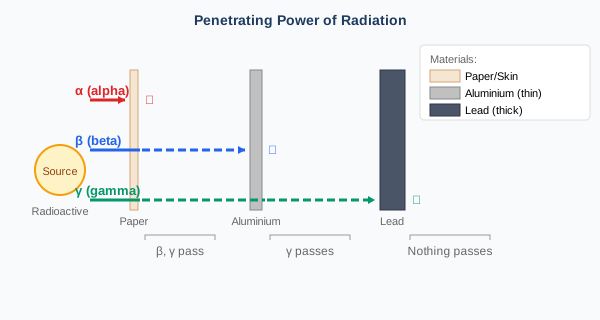
Detailed Explanation
Gamma radiation is the correct answer because it has the highest penetrating power. Since gamma rays are high-energy waves (not particles), they easily pass through thin materials like paper and aluminium. It takes a very dense material, like thick lead, to absorb and stop them.
Why others are wrong:
- Alpha particles are the least penetrating; they are blocked by a simple sheet of paper or even a few centimeters of air.
- Beta particles are stronger than alpha, but they are stopped by a thin sheet of aluminium.
Student Tip: Think of the materials as filters of increasing strength:
- Alpha = Stopped by Paper
- Beta = Stopped by Aluminium
- Gamma = Stopped by Lead
Common Pitfall: Don’t confuse penetrating power (how easily it passes through objects) with ionizing power (how much damage it does). Alpha is the most ionizing but the least penetrating!
A card with the word 'IF' is placed in front of a plane mirror. Which diagram shows the correct image produced by the mirror?
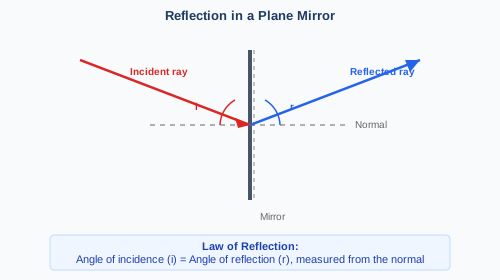
Detailed Explanation
In a plane mirror, images undergo lateral inversion. This means the image is flipped horizontally (left-to-right), but not vertically (upside-down).
Why A is correct: When the word "IF" is reflected, the entire sequence reverses. The 'F', which was on the right, appears on the left side of the reflection and is turned backward (ꟻ). The 'I' moves to the right. Since 'I' is symmetrical, it looks the same, resulting in the image "ꟻI".
Why other answers are wrong:
- No flip: If the image still looks like "IF," it ignores lateral inversion.
- Upside down: This is vertical inversion, which only happens in floor mirrors or water reflections, not a standard wall mirror.
Helpful Tip: The part of the object closest to the mirror always appears closest in the reflection. Imagine the 'F' is touching the mirror; its reflection must also touch the mirror!
Which statement correctly describes the specific heat capacity of a substance? Consider the relationship between the thermal energy transferred, the mass of the material, and its resulting temperature change.
Detailed Explanation
Why it’s correct: Specific heat capacity is the energy needed to warm up a material. To make it a standard measurement, we define it using set units: exactly 1.0 kg of the substance and a temperature rise of exactly 1.0 °C. Answer A is correct because it includes all three essential parts of the formula (Q=mcΔT): energy, mass, and temperature change.
Why other answers are wrong:
- If an answer misses the mass (1 kg), it is describing "Heat Capacity," not Specific Heat Capacity.
- If it mentions melting or boiling, it is describing "Latent Heat." Specific heat is only about changing temperature, not the state of matter.
Helpful Tips:
- The "Specific" Trick: In physics, the word "specific" almost always means "per unit mass" (per kg).
- Units matter: Always look for "kg" and "°C" (or Kelvin) in the definition!
State which statement correctly describes the properties of radio waves and gamma rays as they travel through a vacuum.
Detailed Explanation
Correct Answer: A
Why it’s correct: Radio waves and gamma rays are both members of the Electromagnetic (EM) Spectrum. All EM waves share two fundamental properties when traveling through a vacuum:
- They are transverse waves (their oscillations are at right angles to the direction of travel).
- They travel at the exact same speed: the speed of light (3×10⁸ m/s).
Why other answers are wrong:
- Longitudinal: EM waves are never longitudinal; only waves like sound are.
- Different speeds: While they have different frequencies and wavelengths, their speed in a vacuum is a universal constant. One is not "faster" than the other.
Student Tip: A common pitfall is thinking that high-energy waves (like gamma rays) travel faster than low-energy waves (like radio waves). They don’t! In a vacuum, every EM wave is in a race that always ends in a tie.
State which description of the Solar System is correct.
Detailed Explanation
The Solar System is our small neighborhood in space. The correct answer is C because our system is defined by the objects that orbit our specific star: the Sun. While there are billions of stars in the universe, there is only one at the heart of our own Solar System.
Why the others are wrong:
- Confusing the System with the Galaxy: Many students think the Solar System has billions of stars. They are actually thinking of the Milky Way Galaxy, which contains our Solar System plus billions of other stars.
- Planets aren't Stars: Objects like Jupiter or Earth are planets, not stars, because they don't create their own light through nuclear fusion.
Helpful Tip: Remember the name! "Solar" comes from Sol, the Latin name for the Sun. A "Solar System" refers specifically to the Sun and its family of planets.
Two blocks, X and Y, are placed on a frictionless horizontal surface. Block X has a larger mass than block Y. Which statement explains why block X is more difficult to accelerate horizontally than block Y?
Detailed Explanation
EXPLANATION:
Mass is a direct measure of inertia, which is an object's "stubbornness" or resistance to any change in its motion. Because block X has more mass, it has more inertia, making it naturally harder to start moving, stop, or speed up compared to the lighter block Y.
Why other answers are wrong:
- Weight & Gravity: While block X is heavier, weight is a downward force. On a horizontal, frictionless surface, gravity doesn’t resist sideways motion; only mass (inertia) does.
- Friction: The question states the surface is frictionless, so surface grip is not a factor here.
Helpful Tip: Don’t confuse mass with weight! Even in deep space where objects are weightless, a massive ship is still harder to accelerate than a small pebble because it still has the same amount of mass and inertia. Inertia depends only on mass!
What is a property of steel that makes it suitable for use as a permanent magnet?
Detailed Explanation
Steel is a hard magnetic material. To be a "permanent" magnet, a material must keep its magnetism long after the magnetizing force is removed. While steel takes more effort to magnetize initially, its internal structure "locks" the magnetism in place, making it stay magnetized.
Why the other options are wrong: In contrast, materials that are "easy to magnetize and easy to demagnetize" (like soft iron) are known as soft magnetic materials. These are used for temporary magnets (like electromagnets) because they lose their magnetism as soon as the power is turned off. If a material cannot stay magnetized, it fails as a permanent magnet.
Top Tip: Remember the Hard/Soft rule:
- Hard magnetic materials (Steel) = Hard to change = Permanent.
- Soft magnetic materials (Iron) = Easy to change = Temporary.
A rectangular block measures 2.0 cm by 3.0 cm by 4.0 cm. It is lowered into a measuring cylinder containing 50 cm³ of water. Which calculation determines the new water level in the cylinder?
Detailed Explanation
When you submerge an object, it "pushes" the water up. This is called displacement. The volume of water moved is exactly equal to the volume of the object added.
Why A is Correct: To find the block’s volume, multiply its dimensions: (2.0×3.0×4.0). Because the block is placed into the existing 50 cm³ of water, the new level is the starting volume + the block's volume.
Why others are incorrect:
- Subtraction: Subtracting would mean the water level dropped, which is impossible when adding an object.
- Volume alone: Ignoring the "50" fails to account for the water already in the cylinder.
- Two dimensions: Multiplying only two numbers gives area, not the 3D space (volume) the block occupies.
Helpful Tip: Always check that your units match! In physics, 1 cm3=1 ml. If the block floats, it only displaces the volume of the part underwater.
A 500 g block of ice at 0 °C is supplied with 167 000 J of thermal energy. The specific latent heat of fusion of ice is 334 000 J/kg and the specific heat capacity of water is 4200 J/(kg °C). What is the final temperature of the substance?
Detailed Explanation
EXPLANATION:
To find the energy needed to melt the ice, use the formula Q=mLf.
First, convert grams to kilograms: 500 g=0.5 kg.
Energy needed to melt = 0.5 kg×334,000 J/kg=167,000 J.
Because the energy supplied (167,000 J) is exactly the amount needed to melt the ice, the substance completes the phase change but has no energy left to increase its temperature. During melting, the temperature remains constant at 0 °C.
- Why wrong answers are incorrect: Any temperature above 0 °C would require more than 167,000 J (extra energy to heat the resulting water). Any temperature below 0 °C is impossible since heat was added to the system.
- Common Pitfall: Students often forget to convert grams to kilograms or try to use the specific heat capacity (c) before the ice has fully melted. Always check if the energy provided is enough to finish the phase change first!
Four containers of different shapes are filled with water to the same vertical depth. In which container is the pressure at the bottom the greatest?
Detailed Explanation
EXPLANATION:
Why the correct answer is correct: Liquid pressure depends only on three factors: the vertical depth (h), the density of the liquid (ρ), and gravity (g). This is shown in the formula: P=hρg. Since all containers are filled with the same liquid (water) to the same vertical height, the pressure at the bottom is identical regardless of the container's shape.
Why the other options are incorrect: It is a common mistake to think that the shape of the container or the total volume of water affects pressure. While a wider container holds more water (and thus has more total weight), that weight is spread over a larger area. Pressure is "force per unit area," so these factors cancel out.
Helpful Tip: Don’t be fooled by "extra" water in wider containers! Always look for the vertical height from the surface to the bottom. If the heights and liquids are the same, the pressures are the same.
Two identical resistors are connected to a power supply. The diagrams show these resistors connected in series and then reconnected in parallel. Compare the arrangements to show how the total resistance and the total current from the source change when the circuit is switched from series to parallel.
Detailed Explanation
Why Choice A is Correct: In a Series circuit, electricity has only one path, so resistances add up (R+R=2R). In Parallel, you provide extra branches for the current. This makes it easier for electricity to flow, which decreases the total resistance. According to Ohm’s Law (I=V/R), if the voltage stays the same and resistance drops, the total current must increase.
Why the Others are Wrong:
- Any option stating resistance increases is incorrect; adding parallel paths always lowers total resistance.
- Current and resistance have an "inverse" relationship—if one goes down, the other must go up. They cannot both increase or both decrease.
Helpful Tip: Think of parallel resistors like opening extra lanes on a highway. Even if the road is the same, more lanes mean less "resistance" to traffic, allowing more cars (current) to flow!
An electric motor with an input power of 500 W lifts a load. The motor performs 850 J of useful work in a time of 10 s. Calculate the efficiency of the motor.
Detailed Explanation
To find the efficiency of the motor, follow these two simple steps:
- Calculate Output Power: Power is the rate of doing work. Useful Power Out=Work÷Time=850 J÷10 s=85 W.
- Calculate Efficiency: Efficiency = (Useful Power Out÷Total Power In)×100. (85\text{ W} \div 500\text{ W}) \times 100 = \mathbf{17%}.
Why other answers are wrong:
- Too high (e.g., 170%): This happens if you forget to divide by time (10 s) and use 850 J directly. Efficiency can never be over 100%.
- The "Wasted" Power (e.g., 83%): This calculates how much energy was lost rather than how much was useful.
Top Tip: Always ensure both numbers are in the same units (Watts) before dividing. If your result is over 100%, you likely swapped the input and output!
Which statement would show the correct components that make up our Solar System?
Detailed Explanation
EXPLANATION:
Answer A is correct because our Solar System is defined by everything bound to the gravity of our single central star, the Sun. It consists of eight official planets (Mercury through Neptune), their natural satellites (moons), and "small bodies" like asteroids and comets.
Why other options are usually wrong:
- Too many stars: Some answers suggest multiple stars, but that describes a galaxy. Our system has only one.
- The Pluto Trap: Older or incorrect sources might list nine planets. Remember, Pluto is now classified as a "dwarf planet."
- Leaving things out: A complete list must include the "smaller objects" like asteroids, not just the large planets.
Helpful Tips:
- The Sun is a star: Always remember the Sun is the "One Star" mentioned in the answer.
- Count to 8: If an answer says nine planets, it’s outdated!
Which units show the correct measurement of specific heat capacity?
Detailed Explanation
Specific heat capacity measures how much energy is needed to raise the temperature of 1 kg of a substance by 1°C.
To find the unit, look at the formula:
c=mass×change in temperatureEnergy
- Energy is measured in Joules (J).
- Mass is measured in kilograms (kg).
- Temperature is measured in degrees Celsius (°C).
When you put these together, you get J / (kg °C).
Why the others are wrong:
- J / kg: This is for latent heat (changing state), as it ignores temperature.
- J / °C: This is heat capacity, which ignores the mass of the object.
- kJ / kg: While similar, standard scientific units use Joules (J), not kilojoules, unless specified.
Top Tip: Whenever you see the word "specific" in physics, it almost always means "per unit mass," so look for kg on the bottom of the fraction!
Explain the direction of the magnetic field lines outside a permanent bar magnet. Which statement correctly describes the flow of the magnetic field lines around the magnet?
Detailed Explanation
Think of magnetic field lines as a map showing the "flow" of magnetic force.
Why A is Correct: By scientific convention, magnetic field lines show the direction a tiny North pole would be pushed. Outside a magnet, the force always leaves the North pole and enters the South pole. Therefore, the external flow is always North to South.
Why others are wrong:
- South to North: This is the direction the lines travel inside the magnet to complete the loop, but never on the outside.
- Crossing or Random Lines: Magnetic field lines never cross each other and always form continuous, predictable loops.
Helpful Tip: Remember the phrase: "North to South, Out of the House." This helps you remember that outside the magnet ("the house"), the direction is always N → S.
Common Pitfall: Don't confuse the outside flow with the inside flow! Always read the question carefully to see which part of the magnet it's asking about.
A thin converging lens forms an image of an object placed at a distance of twice the focal length from the lens. What is the nature and the relative size of the image produced by the lens in this specific configuration when light rays pass through the principal focus?
Detailed Explanation
When an object is placed at exactly twice the focal length (2f) from a converging lens, the light rays meet at 2f on the opposite side.
Why A is correct:
- Real: The rays physically intersect, meaning the image can be projected onto a screen.
- Inverted: Ray diagrams show that rays crossing through the center and focus result in an upside-down image.
- Same Size: Because the object and image are the same distance from the lens, the magnification is exactly 1.
Why other options are wrong:
- Virtual/Upright: This only happens if the object is placed closer than the focal length (<f).
- Magnified/Diminished: These occur when the object is moved away from the 2f mark.
Student Tip: Think of 2f as the "symmetry point." At this specific spot, the image is a perfect, upside-down twin of the object!
A beam of white light enters a triangular glass prism. Name the color of light that is refracted the least.
Detailed Explanation
When white light enters a prism, it splits into a rainbow because different colors of light travel at different speeds inside the glass.
Why Red is Correct: Red light has the longest wavelength and the highest speed in the glass. Because it stays faster than the other colors, it doesn't "trip" or slow down as much. This means it undergoes the smallest change in direction, so it is refracted (bent) the least.
Why Others are Incorrect: Colors like orange, green, and blue have shorter wavelengths than red, so they slow down more and bend further. Violet has the shortest wavelength and slows down the most, meaning it is refracted the most.
Helpful Tip: Remember the acronym ROYGBIV. The colors are always listed from least bent (Red) to most bent (Violet). Just remember: Red stays ahead because it’s the fastest!
A student uses two copper wires, X and Y. Wire Y is twice as long and has twice the cross-sectional area of wire X. Show which statement about their electrical resistance is correct.
Detailed Explanation
To understand resistance, think of the formula: Resistance = (Resistivity × Length) / Area.
Why A is correct: Resistance depends on two factors here:
- Length: Wire Y is twice as long (2L), which doubles its resistance.
- Area: Wire Y has twice the area (2A), which halves its resistance.
Because these two changes cancel each other out (2÷2=1), the resistance remains exactly the same as wire X.
Why other answers are incorrect: Any answer claiming one wire has more resistance than the other is incorrect because it only focuses on one change. If you only consider length, Y seems higher; if you only consider area, Y seems lower. You must combine both!
Helpful Tip: Think of a highway. If you make the road twice as long (more traffic), but also add twice as many lanes (more space), the "difficulty" of driving through stays the same!
A speed-time graph for an object shows a horizontal line above the time axis. Which statement describes the motion of the object?
Detailed Explanation
EXPLANATION:
On a speed-time graph, the vertical axis (y-axis) shows how fast an object is going. A horizontal line means that as time passes, the speed value stays exactly the same. Since the speed isn't changing, the object is moving at a constant speed.
Why other answers are wrong:
- Object at rest: If the object were stopped, the line would be flat on the time axis (speed = 0).
- Changing speed (Acceleration/Deceleration): If the speed were increasing or decreasing, the line would slant upwards or downwards.
Helpful Tip: Always check the axis labels! On a distance-time graph, a horizontal line means the object has stopped. But on a speed-time graph, a horizontal line means it is moving at a steady pace. Don't mix them up!
Describe the temperature of water as it boils while thermal energy is supplied at a constant rate.
Detailed Explanation
EXPLANATION:
When water reaches its boiling point (373 K), it undergoes a phase change.
Why A is correct: During boiling, the temperature remains constant even though thermal energy is being added. This energy doesn't make the molecules move faster (which would raise the temperature); instead, it is used to break the attractive bonds between molecules to turn liquid into gas. This increases the internal potential energy, not the kinetic energy.
Why others are incorrect:
- Temperature rise: Any answer suggesting the temperature increases is incorrect because boiling occurs at a fixed temperature plateau.
- Kinetic energy: Since temperature is a measure of average kinetic energy, if the temperature is constant, the kinetic energy must also remain constant.
Helpful Tip: Energy has two "jobs": it can either change the speed of particles (Temperature/Kinetic Energy) OR their bond strength/spacing (Phase/Potential Energy). They never happen at the same time!
Why is the rate of decay of a radioactive isotope unaffected by an increase in temperature?
Detailed Explanation
EXPLANATION:
Radioactive decay is a nuclear process, meaning it happens deep inside the atom’s nucleus. It is spontaneous and random, so it does not require external energy (like heat) to occur. Because the nucleus is tiny and well-shielded, external conditions like temperature or pressure cannot reach it to change how fast it decays.
Why other answers are wrong: Incorrect choices often apply to chemical reactions. In chemistry, increasing temperature makes atoms collide more often, speeding up the reaction. However, nuclear decay happens from within a single atom and does not depend on collisions or electron interactions.
Helpful Tip: Think of chemistry as dealing with the "skin" (electrons) of the atom and radioactivity as dealing with the "heart" (nucleus). While heat can easily affect the "skin," the "heart" remains untouched by outside changes!
Why Topic Practice Quiz?
- Fresh questions: Not from past papers, so you can save those for full exam practice
- Syllabus-aligned: Every question targets specific Cambridge IGCSE topics
- Full explanations: Learn from detailed solutions showing why each answer is correct or wrong
- Topic filtering: Focus on specific areas you need to improve
You're on a roll!
You've viewed 10 topics today
Create a free account to unlock unlimited access to all revision notes, flashcards, and study materials.
You're all set!
Enjoy unlimited access to all study materials.
Something went wrong. Please try again.
What you'll get:
- Unlimited revision notes & flashcards
- Track your study progress
- No spam, just study updates