1. Overview
Angle geometry is a fundamental area of mathematics that deals with the relationships between angles, lines, and shapes. It provides the tools to calculate unknown angles and understand the properties of geometric figures, which is crucial not only for exam success but also for applications in fields like engineering, architecture, and design. This revision note covers the essential angle properties and theorems required for the IGCSE Cambridge Mathematics (0580) syllabus.
Key Definitions
- Acute Angle: An angle less than 90°.
- Obtuse Angle: An angle between 90° and 180°.
- Reflex Angle: An angle greater than 180° but less than 360°.
- Supplementary Angles: Two angles that sum to 180°.
- Complementary Angles: Two angles that sum to 90°.
- Regular Polygon: A shape where all interior angles are equal and all side lengths are equal.
- Transversal: A line that crosses at least two other lines (usually parallel lines).
Core Content
A. Basic Angle Properties
- Angles at a point: Sum to 360°.
- Angles on a straight line: Sum to 180°.
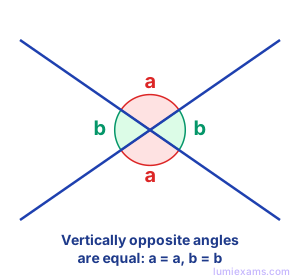
- Vertically opposite angles: Are equal. These are formed when two straight lines cross.
- Angle sum of a triangle: 180°.
- Angle sum of a quadrilateral: 360°.
Worked example 1 — Triangle Angle
Question: Find the value of angle in a triangle where the other two angles are and .
- Step 1: Sum the known angles:
- Reason: Adding the known angles together.
- Step 2: Subtract the sum from 180°:
- Reason: The angles in a triangle add up to .
- Answer:
- Reason: This is the remaining angle in the triangle.
Worked example 2 — Angles at a Point
Question: Three angles at a point are , , and . Calculate the value of .
- Step 1: Sum the known angles:
- Reason: Adding the known angles together.
- Step 2: Subtract the sum from 360°:
- Reason: Angles at a point add up to .
- Answer:
- Reason: This is the remaining angle at the point.
B. Angles in Parallel Lines
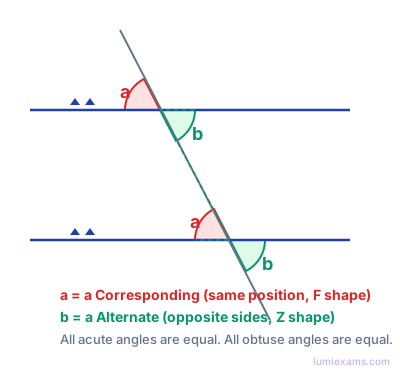
When a transversal crosses two parallel lines (indicated by arrows), specific relationships are formed:
- Alternate Angles: Are equal (Look for a "Z" shape).
- Corresponding Angles: Are equal (Look for an "F" shape).
- Co-interior (Supplementary) Angles: Sum to 180° (Look for a "C" or "U" shape).
Worked example 3 — Parallel Lines
Question: In the diagram below, lines and are parallel. A transversal intersects at and at . If angle is , find the size of angle .
- Step 1: Identify the relationship: Angle and angle are corresponding angles.
- Reason: Corresponding angles are in the same relative position at each intersection.
- Step 2: State the value of angle : Angle
- Reason: Corresponding angles are equal.
- Step 3: Identify the relationship: Angle and angle are angles on a straight line.
- Reason: They lie on the straight line .
- Step 4: Calculate angle :
- Reason: Angles on a straight line add up to .
- Answer: Angle
C. Regular Polygons
For any regular polygon with sides:
- Sum of exterior angles: Always 360°.
- One exterior angle:
- Interior angle + Exterior angle: Sum to 180° (as they sit on a straight line).
Extended Content (Extended Only)
A. Irregular Polygons
While regular polygons have equal angles, the sum of the interior angles is the same for any polygon with sides, whether regular or irregular.
Formula:
Worked example 4 — Irregular Polygon
Question: A pentagon has angles of , , , and . Calculate the size of the fifth angle.
- Step 1: Calculate the sum of interior angles of a pentagon:
- Reason: Using the formula for the sum of interior angles of a polygon.
- Step 2: Sum the known angles:
- Reason: Adding the given angles together.
- Step 3: Subtract the sum of known angles from the total sum:
- Reason: The difference is the missing angle.
- Answer: The fifth angle is
B. Geometric Proofs
Extended students must be able to combine multiple properties (e.g., using isosceles triangle properties within a circle or polygon) and provide formal geometric reasons for every step. This often involves using angle properties of parallel lines, triangles, and polygons in conjunction with each other to deduce unknown angles. A good strategy is to break down complex shapes into simpler ones (triangles, quadrilaterals) and apply known angle rules. Always state your reasoning clearly and completely. For example, instead of just saying "alternate angles," say "Alternate angles are equal because lines AB and CD are parallel."
Worked example 5 — Geometric Proof
Question: In the diagram, is a pentagon. is parallel to , and angle and angle . Find angle . Give reasons for each step.
- Step 1: Find angle , where is a point on extended beyond .
- Reason: Angles on a straight line add up to .
- Step 2: Find angle .
- Angle and angle are co-interior angles.
- Angle
- Reason: Co-interior angles are supplementary.
- Answer: Angle
Key Equations
Note: These formulas are NOT usually provided on the formula sheet; you must memorise them.
| Property | Formula | Variables |
|---|---|---|
| Sum of Interior Angles | = number of sides | |
| Individual Interior Angle | Only for Regular polygons | |
| Individual Exterior Angle | Only for Regular polygons | |
| Number of Sides | Result must be a whole number |
Common Mistakes to Avoid
- ❌ Wrong: Stating that "a line is 180 degrees" as a geometric reason.
- ✓ Right: Provide the complete reason: "Angles on a straight line sum to 180°."
- ❌ Wrong: Assuming a diagram is drawn to scale and using a protractor to measure angles instead of calculating them.
- ✓ Right: Trust your calculations, as diagrams are often "not to scale." Focus on applying the correct angle theorems.
- ❌ Wrong: Forgetting to provide a geometric reason when the question explicitly asks for one.
- ✓ Right: Always state the relevant theorem (e.g., "Alternate angles are equal") after calculating an angle.
- ❌ Wrong: Rounding intermediate values during calculations, leading to an inaccurate final answer.
- ✓ Right: Keep at least four significant figures throughout your calculations and only round the final answer to the required degree of accuracy.
- ❌ Wrong: Confusing the formulas for interior and exterior angles of polygons.
- ✓ Right: Remember that the sum of exterior angles is always 360° for any polygon, while the sum of interior angles depends on the number of sides.
Exam Tips
- Command Word: "Give a reason": If the question asks for a reason, you will lose the mark for the numerical answer if the text explanation is missing or vague. Use terms like "Alternate," "Corresponding," or "Vertical opposite." Be specific: "Alternate angles are equal because line AB is parallel to line CD."
- The "Semicircle" Trick: Always look for triangles drawn inside circles. If one side is the diameter, the angle at the circumference is always 90°. State: "Angle in a semicircle is 90 degrees."
- Ancillary Lines: If you are stuck on a parallel line question, try drawing an extra parallel line (an auxiliary line) through the vertex of the angle you are trying to find. This can help reveal alternate, corresponding, or co-interior angles.
- Calculator Check: Ensure your calculator is in DEG (Degree) mode, not RAD or GRAD. A quick check: sin(90) should equal 1.
- Polygon Strategy: If you can't remember the interior angle formula, remember that any -sided polygon can be split into triangles by drawing lines from one vertex. Each triangle is 180°.