1. Overview
Area and perimeter are fundamental concepts in IGCSE Mathematics, crucial for calculating the space inside a 2D shape (area) and the distance around its boundary (perimeter). This revision note covers calculating the area and perimeter of rectangles, triangles, parallelograms, and trapeziums, as required by the Cambridge IGCSE Mathematics (0580) syllabus. Mastering these skills is essential for success in the exam and for real-world applications.
Key Definitions
- Perimeter: The total distance around the outside edge of a 2D shape.
- Area: The amount of 2D space inside a shape, measured in square units (e.g., ).
- Perpendicular Height: The vertical height of a shape measured at a angle to the base.
- Compound Shape: A shape made up of two or more basic geometric shapes.
Core Content
A. Rectangle
The perimeter is the sum of all four sides, and the area is the product of the length and width.
Area
Perimeter or
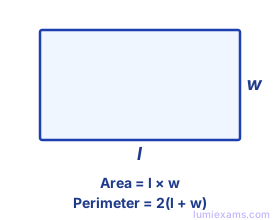
Worked example 1 — Rectangle area and perimeter
A rectangular garden has a length of and a width of . Calculate the perimeter and the area of the garden.
Step 1: Calculate Perimeter
Reason: Substitute the given values of length and width into the perimeter formula.
Step 2: Calculate Area
Reason: Substitute the given values of length and width into the area formula.
Answer: The perimeter of the garden is and the area is .
B. Triangle
The area is half of the base multiplied by the perpendicular height. Do not use the "slant height" for area.
Area
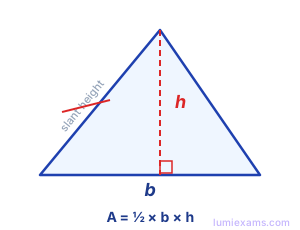
Worked example 2 — Triangle area
A triangle has a base of , a slant height of , and a perpendicular height of . Find the area of the triangle.
Step 1: Identify the correct values Base , Height (Ignore the slant height of for area calculations).
Reason: The area formula requires the perpendicular height, not the slant height.
Step 2: Apply the formula
Reason: Substitute the values of base and height into the area formula.
Answer: The area of the triangle is .
C. Parallelogram
A parallelogram has the same area formula as a rectangle, provided you use the perpendicular height () rather than the sloping side.
Area
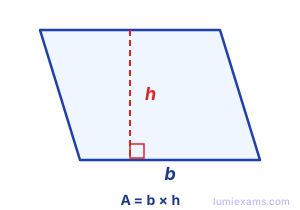
Worked example 3 — Parallelogram area
A parallelogram has a base of and a perpendicular height of . Calculate the area.
Step 1: Apply the formula
Reason: Substitute the values of base and height into the area formula.
Answer: The area of the parallelogram is .
D. Trapezium
A trapezium has one pair of parallel sides (usually called and ).
Area
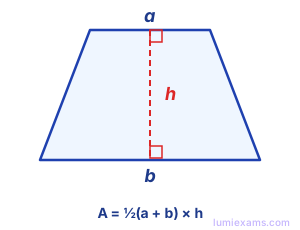
Worked example 4 — Trapezium area
A trapezium has parallel sides of length and . The distance between them is . Calculate the area.
Step 1: Identify and
Reason: Identify the given values that correspond to the variables in the formula.
Step 2: Substitute into formula
Reason: Substitute the identified values into the area formula and simplify.
Answer: The area of the trapezium is .
Extended Content (Extended Only)
While there are no additional specific learning objectives for the Supplement curriculum under topic 5.2, Extended students are expected to apply their knowledge of area and perimeter in more complex scenarios. This often involves:
- Compound Shapes: Calculating the area and perimeter of shapes formed by combining two or more of the basic shapes (rectangles, triangles, parallelograms, trapeziums). This requires breaking down the compound shape into simpler components, calculating the area or perimeter of each component, and then adding or subtracting as necessary.
- Algebraic Problems: Solving problems where the dimensions of the shapes are given as algebraic expressions. This requires applying algebraic skills to manipulate the area and perimeter formulas.
- Problem Solving: Applying area and perimeter concepts to solve real-world problems, often involving multiple steps and requiring careful interpretation of the problem statement.
Worked example 5 — Extended: Compound Shape
The diagram below shows a compound shape made from a rectangle and a right-angled triangle. The rectangle has length and width . The triangle has base and height . Find an expression for the total area of the shape, and if the total area is , find the value of .
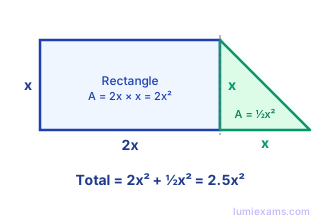
Step 1: Find the area of the rectangle
Reason: Apply the formula for the area of a rectangle.
Step 2: Find the area of the triangle
Reason: Apply the formula for the area of a triangle.
Step 3: Find the total area
Reason: Add the areas of the rectangle and triangle to find the total area.
Step 4: Solve for x when the total area is 54 cm²
Reason: Substitute the given area into the expression and solve for x.
Answer: The expression for the total area is and the value of is approximately .
Key Equations
| Shape | Area Formula | Perimeter Formula | Variables |
|---|---|---|---|
| Rectangle | =length, =width | ||
| Triangle | Sum of all sides | =base, =perpendicular height | |
| Parallelogram | Sum of all sides | =base, =perpendicular height | |
| Trapezium | Sum of all sides | =parallel sides, =height |
Note: These formulas are generally not provided on the IGCSE formula sheet; they must be memorized.
Common Mistakes to Avoid
- ❌ Wrong: Including the length of internal lines when calculating the perimeter of a compound shape. ✓ Right: Only include the lengths of the outer boundary lines when finding the perimeter.
- ❌ Wrong: Calculating the perimeter when the question asks for the area, or vice versa. ✓ Right: Carefully read the question and identify whether it's asking for area or perimeter. Double-check your units ( for perimeter, for area).
- ❌ Wrong: Forgetting to use brackets correctly when using the trapezium area formula on a calculator, leading to incorrect order of operations: e.g., entering instead of . ✓ Right: Use brackets to ensure the addition of the parallel sides is performed before multiplying by the height and 0.5: .
- ❌ Wrong: Using the slant height instead of the perpendicular height when calculating the area of a triangle or parallelogram. ✓ Right: Always use the perpendicular height, which is the vertical distance from the base to the opposite vertex (triangle) or side (parallelogram).
- ❌ Wrong: Forgetting to convert units to be consistent before calculating area or perimeter (e.g., using cm for one side and m for another). ✓ Right: Convert all measurements to the same unit before performing any calculations.
Exam Tips
- Command Words: "Calculate" means show your numerical steps clearly. "Show that" means you must start with the formula and show every line of working to reach the given answer, demonstrating how you arrive at the stated result.
- Show Your Working: Even if you make a small arithmetic error and get the final answer wrong, you can still earn "method marks" (M marks) for correctly substituting values into a formula and showing your steps.
- Units: Always check if the question uses different units (e.g., some sides in and some in ). Convert them all to the same unit before calculating area or perimeter.
- Calculator Tip: For non-calculator papers, look for opportunities to simplify fractions or cancel out common factors to make calculations easier (e.g., of an even number). For calculator papers, enter the entire expression at once, using brackets where necessary, to avoid rounding errors mid-calculation.
- Typical Values: If a question involves , use the button on your calculator for maximum accuracy, or if specified in the question.