1. Overview
Pythagoras' theorem is a cornerstone of geometry that allows you to calculate the side lengths of right-angled triangles. Knowing this theorem is essential for solving various problems in construction, navigation, and more advanced trigonometry. It states that the square of the hypotenuse (the side opposite the right angle) is equal to the sum of the squares of the other two sides.
Key Definitions
- Hypotenuse: The longest side of a right-angled triangle, always located directly opposite the right angle ().
- Right-angled triangle: A triangle that contains one angle measuring exactly .
- Theorem: A mathematical statement or rule that has been proven to be true.
- Square Root (): The value that, when multiplied by itself, gives the original number.
Core Content
Pythagoras' theorem states that in any right-angled triangle, the square of the hypotenuse is equal to the sum of the squares of the other two sides. This can be written as an equation:
where is the hypotenuse, and and are the other two sides.
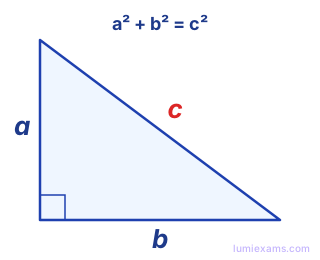
Method 1: Finding the Hypotenuse ()
To find the hypotenuse, you square the two shorter sides, add them together, and then find the square root of the result.
Worked example 1 — Finding the hypotenuse
A right-angled triangle has sides of length 3 cm and 4 cm. Calculate the length of the hypotenuse.
- State the formula:
- Substitute the values:
- Calculate the squares:
- Add the values:
- Square root both sides: Reason: To isolate
- Simplify:
- Final answer:
Method 2: Finding a Shorter Side ( or )
To find a shorter side, you must subtract the square of the known shorter side from the square of the hypotenuse.
Worked example 2 — Finding a shorter side
A right-angled triangle has a hypotenuse of 13 cm and one side of 5 cm. Find the length of the other side.
- State the formula:
- Substitute the values:
- Calculate the squares:
- Rearrange (subtract 25 from both sides): Reason: To isolate
- Simplify:
- Square root both sides: Reason: To isolate
- Simplify:
- Final answer:
Method 3: Using Pythagoras in Isosceles Triangles
Exam questions often feature isosceles triangles where you must find the vertical height. Remember that the height drawn from the vertex angle of an isosceles triangle to its base bisects the base.
Worked example 3 — Isosceles triangle height
An isosceles triangle has two equal sides of 10 cm and a base of 12 cm. Calculate the perpendicular height.
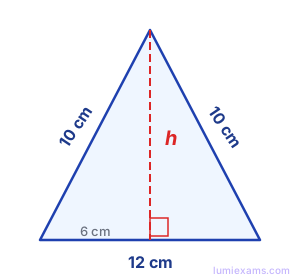
- Halve the base: Because it is an isosceles triangle, the height line splits the base into two equal parts. .
- Identify the right-angled triangle: We now have a right-angled triangle with hypotenuse and one side of . Let the height be .
- Apply the formula:
- Calculate squares:
- Subtract: Reason: To isolate
- Simplify:
- Square root: Reason: To isolate
- Simplify:
- Final answer:
Worked example 4 — Ladder against a wall
A ladder 6 m long leans against a vertical wall. The foot of the ladder is 2 m away from the base of the wall on level ground. How far up the wall does the ladder reach? Give your answer to 3 significant figures.
- Draw a diagram: (Imagine a right-angled triangle with the ladder as the hypotenuse, the wall as one side, and the ground as the other side.)
- Identify knowns: Hypotenuse m, base m. We want to find the height .
- State the formula:
- Substitute the values:
- Calculate the squares:
- Subtract: Reason: To isolate
- Simplify:
- Square root: Reason: To isolate
- Simplify:
- Round to 3 s.f.:
- Final answer:
Extended Content (Extended Only)
For Extended students, Pythagoras' theorem is not just limited to 2D right-angled triangles. You may encounter problems involving 3D shapes, particularly cuboids, where you need to find the length of a space diagonal.
Consider a cuboid with dimensions , , and . The space diagonal, , is the line segment connecting one corner of the cuboid to the opposite corner. To find the length of this space diagonal, you can extend Pythagoras' theorem into three dimensions:
This formula is derived by applying Pythagoras' theorem twice. First, find the diagonal of one face (e.g., the base with sides and ). Then, use that diagonal as one side of a new right-angled triangle, with the height as the other side, and the space diagonal as the hypotenuse.
Worked example 5 — 3D Pythagoras
A cuboid has dimensions 4 cm, 3 cm, and 12 cm. Calculate the length of its space diagonal.
- State the formula:
- Substitute the values:
- Calculate the squares:
- Add the values:
- Square root both sides: Reason: To isolate
- Simplify:
- Final answer:
Key Equations
- The Theorem:
- : The two shorter sides (legs) meeting at the right angle.
- : The hypotenuse (longest side).
- Finding :
- Finding :
- Memorization: This formula is not provided on the IGCSE formula sheet; it must be memorized.
Common Mistakes to Avoid
- ❌ Adding instead of subtracting when finding a shorter side: You might mistakenly add the squares of the hypotenuse and the known shorter side. For example, writing when finding a shorter side given a hypotenuse of 13 and another side of 5.
- ✓ Right: Always subtract the square of the shorter side from the square of the hypotenuse: . In this case, .
- ❌ Forgetting to square root: You might correctly calculate , but then forget to take the square root to find .
- ✓ Right: Always perform the final step to find the actual length: .
- ❌ Not halving the base in isosceles triangles: When finding the height of an isosceles triangle, you might use the full base length in your Pythagoras calculation.
- ✓ Right: Halve the base to create a right-angled triangle before applying Pythagoras' theorem.
- ❌ Rounding too early: Rounding intermediate values during the calculation can lead to inaccuracies in your final answer.
- ✓ Right: Keep full figures on your calculator until the very final step, then round to the required number of significant figures (usually 3 s.f.).
- ❌ Confusing units: Forgetting to include units (e.g., cm, m) in your final answer, or using inconsistent units within the same problem.
- ✓ Right: Always include the correct units in your final answer, and ensure all measurements are in the same units before starting your calculations.
Exam Tips
- Command Words: Look for "Calculate the length..." or "Find the distance...". If the triangle is right-angled and involves sides only (no angles), it is likely a Pythagoras question.
- Rounding: Unless specified otherwise, always give your final answer to 3 significant figures (3 s.f.).
- Calculator Tip: You can type or directly into most scientific calculators to save time and reduce manual errors.
- Real-world Contexts: Be prepared for "ladder against a wall" or "walking across a rectangular field" scenarios. Draw a sketch immediately to visualize the right-angled triangle.
- Show Working: Even if you get the final answer wrong, showing the substitution into can earn you "method marks."
- Double Check: Before submitting your answer, quickly check if your answer makes sense in the context of the problem. For example, the hypotenuse should always be the longest side.