1. Overview
Rates are fundamental in IGCSE Mathematics, describing how one quantity changes relative to another. This often involves different units, such as speed (distance per time) or price per item. You'll learn to solve real-world problems involving travel, wages, currency, consumption, and more. The key is understanding the relationship between quantities and their units, and applying the correct formulas.
Key Definitions
- Rate: A comparison of two quantities with different units (e.g., , ).
- Average Speed: The total distance traveled divided by the total time taken for a journey.
- Unit Rate: A rate expressed as a quantity of one (e.g., price per 1 litre).
- Exchange Rate: The ratio at which one currency can be exchanged for another.
- Constant Rate: A rate that does not change over time.
Core Content
3.1 Common Measures of Rate
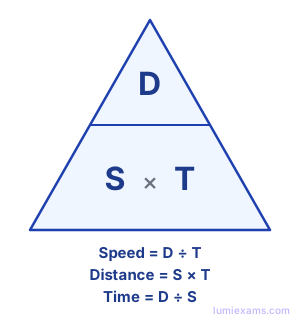
Common rates include speed, hourly wages, and price per unit.
Worked example 1 — Calculating Hourly Wage
A worker earns for working hours. Calculate the hourly rate.
Step-by-Step Working:
- Identify the formula:
- Substitute the values:
- Calculate:
- State with units:
Worked example 2 — Calculating Price Per Kilogram
A 5kg bag of rice costs . What is the price per kilogram?
Step-by-Step Working:
- Identify the formula:
- Substitute the values:
- Calculate:
- State with units:
3.2 Applying Other Measures of Rate
This involves fuel consumption (), flow rates (), or density ().
Worked example 3 — Fuel Consumption
A car uses litres of petrol to travel . Calculate the rate of fuel consumption in litres per .
Step-by-Step Working:
- Find the fuel used per :
- Multiply by to find the rate per :
- Final Answer:
Worked example 4 — Calculating Flow Rate
A tap fills a 9-litre bucket in 2 minutes. Calculate the flow rate in litres per minute.
Step-by-Step Working:
- Identify the formula:
- Substitute the values:
- Calculate:
- State with units:
3.3 Average Speed
Average speed is not the average of the speeds. It is always the total distance over the total time.
Worked example 5 — Basic Average Speed
A cyclist travels in . Calculate the average speed in .
Step-by-Step Working:
- Convert time to hours: , so total time = .
- Use the formula:
- Substitute:
- Calculate:
- Final Answer:
Worked example 6 — Average Speed with Mixed Units
A train travels 120 km in 2 hours and 30 minutes. Calculate the average speed in km/h.
Step-by-Step Working:
- Convert minutes to hours:
- Calculate total time in hours:
- Apply the average speed formula:
- Substitute the values:
- Calculate:
- State the final answer with units:
Extended Content (Extended Only)
4.1 Advanced Average Speed
Extended questions often involve a journey with two or more parts with different speeds. The key is to calculate the total distance and the total time, then divide.
Worked example 7 — Multi-part Journey
A car travels for at and then for at . Calculate the average speed for the whole journey.
Step-by-Step Working:
- Calculate Distance 1:
- Calculate Distance 2:
- Calculate Total Distance:
- Calculate Total Time:
- Use Average Speed formula:
- Final Answer:
Worked example 8 — Journey with Different Speeds and Distances
A train travels 150 km at a speed of 50 km/h, then travels 180 km at a speed of 90 km/h. Calculate the average speed for the entire journey.
Step-by-Step Working:
- Calculate the time for the first part of the journey:
- Calculate the time for the second part of the journey:
- Calculate the total distance:
- Calculate the total time:
- Calculate the average speed:
- State the final answer with units:
4.2 Converting Compound Units
Converting units like to requires two steps. It's vital to show your working clearly, especially in non-calculator papers.
Worked example 9 — Convert to
- Convert to :
- Convert hours to seconds:
- Calculate the new rate:
- Simplify:
- Final Answer:
Worked example 10 — Converting Fuel Consumption Units
A car has a fuel consumption of 7 litres per 100 km. Convert this to millilitres per meter (mL/m).
Step-by-Step Working:
- Convert litres to millilitres:
- Convert kilometers to meters:
- Calculate the new rate:
- Simplify:
- Final Answer:
Key Equations
Average Speed:
- in or ; in or ; in or .
- Not on formula sheet - MEMORISE
Density:
- in or .
- Not on formula sheet - MEMORISE
Unit Price:
- Not on formula sheet - MEMORISE
Common Mistakes to Avoid
❌ Wrong: Calculating the average speed of two parts of a journey by adding the two speeds and dividing by 2. For example, travelling 50 km/h then 70 km/h, and saying the average speed is 60 km/h.
- ✓ Right: Always divide Total Distance by Total Time.
❌ Wrong: Rounding exchange rates or intermediate values to 2 decimal places in the middle of a calculation, leading to inaccurate final answers, especially in multi-step currency conversions.
- ✓ Right: Keep the full number on your calculator until the very final step to avoid "rounding errors."
❌ Wrong: Assuming is .
- ✓ Right: .
❌ Wrong: Converting to by dividing by .
- ✓ Right: Divide by ().
❌ Wrong: Forgetting to convert units before calculating. For example, using km for distance and seconds for time when the question requires m/s.
- ✓ Right: Convert all quantities to the same units before applying any formulas. Highlight the required units in the question.
Exam Tips
- Units: Always check the units requested in the question. If the question gives distance in and time in , but asks for , convert at the start or the end. Use the "fraction chain" method to convert compound units reliably.
- Calculator vs Non-Calculator: In non-calculator papers, rates are usually chosen to cancel out (e.g., multiples of or ). In calculator papers, do not round until the end.
- Command Words:
- "Calculate": Show every step of your arithmetic.
- "Show that": You are given the answer; you must show the full method to reach it.
- Contexts: Expect questions on "Best Buy" (comparing price per ), currency conversion for holidays, and travel timetables.
- Time Conversions: Remember the magic number 3600 (the number of seconds in one hour). To convert to quickly, you are effectively dividing by . Conversely, to convert from m/s to km/h, multiply by 3.6.