1. Overview
Forces are pushes or pulls that act on an object due to its interaction with another object. This topic explores how forces can change an object’s shape (deformation) and its motion (acceleration and circular paths), providing the foundation for all mechanical physics.
Key Definitions
- Force: An influence that can change the motion or shape of an object (measured in Newtons, N).
- Resultant Force: The single force that has the same effect as all the individual forces acting on an object combined.
- Extension: The increase in length of an object when a load is applied (Extension = New Length – Original Length).
- Spring Constant (): A measure of a spring's stiffness; the force required per unit extension.
- Friction: A force that opposes motion between two surfaces in contact.
- Limit of Proportionality: The point beyond which extension is no longer directly proportional to the force applied.
Core Content
Changes in Size and Shape
When forces act on an object, they can cause it to compress (squash), stretch, or bend.
- Elastic Deformation: The object returns to its original shape once the force is removed.
- Plastic Deformation: The object is permanently stretched and does not return to its original shape.
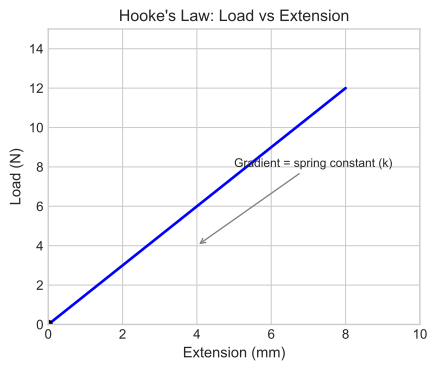
Load-Extension Graphs & Experiment
To investigate the extension of a spring:
- Measure the original length of the spring using a ruler.
- Add a known mass (load) to the spring.
- Measure the new length and calculate extension ().
- Repeat by adding more masses and record the results.
**
**
What Else Can Forces Do?
Forces can produce changes in:
- The size and shape of an object (stretching, compressing, bending)
- The speed of an object (speeding up or slowing down)
- The direction of an object’s motion
Think of it this way: a footballer kicks a ball (applies a force). The ball might squash slightly on impact (shape change), it speeds up (speed change), and it flies off in a new direction (direction change). These three effects cover everything a force can do to an object.
Worked Example: Finding Mass from Weight A bag of sugar hangs from a spring balance. The reading shows a weight of . Calculate the mass.
- , so rearrange:
- (or )
This rearrangement () appears in almost every exam. Practise it until automatic.
Resultant Force along a Straight Line
- Forces in the same direction: Add them together ().
- Forces in opposite directions: Subtract the smaller force from the larger force. The resultant force acts in the direction of the larger force ().
Newton’s First Law
- If the resultant force is zero, an object at rest stays at rest, and an object in motion continues at a constant speed in a straight line.
- If there is a resultant force, the object will change its velocity (accelerate, decelerate, or change direction).
Friction and Drag
- Solid Friction: Occurs between two surfaces. It impedes (slows down) motion and transforms kinetic energy into heat.
- Drag (Fluid Friction): The resistive force acting on an object moving through a liquid or a gas (e.g., air resistance). Drag increases as the speed of the object increases.
Extended Content (Extended Curriculum Only)
The Spring Constant ()
The relationship between force and extension is defined by the equation:
- A "stiff" spring has a high spring constant.
- Limit of Proportionality: On a load-extension graph, this is the point where the line begins to curve. Before this point, the spring obeys Hooke’s Law ().
Worked Example: A force of 10N causes a spring to stretch from 5cm to 9cm. Calculate the spring constant.
- Extension () =
Newton’s Second Law
A resultant force causes an object to accelerate. The force and acceleration are always in the same direction.
Worked Example: Force on a Lorry A lorry of mass accelerates at . Calculate the resultant force.
Why the motor force is larger than : The calculation above gives the net force needed purely for acceleration. But in the real world, the vehicle also has to push against friction from the road and drag from the air. The engine must provide enough force to cover both — the acceleration and the resistive forces combined. So the actual driving force from the motor is always greater than alone.
Worked Example: Time from Acceleration The same lorry increases speed from to . Calculate the time taken.
- , so rearrange:
Terminal Velocity
When a skydiver jumps from a plane, they don’t keep accelerating forever. Here’s why:
At first, the only significant downward force is gravity (their weight), so they accelerate quickly. But as they fall faster, the air pushing against them gets stronger — think of how much more wind you feel cycling fast versus slow. This growing air resistance opposes their weight, reducing the overall resultant force. With a smaller resultant force, the acceleration gets smaller too. Eventually the air resistance grows large enough to exactly balance their weight. At that point the resultant force is zero, acceleration stops, and the skydiver falls at a steady speed — this is terminal velocity.
The same idea applies to any object falling through a fluid (air, water, oil). The denser the fluid or the larger the surface area, the lower the terminal velocity.
Circular Motion
When an object moves in a circle, a force acts perpendicular to the motion (towards the center). Qualitatively:
- Speed: To move faster in the same circle, a larger force is needed.
- Radius: To move in a smaller circle at the same speed, a larger force is needed.
- Mass: A larger mass requires a larger force to keep the same speed and radius.
Key Equations
| Equation | Symbols | Units |
|---|---|---|
| = Spring constant, = Force, = Extension | (N/m or N/cm), (N), (m or cm) | |
| = Resultant Force, = Mass, = Acceleration | (N), (kg), (m/s²) | |
| Resultant Force | Newtons (N) |
Common Mistakes to Avoid
- ❌ Wrong: Adding two forces that are acting in opposite directions.
- ✓ Right: Subtract the magnitudes of opposing forces to find the resultant.
- ❌ Wrong: Using the "total length" of a spring in calculations.
- ✓ Right: Always subtract the original length from the new length to find the extension ().
- ❌ Wrong: Assuming a resultant force is required to keep an object moving at a constant speed.
- ✓ Right: If the speed and direction are constant, the resultant force must be zero.
- ❌ Wrong: Adding forces together when they act at right angles (perpendicular).
- ✓ Right: IGCSE Core/Extended focuses on forces in a straight line; do not simply add/subtract them if they are not on the same axis.
Exam Tips
- Read the Graph Axes: Check if the graph is Load-Extension or Load-Length. If it's Load-Length, the line will not start at (0,0); it starts at the original length.
- Direction Matters: When asked for a resultant force, always state the magnitude and the direction (e.g., "5N to the right").
- Units: Ensure mass is in kg before using . If given in grams, divide by 1000.
Exam-Style Questions
Practice these original exam-style questions to test your understanding. Each question mirrors the style, structure, and mark allocation of real Cambridge 0625 Theory papers.
Exam-Style Question 1 — Short Answer [5 marks]
Question:
A student investigates the extension of a spring when different masses are hung from it. The original length of the spring is 5.0 cm. The student records the following data:
| Mass (g) | Length of spring (cm) |
|---|---|
| 0 | 5.0 |
| 50 | 6.0 |
| 100 | 7.0 |
| 150 | 8.0 |
| 200 | 9.0 |
(a) Define the term 'limit of proportionality'. [2]
(b) Calculate the spring constant, , of this spring. Give your answer in N/m. Assume the spring obeys Hooke's Law. [3]
Worked Solution:
(a)
- The limit of proportionality is the point beyond which Hooke's Law is no longer obeyed.
- A more complete definition
How to earn full marks:
- Mention 'Hooke's Law' or 'proportionality' or 'linear relationship' or 'not proportional' (1 mark)
- Mention 'extension' and 'force' or 'load' (1 mark)
(b)
- Convert the mass to weight using W = mg. Choose two data points to calculate the force and corresponding extension. Using the 200g data point.
- Calculate the extension in meters.
- Apply Hooke's Law to determine the spring constant. Rounded to 3 s.f.
How to earn full marks:
- Correctly convert mass to weight in Newtons (1 mark)
- Calculate the extension in metres (1 mark)
- Correctly calculate the spring constant with units (1 mark)
Common Pitfall: Remember to convert your units to SI units (meters and kilograms) before using them in calculations. Also, the extension is the change in length, not the final length.
Exam-Style Question 2 — Extended Response [8 marks]
Question:
A car of mass 1200 kg is travelling at a constant speed of 25 m/s along a straight, level road. The driver applies the brakes, and the car decelerates uniformly to rest in a distance of 80 m.
(a) Calculate the deceleration of the car. [3]
(b) Calculate the braking force acting on the car. [2]
(c) Explain, in terms of forces, why the stopping distance of the car would be greater if the road were wet. [3]
Worked Solution:
(a)
- Identify the relevant kinematic equation.
- Rearrange the equation to solve for acceleration.
- Substitute the given values into the equation. Rounded to 3 s.f. The negative sign indicates deceleration.
How to earn full marks:
- Select the correct kinematic equation (1 mark)
- Correctly substitute the values into the equation (1 mark)
- Correctly calculate the deceleration with correct units and negative sign (1 mark)
(b)
- Apply Newton's Second Law to calculate the braking force. Rounded to 3 s.f.
How to earn full marks:
- Correctly substitute the mass and acceleration (1 mark)
- Correctly calculate the braking force with correct units and negative sign (1 mark)
(c)
- State that friction is reduced on a wet road. The water between the tyres and the road reduces the friction.
- Explain how this affects the braking force. The maximum braking force is reduced.
- Relate the reduced braking force to the stopping distance. Since , a smaller braking force results in a smaller deceleration. Because the deceleration is smaller, the car takes longer to stop, and the stopping distance is increased.
How to earn full marks:
- State that the friction between the tyres and the road is reduced on a wet surface (1 mark)
- State that the braking force is reduced (1 mark)
- Explain how the reduced braking force leads to a smaller deceleration and therefore a greater stopping distance (1 mark)
Common Pitfall: Remember that deceleration is just negative acceleration. Also, be sure to explain the connection between reduced friction, reduced braking force, and increased stopping distance clearly in part (c).
Exam-Style Question 3 — Short Answer [6 marks]
Question:
A small helicopter of mass 800 kg is hovering at a constant height. The rotor blades exert an upward force on the helicopter.
(a) State the name of the force acting downwards on the helicopter. [1]
(b) State the magnitude of the upward force exerted by the rotor blades. [2]
(c) The helicopter now begins to accelerate upwards at a rate of 0.5 m/s². Calculate the resultant force acting on the helicopter. [3]
Worked Solution:
(a)
- Identify the force acting downwards due to gravity. Weight due to gravitational force
How to earn full marks:
- State "weight" or "force of gravity" or "gravitational force" (1 mark)
(b)
- When hovering, the helicopter is in equilibrium. Therefore, the upward force equals the downward force.
- Calculate the weight of the helicopter. Rounded to 3 s.f.
How to earn full marks:
- State that upward force equals downward force when hovering (1 mark)
- Calculate the weight correctly with correct units (1 mark)
(c)
- Apply Newton's Second Law to calculate the resultant force.
How to earn full marks:
- Correctly substitute the mass and acceleration (1 mark)
- Correctly calculate the resultant force (1 mark)
- State units (1 mark)
Common Pitfall: When an object is hovering, the forces are balanced. However, when it starts accelerating, there is a resultant force. Don't confuse the weight with the resultant force in part (c).
Exam-Style Question 4 — Extended Response [10 marks]
Question:
A student performs an experiment to investigate the relationship between the force applied to a spring and its extension. The student hangs different weights from the spring and measures the corresponding extension. The results are shown below:
| Force (N) | Extension (cm) |
|---|---|
| 0.0 | 0.0 |
| 1.0 | 2.0 |
| 2.0 | 4.0 |
| 3.0 | 6.0 |
| 4.0 | 8.0 |
| 5.0 | 10.0 |
| 6.0 | 12.0 |
| 7.0 | 14.0 |
| 8.0 | 16.0 |
| 9.0 | 20.0 |
(a) On the grid below, plot a graph of force (y-axis) against extension (x-axis). Draw a line of best fit. [4]
(b) Determine the spring constant, , of the spring from the linear portion of your graph. State the unit. [3]
(c) Identify the point on your graph where the spring no longer obeys Hooke's Law. Explain how you can tell. [3]
Worked Solution:
(a)
- Choose appropriate scales for the axes.
- Plot the data points accurately.
- Draw a smooth line of best fit through the linear portion of the graph.A graph with Force (N) on the y-axis from 0 to 10, with major gridlines every 1 N, and Extension (cm) on the x-axis from 0 to 20, with major gridlines every 2 cm. The data points are plotted accurately, and a straight line of best fit is drawn through the points up to approximately (8,16). The point (9,20) is clearly off the line.
How to earn full marks:
- Correctly label both axes with units (1 mark)
- Choose a suitable scale and plot points accurately (2 marks)
- Draw a clear line of best fit through the linear part of the graph (1 mark)
(b)
- Determine the gradient of the linear portion of the graph. The gradient represents the spring constant.
- Choose two points on the line of best fit to calculate the gradient. For example, using (0,0) and (8,16): Converting extension to meters.
How to earn full marks:
- Convert extension to meters (1 mark)
- Calculate the gradient correctly from the graph using two points on the line of best fit (1 mark)
- State the correct units (1 mark)
(c)
- Identify the point where the graph deviates from the linear relationship. The point at (9.0 N, 20.0 cm) is off the line. The spring no longer obeys Hooke's Law.
- Explain how you can tell. Beyond 8.0 N, the extension is no longer proportional to the force. The graph curves, indicating that the extension increases more rapidly for each additional Newton of force applied. This demonstrates the limit of proportionality has been exceeded.
How to earn full marks:
- Identify the correct point on the graph where the spring no longer obeys Hooke's Law (1 mark)
- State that the extension is no longer proportional to the force (1 mark)
- State that the graph curves OR that the extension increases more rapidly per unit force (1 mark)
Common Pitfall: When calculating the spring constant from a graph, make sure to use points on the line of best fit, not just data points from the table. Also, always convert the extension to meters before calculating the spring constant.