1. Overview
This topic explores how gas particles behave when we change their environment. By understanding the relationship between pressure, volume, and temperature at a molecular level, we can predict how gases will respond in everything from bicycle pumps to weather balloons.
Key Definitions
- Pressure: The force exerted by gas particles colliding with the walls of a container per unit area.
- Absolute Zero: The lowest possible temperature (0 Kelvin or -273°C), where particles have minimum kinetic energy and effectively stop moving.
- Kelvin Scale: An absolute temperature scale that starts at absolute zero.
- Kinetic Energy: The energy an object has due to its motion. In gases, temperature is a direct measure of the average kinetic energy of the particles.
Core Content
(a) Effect of Temperature on Pressure (Constant Volume)
When the temperature of a gas increases in a fixed-volume container:
- The particles gain more kinetic energy and move faster.
- They collide with the container walls more frequently.
- They hit the walls with greater force.
- Result: The pressure increases.
(b) Effect of Volume on Pressure (Constant Temperature)
When the volume of a gas is decreased (compressed) at a constant temperature:
- The particles are pushed closer together.
- The particles collide with the walls more frequently because there is less space to travel between impacts.
- Result: The pressure increases. (Conversely, increasing volume decreases pressure).
Temperature Conversions
To work with the absolute scale, you must be able to convert between Celsius (°C) and Kelvin (K).
- Equation:
Worked Example:
- Question: A gas is at . What is this temperature in Kelvin?
- Answer:
Extended Content (Extended Only)
The Relationship (Boyle’s Law)
For a fixed mass of gas at a constant temperature, pressure and volume are inversely proportional. If you double the pressure, the volume halves.
- Equation: (where 1 is the initial state and 2 is the final state)
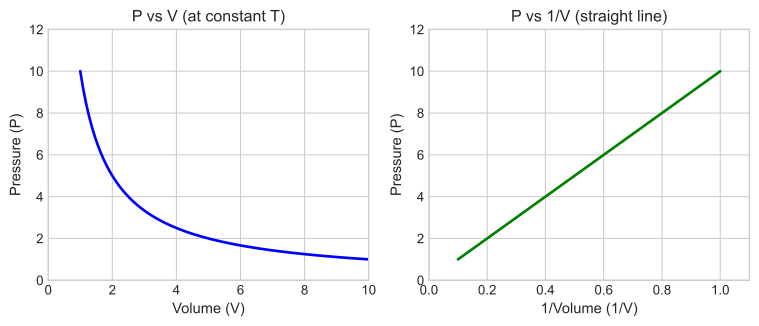
- Graphical Representation:
- A graph of Pressure vs. Volume shows a curve (hyperbola). As volume decreases, pressure rises exponentially.
- A graph of Pressure vs. 1/Volume shows a straight line through the origin, proving the inverse relationship.
Worked Example:
- Question: A gas occupies at a pressure of . If the gas is compressed to at a constant temperature, what is the new pressure?
- Answer:
Key Equations
- Temperature Conversion:
- : Temperature in Kelvin (K)
- : Temperature in Celsius (°C)
- Boyle's Law: or
- : Pressure (Pascals, Pa)
- : Volume ( or )
Common Mistakes to Avoid
- ❌ Wrong: Thinking that increasing the volume of a container makes the pressure go up.
- ✓ Right: Recognize that an increase in volume reduces the rate of molecular collisions, leading to a drop in pressure (unless temperature is increased significantly to compensate).
- ❌ Wrong: Suggesting that faster particle speed leads to lower pressure.
- ✓ Right: Always remember that higher speed means harder and more frequent collisions, which increases pressure.
- ❌ Wrong: Forgetting that a "standard" container usually already has air in it.
- ✓ Right: Unless a container is a vacuum, it starts with an initial atmospheric pressure of approximately .
- ❌ Wrong: Drawing a straight line for a Pressure vs. Volume graph.
- ✓ Right: Use a curve to show the dynamic, non-linear relationship that occurs when gas particles are compressed.
Exam Tips
- Use Key Words: When explaining pressure changes, always use the terms "frequency of collisions" and "force of impact." Examiners look specifically for these.
- Check Units: Ensure volume units are the same on both sides of the equation. You don't always have to convert to , but they must match!
- Temperature Link: If a question mentions "Average Kinetic Energy," they are asking about Temperature. If they mention "Temperature," they are asking about Average Kinetic Energy.
Exam-Style Questions
Practice these original exam-style questions to test your understanding. Each question mirrors the style, structure, and mark allocation of real Cambridge 0625 Theory papers.
Exam-Style Question 1 — Short Answer [5 marks]
Question:
A sealed container of gas is heated.
(a) State what happens to the average speed of the gas molecules as the temperature increases. [1]
(b) Explain, in terms of the movement of gas molecules, why the pressure inside the container increases as the temperature increases. [3]
(c) State one assumption made about the gas molecules in the kinetic theory of gases. [1]
Worked Solution:
(a)
- The average speed of the gas molecules increases. [Direct recall from kinetic theory]
How to earn full marks:
- State "increases" or "gets faster". Do not say "stays the same" or "decreases".
(b)
- The gas molecules move faster. [Increased temperature means increased kinetic energy]
- The gas molecules collide more frequently with the walls of the container. [More collisions per second]
- The gas molecules collide with the walls of the container with more force. [Each collision imparts a greater impulse]
How to earn full marks:
- Mention faster movement of molecules (1 mark)
- Mention more frequent collisions (1 mark)
- Mention greater force/impact during collisions (1 mark)
(c)
- The gas molecules move randomly / The gas molecules have negligible volume / There are no intermolecular forces between the gas molecules. [One valid assumption of the kinetic theory of gases]
How to earn full marks:
- State one valid assumption.
Common Pitfall: Remember that increasing the temperature increases the average kinetic energy of the molecules. While some molecules might slow down, the overall trend is that they move faster. Also, be specific about why the pressure increases – it's not just about more collisions, but also the increased force of each collision.
Exam-Style Question 2 — Short Answer [6 marks]
Question:
A gas is trapped inside a cylinder by a piston. The initial volume of the gas is and the pressure is . The piston is slowly moved, compressing the gas. The temperature of the gas remains constant.
(a) State the name of the law that describes the relationship between pressure and volume for a fixed mass of gas at constant temperature. [1]
(b) Calculate the new pressure of the gas if the volume is reduced to . [3]
(c) Explain, in terms of gas molecules, why the pressure increases as the volume decreases at constant temperature. [2]
Worked Solution:
(a)
- Boyle's Law [Direct recall]
How to earn full marks:
- State "Boyle's Law" explicitly.
(b)
- State Boyle's Law: [Identifying the correct equation]
- Substitute values: [Correct substitution of values]
- Rearrange and calculate: [Correct rearrangement and calculation]
How to earn full marks:
- State the correct equation (1 mark)
- Correct substitution (1 mark)
- Correct answer with unit (1 mark):
(c)
- Decreasing the volume means the gas molecules collide more frequently with the walls of the container. [Smaller volume means more frequent collisions]
- This results in a greater force per unit area on the walls of the container, hence a higher pressure. [Pressure is force per unit area]
How to earn full marks:
- Mention increased collision frequency (1 mark)
- Mention increased force per unit area / pressure (1 mark)
Common Pitfall: Make sure you state Boyle's Law by name in part (a). In part (b), always include the units in your final answer. For part (c), remember that the temperature is constant, so the molecules aren't moving faster; the pressure increase is solely due to the increased collision frequency.
Exam-Style Question 3 — Extended Response [8 marks]
Question:
A student investigates the relationship between the pressure and volume of a fixed mass of gas at constant temperature. The student uses a bicycle pump connected to a pressure gauge and a sealed container with a variable volume.
(a) Describe how the student could use this apparatus to obtain a set of readings of pressure and volume. Include details of how the volume is changed and measured. [4]
(b) State the relationship the student should expect to find between the pressure and the volume of the gas. [1]
(c) Sketch a graph of pressure (y-axis) against volume (x-axis) that the student should expect to obtain. [1]
(d) The student obtains the following data:
| Pressure (kPa) | Volume (cm) |
|---|---|
| 100 | 500 |
| 125 | 400 |
| 167 | 300 |
| 250 | 200 |
Show that these data support the relationship stated in part (b). [2]
Worked Solution:
(a)
- The student can change the volume of the container by adjusting the bicycle pump. [Manipulation of the apparatus]
- The volume can be measured using markings on the side of the container or a ruler if the container is cylindrical. [Method of volume measurement]
- The pressure can be read directly from the pressure gauge. [Method of pressure measurement]
- The student should record multiple readings of pressure and volume for different volume settings. [Importance of repeats]
How to earn full marks:
- Mention changing the volume (1 mark)
- Mention how to measure the volume (1 mark)
- Mention how to measure the pressure (1 mark)
- Mention taking multiple readings for different volumes (1 mark)
(b)
- Pressure is inversely proportional to volume. [Statement of Boyle's Law]
How to earn full marks:
- State "inversely proportional" or "P is proportional to 1/V"
(c)
- A sketch graph of pressure against volume, showing a curve that decreases as volume increases. The curve should not touch either axis and should be asymptotic to both axes.*[Correct shape of the graph for Boyle's Law]*
How to earn full marks:
- Draw a curve that decreases as volume increases and is asymptotic to both axes (1 mark)
(d)
- Calculate the product of pressure and volume for each data point:
- [Calculation of PV for each data point]
- Since the product of pressure and volume is approximately constant, this supports Boyle's Law / the relationship stated in part (b). [Conclusion based on the calculations]
How to earn full marks:
- Calculate PV for all 4 points (1 mark)
- State that the product is approximately constant, supporting the relationship (1 mark)
Common Pitfall: In describing the experiment, be specific about how the volume is changed and measured. A vague answer won't get the mark. When sketching the graph, make sure the curve doesn't touch the axes, as this would imply either zero pressure or infinite volume. In part (d), show your working for all data points to get full credit.
Exam-Style Question 4 — Extended Response [9 marks]
Question:
A rigid sealed container contains a fixed mass of gas. The gas has a pressure of at a temperature of .
(a) State the temperature of the gas in Kelvin. [1]
(b) Explain, using the kinetic theory of gases, how the pressure of the gas is related to the motion of the gas molecules. [3]
(c) The container is heated to a temperature of . Calculate the new pressure of the gas. [3]
(d) Suggest how the experiment could be modified to investigate Boyle's Law. [2]
Worked Solution:
(a)
- Convert Celsius to Kelvin: [Application of the conversion formula]
How to earn full marks:
- Correct answer with unit (1 mark):
(b)
- The gas molecules are in constant, random motion. [Basic principle of kinetic theory]
- The molecules collide with the walls of the container. [Collisions with the walls]
- These collisions exert a force on the walls, and pressure is defined as force per unit area. [Linking collisions to pressure]
How to earn full marks:
- Mention random motion (1 mark)
- Mention collisions with the walls (1 mark)
- Mention force per unit area / pressure (1 mark)
(c)
- Convert temperatures to Kelvin: and [Conversion to Kelvin]
- Apply the pressure-temperature relationship: , therefore [Applying the relationship and substituting values]
- Calculate the new pressure: [Calculating the final answer]
How to earn full marks:
- Convert both temperatures to Kelvin (1 mark)
- State the correct relationship and substitute correctly (1 mark)
- Correct answer with unit (1 mark):
(d)
- The container should have a variable volume, such as a cylinder with a movable piston. [Changing the volume is key to Boyle's Law]
- The temperature of the gas must be kept constant, perhaps by immersing the container in a water bath. [Constant temperature is a condition of Boyle's Law]
How to earn full marks:
- Mention variable volume (1 mark)
- Mention keeping temperature constant (1 mark)
Common Pitfall: Don't forget to convert Celsius to Kelvin in parts (a) and (c)! Using Celsius temperatures in the gas laws will give you a completely wrong answer. Also, remember that for the pressure-temperature relationship to hold, the volume must be constant.