📅 5 Fresh Questions Every Day
Build a daily study habit! New questions every day for consistent practice. Questions are selected from the Cambridge IGCSE Physics syllabus.
Today's Date
Today
Questions
5
An electric motor is used to raise a load of mass 60 kg through a vertical height of 15 m at a steady speed. The motor draws electrical power from the supply at a rate of 500 W and is 40% efficient. Taking g=10 N/kg, how long does the lift take?
Detailed Explanation
The motor must supply more energy than it usefully delivers because it is only 40% efficient, so divide the lifting work (mgh) by the efficiency to get the input energy, then divide by the input power to get the time (45 s).
A rectangular coil of 3 turns is connected in series with a 2.0Ω resistor to a 12V supply of negligible internal resistance. The coil wire itself has a total resistance of 4.0Ω. One side of the coil, of length 0.25m, lies at right angles to a uniform magnetic field of flux density 0.40T. What is the total magnetic force acting on that side of the coil?
Detailed Explanation
First use the series resistance (4.0 + 2.0 = 6.0 ohm) and Ohm's law to find I = 2.0 A, then apply F = BIL for one wire and multiply by the 3 turns to get 0.60 N. Skipping the series resistor or the number of turns each lands you on a wrong but plausible value.
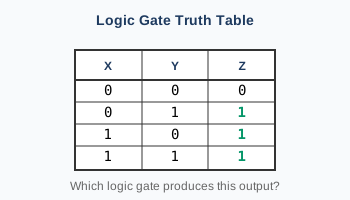
A logic circuit has three inputs X, Y and W and one output Z. It is built from three gates connected in stages: first an AND gate combines X and Y to give signal P; then an OR gate combines X and W to give signal Q; finally a NAND gate combines P and Q to give the output Z. For how many of the 8 possible input combinations of X, Y and W is the output Z equal to 1?
Detailed Explanation
Work column by column: P = X AND Y is 1 in only the two rows where X and Y are both 1, and in both of those Q is also 1, so the final NAND outputs 0 there and outputs 1 everywhere else, giving 6 ones.
Three identical resistors are connected to identical batteries. Circuit X has one resistor, Circuit Y has two resistors in series, and Circuit Z has two resistors in parallel. The diagrams show the current in each circuit. Which diagram correctly shows the relative magnitudes of current?
Detailed Explanation
Why this is correct: With identical batteries (same voltage V) and identical resistors (each R), use I = V/R for each circuit. Two resistors in series double the total resistance to 2R, giving the smallest current (V/2R); the single resistor has resistance R, giving a medium current (V/R); two resistors in parallel halve the total resistance to R/2, giving the largest current (2V/R). So the ranking is series smallest, single in the middle, parallel largest — the choice with the single resistor at medium, the series pair smallest, and the parallel pair largest.
Common mistakes: Many students mix up series and parallel and claim the series circuit has the largest current — but adding a resistor in series adds resistance and reduces current. Others forget that parallel resistors give less total resistance (R/2), and therefore more current, not less. Remember: more paths for the current means lower resistance and higher current.
Equal masses of different substances are heated with the same energy. What determines which substance has the smallest temperature rise?
Detailed Explanation
Why D is Correct: Specific heat capacity tells us how much energy is needed to raise 1 gram of a substance by 1°C. When equal masses receive equal energy, the substance with the highest specific heat capacity will have the smallest temperature rise because it "absorbs" more energy per degree of temperature change.
Think of it like a sponge - substances with high specific heat capacity are like big sponges that soak up lots of energy without getting much hotter.
Why Others Are Wrong:
- Lowest specific heat capacity → largest temperature rise (not smallest)
- Density and molecular structure don't directly determine temperature change from heating
Helpful Tips:
- Remember: Q = mcΔT (energy = mass × specific heat × temperature change)
- Water has high specific heat capacity - that's why oceans moderate Earth's temperature
- Metals typically have low specific heat capacity - they heat up quickly
A cork floating on water is made to bob up and down by a passing wave. The cork completes 12 full oscillations in 48 s. The distance between two adjacent wave crests on the water is 8 m. How long does this wave take to travel a distance of 80 m across the pond?
Detailed Explanation
The bobbing gives the period (4 s), so the frequency is 0.25 Hz; the crest spacing is the wavelength (8 m), so v = f x lambda = 2 m/s, and travelling 80 m at 2 m/s takes 40 s.
What is the unit of gravitational field strength?
Detailed Explanation
Gravitational Field Strength Unit: N/kg
Why N/kg is correct: Gravitational field strength measures the gravitational force per unit mass at a point. Since:
- Force is measured in Newtons (N)
- Mass is measured in kilograms (kg)
- Field strength = Force ÷ Mass
The unit is N/kg (Newtons per kilogram).
Why other options are wrong:
- N·kg: This would be force × mass, not force ÷ mass
- kg/N: This is the inverse relationship (mass per force)
- m/s²: While gravitational field strength numerically equals acceleration due to gravity, the question asks for field strength units specifically
Helpful tip: Remember that "per" means division! Gravitational field strength tells you how many Newtons of force act on each kilogram of mass. On Earth, g = 9.8 N/kg, meaning every kilogram experiences 9.8 N of gravitational force.
An open rectangular tank has a horizontal base measuring 0.5 m by 0.4 m. The empty tank has a mass of 6 kg. It is filled with oil of density 800 kg/m3 to a depth of 0.5 m, then stood on a level floor. Taking g=10 N/kg, what pressure does the filled tank exert on the floor?
Detailed Explanation
Build the force in stages: get the oil's volume, turn it into mass with density, add the tank's mass, convert the whole thing to a weight with g, then divide that weight by the base area to get the pressure (4300 Pa). Skipping the tank's mass, using water's density, or mis-reading a dimension each lands you on a wrong but tempting answer.
State the location of electrons in an atom and their charge.
Detailed Explanation
Where Are Electrons and What's Their Charge?
Correct Answer: Outside the nucleus, negative charge
Why This is Right:
Electrons orbit around the nucleus in electron shells/energy levels, similar to planets orbiting the sun. They carry a negative electrical charge (-1).
Why Other Options Are Wrong:
- Inside the nucleus: Only protons (+) and neutrons (neutral) are in the nucleus
- Positive charge: Electrons are always negative; protons are positive
- No charge: Electrons definitely have charge (negative)
Memory Tips:
- "Electrons are External" - they're outside the nucleus
- "Negative Nancy" - electrons are negative (opposite of protons)
- Think of the atom like a solar system: nucleus = sun (center), electrons = planets (orbiting outside)
- Remember: Protons are Positive, Electrons are nEgative (opposite letters in alphabet!)
The negative electrons are attracted to the positive protons, keeping them in orbit around the nucleus.
A stone of mass 4.0kg is dropped from rest and falls for 2.0s before hitting the ground. During the fall, air resistance removes 20% of the kinetic energy the stone would otherwise have had. On impact the stone embeds itself 0.40m into the ground before stopping. Assuming the ground exerts a constant average resisting force, calculate that force. (Take g=10m/s2 and ignore the stone's weight during the embedding.)
Detailed Explanation
Chain kinematics to get the impact speed, then kinetic energy, then keep only the 80% that survives air resistance, and finally use work = force x distance to get the ground's average resisting force: 1600 N.
The diagram shows a three-pin plug wired to an electrical appliance. Which component will stop the flow of current if the current becomes too large?
Detailed Explanation
Why the fuse is correct: A fuse contains a thin piece of wire that heats up as current passes through it. If the current rises above the fuse's rated value, this wire gets hot enough to melt, which breaks the circuit and stops the current flowing. This protects both the appliance and the user.
Common mistakes: Picking the earth wire confuses two different jobs. The earth wire is a safety path that carries current to the ground if a fault makes the metal casing live, but it does not switch the current off on its own when the current is too large. Choosing the live or neutral wire is also wrong because those wires simply carry the current around the complete circuit and have no mechanism to break it.
Two stones of different masses are dropped from the same height. Which statement about their motion is correct?
Detailed Explanation
Why B is Correct: All objects in free fall have the same acceleration due to gravity (g = 9.8 m/s²), regardless of their mass. This is because gravitational force increases with mass, but so does inertia (resistance to acceleration). These effects cancel out perfectly, giving identical acceleration.
Why Other Options are Wrong:
- Different accelerations: Mass doesn't affect gravitational acceleration
- Heavier falls faster: This is a common misconception - mass doesn't determine fall speed in a vacuum
- Lighter falls faster: Same misconception in reverse
Helpful Tips:
- Think of Galileo's famous experiment at the Leaning Tower of Pisa
- Air resistance is ignored in physics problems unless specifically mentioned
- Remember: F = ma, but gravitational force F also depends on mass, so they cancel out
- All objects fall at the same rate in a vacuum (like on the Moon)
The key insight: gravity affects all objects equally!
What determines the pitch of a sound wave?
Detailed Explanation
Why this is correct: The pitch of a sound, meaning how high or low it sounds, is set by its frequency (the number of vibrations per second, measured in hertz). A higher frequency gives a higher pitch, and a lower frequency gives a lower pitch.
Common mistakes: The most frequent error is choosing amplitude, which controls loudness (how big the vibration is), not pitch. Picking diffraction or refraction mixes up pitch with general wave behaviours: these describe how waves bend around obstacles or change direction when entering a new medium, and neither affects how high or low a sound seems.
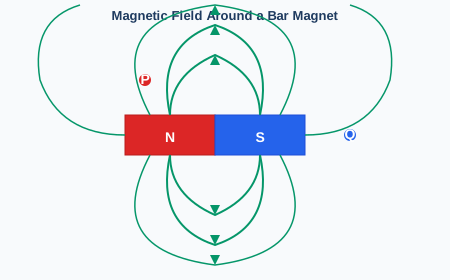
A magnet is brought near three objects: iron nail (X), steel paper clip (Y), and copper wire (Z). What happens when the magnet approaches these objects?
Detailed Explanation
Why A is Correct: Iron nail (X) and steel paper clip (Y) are both ferromagnetic materials. Iron is naturally magnetic, and steel contains iron, so both are strongly attracted to magnets. Copper wire (Z) is non-magnetic - it contains no iron and won't be attracted to magnets.
Why Other Options Are Wrong:
- If an option says all three are attracted: Copper is never magnetic
- If an option says only iron is attracted: Steel (which contains iron) is also magnetic
- If an option says none are attracted: This ignores that iron and steel are definitely magnetic
Helpful Tips: 🧲 Remember "IRON" - Iron, steel (contains iron), nickel, and cobalt are magnetic 🚫 Common non-magnetic metals: Copper, aluminum, gold, silver ✅ Quick test: If it contains iron, it's likely magnetic
Think: "Iron attracts iron-based materials!"
A Geiger counter near a radioactive source always registers a constant background of 20 counts/s. With the source in place the counter reads 660 counts/s at the start, and 340 counts/s exactly 10 minutes later. Assuming the background stays constant, what will the counter read 40 minutes after the start?
Detailed Explanation
Always strip the background from a count rate before doing any half-life calculation, then add it back at the end, because the counter measures the true decay plus the ever-present background. Here that gives a half-life of 10 min, four half-lives in 40 min, and a final reading of 60 counts/s.
What happens to the pressure of a gas when its volume is doubled at constant temperature?
Detailed Explanation
Why D is Correct: According to Boyle's Law, pressure and volume have an inverse relationship at constant temperature. When volume doubles, pressure is cut in half. Think of it like a balloon - if you squeeze it to half its size, the pressure inside doubles. The opposite happens when volume increases.
Why Other Answers Are Wrong:
- "Pressure doubles" - This would happen if volume was halved, not doubled
- "Pressure stays the same" - This ignores the inverse relationship between P and V
- "Pressure quadruples" - No gas law supports this relationship
Helpful Tips:
- Remember: P₁V₁ = P₂V₂ (Boyle's Law)
- Use the "seesaw" analogy - when one goes up, the other goes down
- Practice with numbers: If P₁ = 4 atm and V₁ = 2 L, then when V₂ = 4 L, P₂ = 2 atm
- Only works at constant temperature!
A liquid is heated from below, setting up a convection current. What happens to the cooler liquid in the current, and why?
Detailed Explanation
In a convection current, the cooler liquid is denser than the warm liquid, so it sinks. The warm, less dense liquid rises to take its place.
A current-carrying wire is placed in a uniform magnetic field. The diagrams show the wire at different angles to the field lines. Which diagram shows the position where the magnetic force on the wire is zero?
Detailed Explanation
Why A is Correct: When a wire is parallel to magnetic field lines, the magnetic force is zero. This happens because the formula for magnetic force is F = BIL sin θ, where θ is the angle between the wire and field. When parallel, θ = 0°, and sin(0°) = 0, making the force zero.
Why Others are Wrong:
- Perpendicular positioning (90°): Creates maximum force since sin(90°) = 1
- Any angled positioning: Produces some force since sin θ > 0 for angles between 0° and 180°
Helpful Tips:
- Remember: Parallel = Zero force, Perpendicular = Maximum force
- Think of it like pushing a door: pushing parallel to the door (along its surface) won't open it, but pushing perpendicular creates maximum effect
- The sine function determines force strength: sin(0°) = 0, sin(90°) = 1
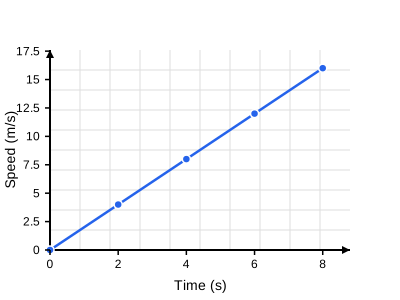
A velocity-time graph shows a car accelerating from rest for 4 seconds, then moving at constant velocity for 6 seconds. Which statement correctly describes how to plot the distance travelled on a distance-time graph for the same journey?
Detailed Explanation
Why C is Correct: During acceleration (0-4s), the car covers increasing distances each second, creating a curved upward line on the distance-time graph. During constant velocity (4-10s), the car covers equal distances each second, creating a straight line with constant positive gradient.
Why Others Are Wrong:
- Straight lines during acceleration would mean constant velocity (no acceleration)
- Horizontal lines would mean the car stopped moving
- Downward curves/negative gradients would mean the car was slowing down or moving backward
Helpful Tips:
- Acceleration = curved line on distance-time graphs
- Constant velocity = straight line with steady gradient
- Stationary = horizontal line
- The steeper the gradient, the faster the speed
- Always check: is distance increasing? (Yes = positive gradient)
Remember: Acceleration means speed is changing, so distance covered per second changes too!
A transformer has 100 turns on the primary coil and 500 turns on the secondary coil. The primary voltage is 12V. Which statement about this transformer is correct?
Detailed Explanation
Transformer Explanation
Why D is correct: This is a step-up transformer because the secondary coil (500 turns) has more turns than the primary coil (100 turns).
Using the transformer equation: Vs/Vp = Ns/Np
Where:
- Vs = secondary voltage, Vp = primary voltage (12V)
- Ns = secondary turns (500), Np = primary turns (100)
Calculation: Vs/12 = 500/100 = 5 Therefore: Vs = 12 × 5 = 60V
Key Tips:
- Step-up: Secondary has MORE turns → voltage increases
- Step-down: Secondary has FEWER turns → voltage decreases
- The turns ratio directly equals the voltage ratio
- More turns = higher voltage, fewer turns = lower voltage
Memory trick: Think "turns UP = voltage UP" for step-up transformers!
The secondary voltage is 60V, and since voltage increased from 12V to 60V, this confirms it's a step-up transformer.
What is the formula for calculating the efficiency of a machine that converts input energy to useful output energy?
Detailed Explanation
Machine Efficiency Formula
Why B is correct:
Efficiency measures how well a machine converts input energy into useful work. The formula efficiency = (useful output energy / input energy) × 100% gives you the percentage of input energy that becomes useful output. Since some energy is always lost (usually as heat), efficiency is always less than 100%.
Why other answers are wrong:
- Flipping the fraction (input/output) would give values greater than 100%, which is impossible
- Using power instead of energy changes the concept entirely
- Missing the ×100% means you get a decimal instead of a percentage
Helpful Tips:
- Think "what you get out" ÷ "what you put in"
- Efficiency is always between 0% and 100%
- No machine is 100% efficient due to energy losses
- Remember to multiply by 100 to convert to percentage
Example: If a motor uses 1000J and produces 800J of useful work, efficiency = (800/1000) × 100% = 80%
What is left behind after a supernova explosion?
Detailed Explanation
What's Left After a Supernova? 🌟💥
Why C is correct: When a massive star explodes in a supernova, its core collapses under extreme gravity. If the core is 1.4-3 times our Sun's mass, it becomes a neutron star - an incredibly dense object where protons and electrons are crushed together. If the core exceeds 3 solar masses, it becomes a black hole where gravity is so strong that nothing can escape.
Why other options are wrong:
- White dwarf: Forms when smaller stars (like our Sun) die peacefully, not from supernovas
- Red giant: This is a phase before a star dies, not what's left after
- New star formation: Supernovas can trigger new star birth in nearby gas clouds, but don't directly create new stars
💡 Memory tip: Think "supernova = super collapse" - only the most extreme objects (neutron stars/black holes) can result from such violent explosions!
What happens to the speed of sound when it travels from air into water?
Detailed Explanation
Sound travels faster in water than in air because water is a denser, stiffer medium. So the speed of sound increases when it goes from air into water.
A hydraulic press is filled with an incompressible liquid. The large piston has a diameter of 20cm and the small piston has a diameter of 10cm. A load of mass 160kg rests on the large piston. Taking the gravitational field strength as g=10N/kg, what is the smallest mass that must be placed on the small piston to just hold the load in equilibrium?
Detailed Explanation
Pressure is the same everywhere in the liquid, so the forces on the pistons are in the same ratio as their areas, and area grows with the square of the diameter. Halving the diameter quarters the area, so the small piston needs only a quarter of the load's weight, i.e. a 40 kg mass.
An electric motor is connected to a 240V supply and draws a current of 2.5A. The motor is 75% efficient and lifts a load of weight 300N at a steady speed. Calculate the time taken to raise the load through a height of 12m.
Detailed Explanation
First convert the electrical supply into input power with P=VI, scale it down by the 75% efficiency to get the useful lifting power, then use power = force × speed (or work = weight × height) to reach the time. Each option hides a single classic slip, so only the full four-step chain gives 8 s.
Two solid blocks, X and Y, have the same volume but X has a greater mass. What explains why block X is heavier than block Y?
Detailed Explanation
Why A is Correct: Density tells us how much "stuff" (mass) is packed into a certain amount of space (volume). Since both blocks take up the same amount of space, the only way Block X can have more mass is if its material is "packed tighter." This means Block X is made of a denser material.
Why the others are wrong:
- Options suggesting Block X is larger or has more volume are incorrect because the question states they are the same size.
- Options mentioning gravity are wrong because gravity pulls on both blocks equally; the difference in "heaviness" here is caused by the material itself, not a change in gravity.
Helpful Tip: Think of a sponge and a brick of the exact same size. The brick is much heavier because it is denser, even though it takes up the same amount of space as the sponge!
Describe the substance at 0 ∘C as water freezes and the change in its molecules.
Detailed Explanation
At 0 ∘C, water is at its freezing point. During any phase change, the temperature remains constant, meaning both ice and liquid exist together until the water is completely frozen. To turn from a liquid to a solid, molecules must lose energy (heat) to their surroundings. This loss of energy causes them to slow down and lock into a fixed, ordered crystal structure.
Why other answers are wrong:
- If only liquid or only ice were mentioned, it wouldn't accurately describe the "freezing process" where both states coexist.
- Gaining energy or becoming "less ordered" describes melting (solid to liquid), which is the opposite of freezing.
Helpful Tip: Remember that during a phase change, energy is used to break or form bonds, so the temperature stays exactly the same until the change is finished!
The diagrams show four students performing different tasks. Which student does the most work on an object?
Detailed Explanation
To find the correct answer, use the formula: Work = Force × Distance.
Why D is correct: The student applies a force of 50 N over a distance of 0.2 m. Calculation: 50 N×0.2 m=10 Joules of work. In this specific question, this represents the highest value of energy transferred to the object.
Why the others are incorrect: In physics, "Work" only happens if the object moves in the direction of the force. Other options are usually wrong because:
- No movement: If a student just holds a heavy box or pushes a stationary wall, the distance is zero, so the Work is zero.
- Perpendicular motion: If a student carries a box horizontally, the lifting force is upward but the motion is sideways. This counts as zero work on the box.
Top Tip: Don't confuse "effort" with "work." You might get tired holding a heavy bag, but if it doesn't move, you aren't doing any physics work!
An object has a mass of 500 g. Which value represents the weight of this object on Earth, where the gravitational field strength is 9.8 N/kg?
Detailed Explanation
To find the weight of an object, use the formula: Weight = mass × gravitational field strength (W=m×g).
Why B is correct:
- Convert the units: In physics, mass must be in kilograms (kg). Since there are 1,000 grams in a kilogram, 500g÷1000=0.5kg.
- Calculate: Multiply the mass by the gravity: 0.5kg×9.8N/kg=4.9N.
Why the other answers are wrong: Other options are incorrect because they usually come from common mistakes, such as forgetting to convert grams to kilograms (which would give a result of 4,900 N) or dividing the numbers instead of multiplying them.
Common Pitfall: The biggest trap in weight questions is using mass in grams. Always check your units first! If the mass is in grams, divide by 1,000 to get kg before you do anything else.
State the name of the phenomenon where the wavelength of light from distant galaxies increases as they move away from the Earth at high speeds.
Detailed Explanation
EXPLANATION:
Why it’s correct:
As a galaxy moves away from Earth, the light waves it emits are "stretched" by the expansion of space. Because red light has the longest wavelength in the visible spectrum, this stretching causes the light to shift toward the red end. This is known as redshift.
Why other answers are incorrect:
- Blueshift: This is the opposite. It occurs when an object moves toward us, causing light waves to compress into shorter (bluer) wavelengths.
- Reflection/Refraction: These describe light bouncing off a surface or bending through a material; they do not involve the motion of galaxies.
Helpful Tip:
Remember the "Double R" rule: If an object is Receding (moving away), it is Redshifted.
Common Pitfall:
Redshift doesn't mean the galaxy looks bright red; it just means the light's wavelength is longer than it was when it started!
Which statement correctly describes the movement of air during convection?
Detailed Explanation
EXPLANATION:
Convection is the way heat travels through liquids and gases.
Why B is correct: When air is heated, its molecules move faster and spread out. This causes the air to expand. Because the same amount of air now takes up more space, it becomes less dense (lighter) than the cooler air around it. Just like a cork in water, this lighter air floats upward.
Why other options are wrong:
- Air does not contract (shrink) when heated; it expands.
- Warm air does not sink; it is pushed upward by heavier, cooler air.
- Cooling makes air more dense, not less dense.
Helpful Tip: Think of a hot air balloon. The burner heats the air, making it expand and become less dense than the outside air, which causes the balloon to rise!
Common Pitfall: Don't forget the order: Heat → Expand → Less Dense → Rise.
Four rods made of different materials show how thermal energy is transferred when one end of each rod is heated. Each rod has the same length and diameter. Which statement correctly describes the conduction process in these rods?
Detailed Explanation
EXPLANATION:
Why the correct answer is correct: Conduction is how heat travels through solids. Metals are great conductors because they have free electrons that move quickly, bumping into atoms and transferring energy. However, every metal has a unique atomic structure. Because of these differences, some metals (like copper) allow heat to pass through much faster than others (like steel).
Why other answers are incorrect:
- Uniformity: Any claim that all metals conduct heat at the same rate is false; material type always matters.
- Insulators: Answers suggesting materials like plastic or wood conduct faster than metals are wrong; these are insulators that block heat flow.
- Process: Conduction happens in solids. If an answer mentions "fluids" or "rising air," it is describing convection, not conduction.
Student Tip: When the rods are the same size, the material is the only thing that changes the result.
Common Pitfall: Don’t assume all metals are equal! Always look for the specific material mentioned.
State which statement about the planets in our Solar System is correct.
Detailed Explanation
EXPLANATION:
Why Answer A is Correct: Jupiter is known as the "King of the Planets." It is a gas giant so massive that it contains more than twice the mass of all other planets in our Solar System combined. In terms of size, you could fit over 1,300 Earths inside it!
Why common distractors are wrong:
- "Mercury is the hottest planet": While Mercury is closest to the Sun, Venus is actually the hottest because its thick atmosphere traps heat.
- "Saturn is the largest planet": Saturn has the most spectacular rings, but Jupiter is physically larger and heavier.
- "Mars is larger than Earth": Mars is actually a "miniature" world, only about half the size of Earth.
Helpful Tip: Don’t confuse distance with temperature. The closest planet (Mercury) isn't the hottest. Also, remember that the four outer "Gas Giants" are always much larger than the four inner "Rocky Planets."
A machine lifts a 40 kg mass vertically through a distance of 5.0 m in 2.0 s. What is the work done on the mass?
Detailed Explanation
The work done against gravity equals the weight times the height: mgh = 40 x 10 x 5.0 = 2000 J. The time of 2.0 s is not needed for work; it would only matter for power.
A student wants to measure the mass of a small rock, which instrument should they use?
Detailed Explanation
To measure mass (the amount of matter in an object), an electronic balance is the correct tool. It provides a precise digital reading, usually in grams or kilograms.
Why the other options are incorrect:
- Rulers are used to measure length, width, or height, not how much an object weighs.
- Graduated cylinders measure volume (the amount of space an object takes up), often by seeing how much water the rock displaces.
- Thermometers measure temperature (how hot or cold something is).
💡 Helpful Tip: Students often confuse mass and volume. Remember:
- Mass = How much "stuff" is inside (use a balance).
- Volume = How much space it fills (use a graduated cylinder).
⚠️ Common Pitfall: Always "tare" or zero your electronic balance before starting! If it doesn't show 0.00 before you begin, your measurement will be wrong.
A copper wire carries an electric current. Which row shows the particles that move to constitute the current and the direction of their movement relative to the conventional current?
Detailed Explanation
Why A is correct: In metal wires like copper, the only particles free to move are electrons. Because electrons have a negative charge, they are repelled by the negative terminal and move toward the positive terminal. However, conventional current is a historical convention defined as the flow of charge from positive to negative. Therefore, the actual movement of electrons is always opposite to the direction of conventional current.
Why the others are wrong:
- Protons/Positive ions: These are locked firmly in the metal's lattice structure and cannot move to carry current.
- Same direction: No particles in a copper wire move in the same direction as conventional current, as the moving charges (electrons) are negative.
Helpful Tip: Think of conventional current as a "historical mistake." Scientists originally guessed current flowed from positive to negative before they discovered electrons. Just remember: Electrons move Elsewhere (the opposite way)!
State how the probability of decay for one individual nucleus in a radioactive sample changes as the total activity of the sample decreases over time.
Detailed Explanation
EXPLANATION:
Radioactive decay is a random and spontaneous process. The probability of an individual nucleus decaying per unit of time is known as the decay constant. This is a fundamental property of the isotope and does not change.
- Why C is correct: Each nucleus acts independently. It doesn't "know" how much time has passed or how many other nuclei are nearby. Its individual "odds" of decaying remain constant until the moment it actually decays.
- Why others are wrong: Students often confuse Activity (total decays per second) with Probability. While Activity decreases because there are fewer nuclei left to decay, the individual probability for any single survivor stays the same.
Helpful Tip: Think of rolling a die. Even if you have fewer dice left in a game, the chance of any single die landing on a "6" is always 1 in 6. It never gets "tired" or less likely to hit that number!
Equal masses of water and oil are initially at 20 °C. The same amount of thermal energy is supplied to both liquids. The oil reaches a final temperature of 50 °C. Calculations show the final temperature of the water. Which value identifies the water's final temperature, given that the specific heat capacity of water is twice that of oil?
Detailed Explanation
Specific heat capacity tells us how much energy is needed to change a substance's temperature. Because water’s capacity is twice that of oil, it is twice as "stubborn"—it requires double the energy to achieve the same temperature increase.
Since both liquids receive the same energy, water’s temperature rise (ΔT) will be half that of oil’s.
- Oil’s rise: 50∘C−20∘C=30∘C.
- Water’s rise: Half of 30∘C=15∘C.
- Final temp: 20∘C+15∘C= 35 °C.
Why other answers are wrong:
- 25 °C / 30 °C: These use the wrong calculation for the temperature change.
- 50 °C: Incorrectly assumes both liquids heat up at the same rate.
- 80 °C: This results from doubling the temperature rise instead of halving it.
Tip: A higher specific heat capacity means a smaller temperature change. Always add your calculated change to the initial temperature!
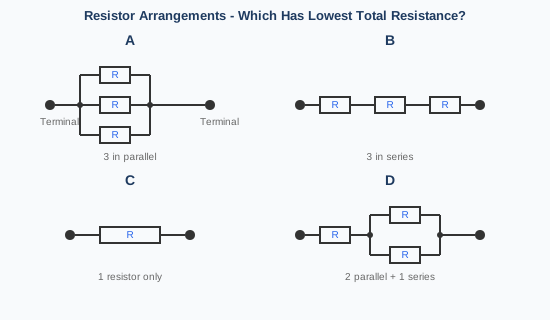
A lamp is connected in series with a cell. What happens to the current in the circuit and the lamp brightness when a second lamp is added in series?
Detailed Explanation
Why this is correct: Adding a second lamp in series increases the total resistance of the circuit. The cell's voltage is fixed, so by Ohm's law (current = voltage / resistance) a larger resistance means a smaller current. In any series circuit the current is the same at every point, and because that smaller current now flows through both lamps, each one glows dimmer than the single lamp did.
Common mistakes: Thinking the current splits between the lamps is a parallel-circuit idea — in series the same current passes through every component, so it does not divide. Believing the first lamp gets more voltage or more energy is also wrong: the supply voltage is now shared between two lamps, so the voltage and power delivered to the first lamp actually go down, which is exactly why it dims.
A lamp and a resistor are in series with a 12 V battery. The voltage across the lamp is 4 V and the current is 2 A. What is the energy transferred by the lamp in 2 minutes?
Detailed Explanation
To find the energy transferred by the lamp, use the formula:
Energy (E) = Voltage (V) × Current (I) × Time (t)
- Voltage: Use the lamp’s specific voltage (4 V), not the battery's 12 V.
- Current: 2 A.
- Time: Must be in seconds. 2 minutes = 120 seconds.
- Calculation: 4 V×2 A×120 s=960 J.
Why other answers are incorrect:
- 2880 J: This uses the total battery voltage (12 V). It calculates the energy for the entire circuit, not just the lamp.
- 1920 J: This uses the resistor’s voltage (8 V).
- 16 J: This uses minutes instead of converting to seconds (4×2×2).
Helpful Tip: Always check your units! In physics formulas, time must almost always be in seconds. Also, only use the voltage specifically across the component you are calculating for.
What is the original source of energy for both wind power and the formation of fossil fuels?
Detailed Explanation
Why the correct answer is correct: The Sun is the ultimate "battery" for Earth.
- Wind Power: The Sun heats the Earth’s surface unevenly. This creates differences in air pressure that cause air to move, creating wind.
- Fossil Fuels: Millions of years ago, plants captured sunlight through photosynthesis. When those plants (and the animals that ate them) died and were buried, that solar energy was "locked away," eventually turning into coal, oil, or gas.
Why other answers are incorrect:
- Heat from the Earth’s core only powers geothermal energy.
- Gravity is primarily responsible for tidal energy (along with the Moon).
- While fossil fuels contain chemical energy, they aren't the original source; they just store the Sun's energy.
Helpful Tip: When a question asks for the "original" or "ultimate" source of energy for anything involving weather or living things, the answer is almost always the Sun!
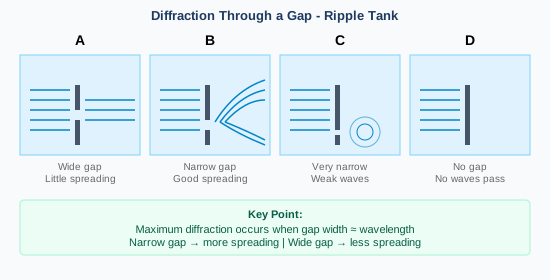
A wave travels from deep water into shallow water, where its speed and wavelength decrease. State what happens to the frequency of the wave.
Detailed Explanation
Why it’s correct: The frequency of a wave is determined solely by the source that created it (like a vibrating paddle). Once a wave is moving, changing the medium (moving from deep to shallow water) affects its speed and wavelength, but it cannot change how many waves the source produces per second.
Think of the wave equation: v=fλ. In shallow water, the wave slows down (v decreases). To keep the equation balanced, the wavelength (λ) must also decrease. This allows the frequency (f) to remain constant.
Why other answers are wrong:
- Frequency increases/decreases: These are incorrect because the medium cannot "add" or "remove" wave cycles. Only the original source controls the rate of the waves.
Top Tip: Think of frequency as the wave’s "DNA"—it stays the same regardless of where the wave travels. Remember: Source = Frequency and Medium = Speed.
A liquid-in-glass thermometer is placed in a beaker of hot water. Which statement correctly explains why the liquid level rises inside the narrow capillary tube?
Detailed Explanation
EXPLANATION:
When the thermometer is heated, the molecules in the liquid gain energy and move faster, pushing each other further apart. This causes the liquid’s volume to increase (thermal expansion). While the glass bulb also expands, the liquid expands much more than the glass. Because the liquid has more volume and nowhere else to go, it is forced up the narrow capillary tube.
Why other answers are wrong:
- If the glass expanded more than the liquid, the liquid level would actually drop.
- Molecules never change size or grow; they only change the amount of space between them.
- Air pressure does not cause the rise; it is purely due to the expansion of the liquid.
Helpful Tip: A common pitfall is forgetting that the glass expands too! A thermometer only works because the liquid expands at a significantly higher rate than the glass container.
What is the best material for the core of a temporary electromagnet and why?
Detailed Explanation
Soft iron is the ideal material because it is a soft magnetic material. This means it magnetizes quickly when the current is turned on, but loses its magnetism almost instantly when the current is switched off. This "on-off" control is exactly what makes an electromagnet "temporary."
Why other options are wrong:
- Steel: Steel is a hard magnetic material. Once magnetized, it stays magnetic even after the power is turned off. This creates a permanent magnet, which isn't useful for a temporary device like a scrap metal crane or a doorbell.
- Non-magnetic materials (like copper or wood): These would not concentrate the magnetic field at all, making the electromagnet very weak.
Top Tip: In physics, "soft" doesn't mean the metal is squishy! It refers to how easily the material "lets go" of its magnetism. Just remember: Iron for Instant (temporary) magnets; Steel for Stay (permanent) magnets.
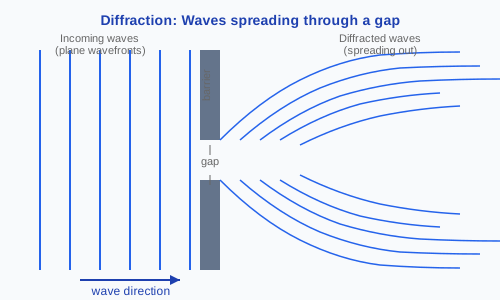
A buzzer vibrates at 170 Hz, producing sound that travels through air at 340 m/s before passing into a long steel rail, where sound travels at 5100 m/s. What is the wavelength of the sound while it is inside the steel rail?
Detailed Explanation
When sound enters a new medium the frequency stays the same as the source, but the faster speed in steel makes the wavelength longer. Wavelength = speed / frequency = 5100 / 170 = 30 m.
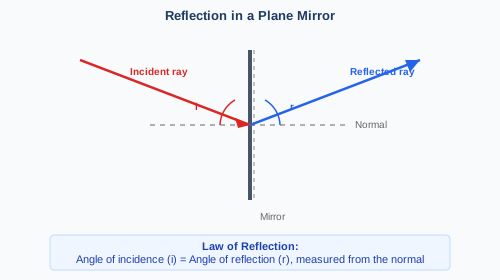
A card with the word 'IF' is placed in front of a plane mirror. Which diagram shows the correct image produced by the mirror?
Detailed Explanation
In a plane mirror, images undergo lateral inversion. This means the image is flipped horizontally (left-to-right), but not vertically (upside-down).
Why B is correct: When the word "IF" is reflected, the entire sequence reverses. The 'F', which was on the right, appears on the left side of the reflection and is turned backward (ꟻ). The 'I' moves to the right. Since 'I' is symmetrical, it looks the same, resulting in the image "ꟻI".
Why other answers are wrong:
- No flip: If the image still looks like "IF," it ignores lateral inversion.
- Upside down: This is vertical inversion, which only happens in floor mirrors or water reflections, not a standard wall mirror.
Helpful Tip: The part of the object closest to the mirror always appears closest in the reflection. Imagine the 'F' is touching the mirror; its reflection must also touch the mirror!
Two blocks, X and Y, are placed on a frictionless horizontal surface. Block X has a larger mass than block Y. Which statement explains why block X is more difficult to accelerate horizontally than block Y?
Detailed Explanation
EXPLANATION:
Mass is a direct measure of inertia, which is an object's "stubbornness" or resistance to any change in its motion. Because block X has more mass, it has more inertia, making it naturally harder to start moving, stop, or speed up compared to the lighter block Y.
Why other answers are wrong:
- Weight & Gravity: While block X is heavier, weight is a downward force. On a horizontal, frictionless surface, gravity doesn’t resist sideways motion; only mass (inertia) does.
- Friction: The question states the surface is frictionless, so surface grip is not a factor here.
Helpful Tip: Don’t confuse mass with weight! Even in deep space where objects are weightless, a massive ship is still harder to accelerate than a small pebble because it still has the same amount of mass and inertia. Inertia depends only on mass!
Four containers of different shapes are filled with water to the same vertical depth. In which container is the pressure at the bottom the greatest?
Detailed Explanation
EXPLANATION:
Why the correct answer is correct: Liquid pressure depends only on three factors: the vertical depth (h), the density of the liquid (ρ), and gravity (g). This is shown in the formula: P=hρg. Since all containers are filled with the same liquid (water) to the same vertical height, the pressure at the bottom is identical regardless of the container's shape.
Why the other options are incorrect: It is a common mistake to think that the shape of the container or the total volume of water affects pressure. While a wider container holds more water (and thus has more total weight), that weight is spread over a larger area. Pressure is "force per unit area," so these factors cancel out.
Helpful Tip: Don’t be fooled by "extra" water in wider containers! Always look for the vertical height from the surface to the bottom. If the heights and liquids are the same, the pressures are the same.
Which units show the correct measurement of specific heat capacity?
Detailed Explanation
Specific heat capacity measures how much energy is needed to raise the temperature of 1 kg of a substance by 1°C.
To find the unit, look at the formula:
c=mass×change in temperatureEnergy
- Energy is measured in Joules (J).
- Mass is measured in kilograms (kg).
- Temperature is measured in degrees Celsius (°C).
When you put these together, you get J / (kg °C).
Why the others are wrong:
- J / kg: This is for latent heat (changing state), as it ignores temperature.
- J / °C: This is heat capacity, which ignores the mass of the object.
- kJ / kg: While similar, standard scientific units use Joules (J), not kilojoules, unless specified.
Top Tip: Whenever you see the word "specific" in physics, it almost always means "per unit mass," so look for kg on the bottom of the fraction!
A student uses two copper wires, X and Y. Wire Y is twice as long and has twice the cross-sectional area of wire X. Show which statement about their electrical resistance is correct.
Detailed Explanation
To understand resistance, think of the formula: Resistance = (Resistivity × Length) / Area.
Why D is correct: Resistance depends on two factors here:
- Length: Wire Y is twice as long (2L), which doubles its resistance.
- Area: Wire Y has twice the area (2A), which halves its resistance.
Because these two changes cancel each other out (2÷2=1), the resistance remains exactly the same as wire X.
Why other answers are incorrect: Any answer claiming one wire has more resistance than the other is incorrect because it only focuses on one change. If you only consider length, Y seems higher; if you only consider area, Y seems lower. You must combine both!
Helpful Tip: Think of a highway. If you make the road twice as long (more traffic), but also add twice as many lanes (more space), the "difficulty" of driving through stays the same!
Why Topic Practice Quiz?
- Fresh questions: Not from past papers, so you can save those for full exam practice
- Syllabus-aligned: Every question targets specific Cambridge IGCSE topics
- Full explanations: Learn from detailed solutions showing why each answer is correct or wrong
- Topic filtering: Focus on specific areas you need to improve